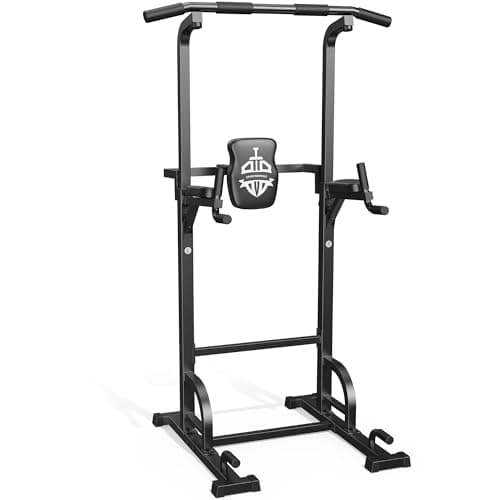
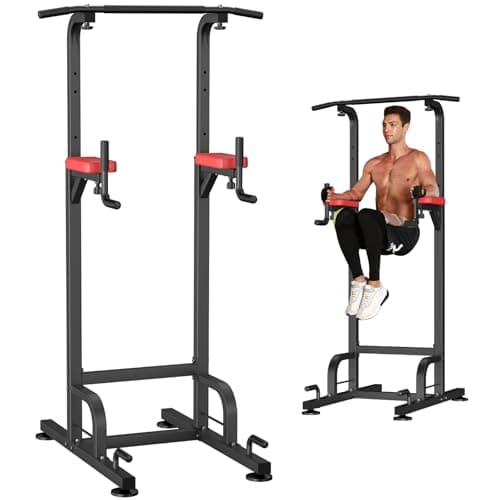
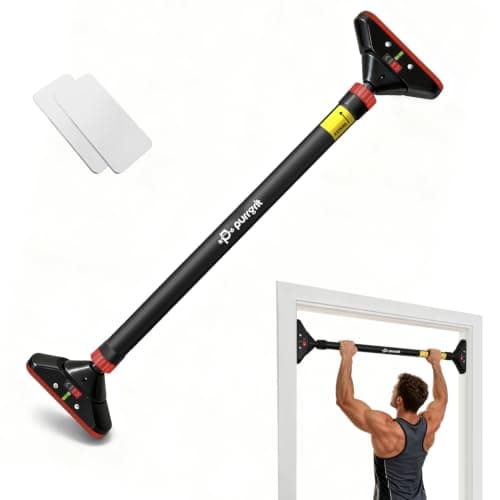
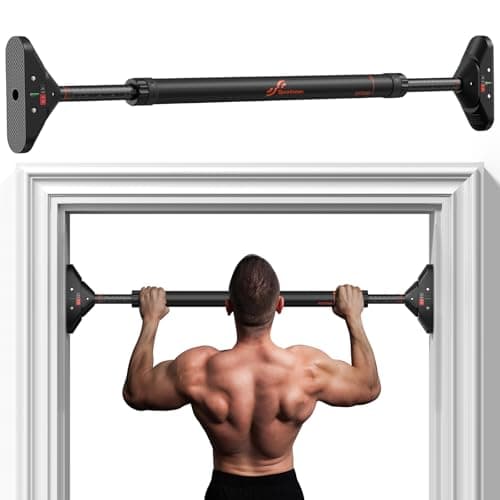
Buy a doorway bar if the room has another job, if you rent, or if your ceiling is under about 7 ft 6 in — it costs about thirty dollars, takes no floor and comes down in seconds. Buy a power tower if you want dips and knee raises as well as pull-ups, and you can permanently commit roughly four square feet plus the height.
Vertical pulling is the movement small-space gyms most often go without, and there are exactly two mainstream ways to get it at home. They are not close substitutes, and the usual advice — "get a power tower, it does more" — ignores the two constraints that actually apply in a small room: the floor it holds permanently, and the ceiling it needs.
We run this on the same four numbers as every comparison on this site: floor held when idle, ceiling required, install reversibility, and what happens as you get stronger. Then picks on both sides, plus the middle option most people do not consider.
Head to head
| Factor | Doorway pull-up bar | Power tower |
|---|
| Floor held when idle | None | About 4 sq ft, permanently |
| Ceiling needed | Door height — always available | Tall — the frame sets the height |
| Install / renter | No-drill leverage mount, seconds to remove | Freestanding, but immovable in practice |
| Pull-ups | Yes, with bent knees | Yes, full hang |
| Dips | No | Yes — the main reason to buy one |
| Knee and leg raises | Hanging only | Yes, with back and arm pads |
| Assembly | Minutes | An hour or more |
| Typical price | Around $30 | Several times that |
The row that decides it for most readers is the first one. A power tower does not fold, does not move easily once assembled, and occupies its corner whether or not you are training. In a spare bedroom that is also an office, or a living room that hosts people, that is not a purchase — it is a decision about the room.
The bent-knee objection, addressed
The standard argument against doorway bars is that you cannot hang fully — your feet touch the floor, so you bend your knees. That is true and it matters far less than it sounds. Bending the knees changes nothing about the pull itself; every muscle involved works identically. What you lose is the ability to do full hanging leg raises, and long-limbed lifters may find the position awkward.
Against that, you gain a bar that is genuinely available in every room with a door frame, needs no floor, and disappears when guests come. For most small-space readers, that trade is obviously worth it. Our doorway pull-up bar roundup covers which models seat properly and which mark the frame.
When a power tower earns its footprint
Three cases where the tower is genuinely the right buy.
- You want dips. No doorway bar does dips, and dips are one of the best upper-body pressing movements available without any weight at all. If dips are in your program, that alone settles it.
- Your doors are unsuitable. Trim-less frames, very wide openings, arched doorways and door frames that are already marked all rule out a leverage-mount bar.
- You have a garage corner or a dedicated room. If the floor is not contested, take the machine that does more. Our power tower roundup ranks the field.
The middle option: a dip station
Most people comparing these two want pull-ups and dips, and assume the tower is the only way to get both. It is not. A doorway bar plus a separate dip station or a pair of parallettes covers the same two movements for less money, and the dip station moves out of the way in a way a tower does not.
Parallettes in particular are the smallest thing on this page — a pair of steel bars that store under a sofa and still train dips, L-sits and push-up variations. See our dip station roundup for that route.
The ceiling check nobody does
A power tower sets its own pull-up bar height, and that height plus your head is what the ceiling has to clear. In a room with an 8-foot ceiling that is usually fine; in a basement or an attic it frequently is not, and a tower that does not let you hang without ducking is useless.
A doorway bar never has this problem, because a door is by definition shorter than the ceiling. In a low room that is decisive — read squat racks for low ceilings, which makes the same argument for barbell work.
What happens as you get stronger
Both scale the same way, by adding load with a dip belt or a weighted vest. The doorway bar is the one to check here: leverage-mount bars carry a published user weight limit, and adding 40 lb of vest to a 200 lb user may exceed it. Rated capacities are stated on the listings for both picks above; read yours before you hang weight on it.
A power tower typically has more headroom on rated capacity, which is a real argument for it if weighted work is where you are heading. So is the third option neither column covers: a bolted wall or ceiling bar, where published ratings run from 300 lb to 850 lb — at the cost of holes in structural framing.