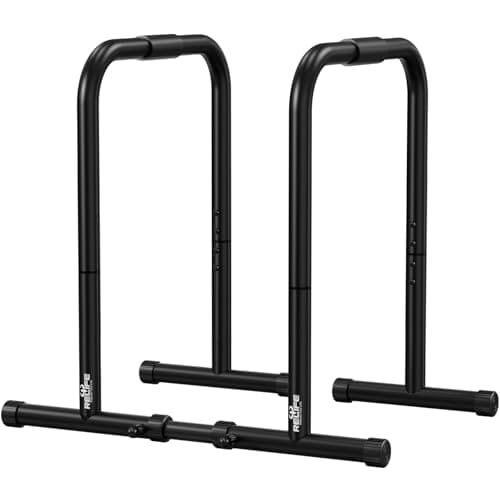
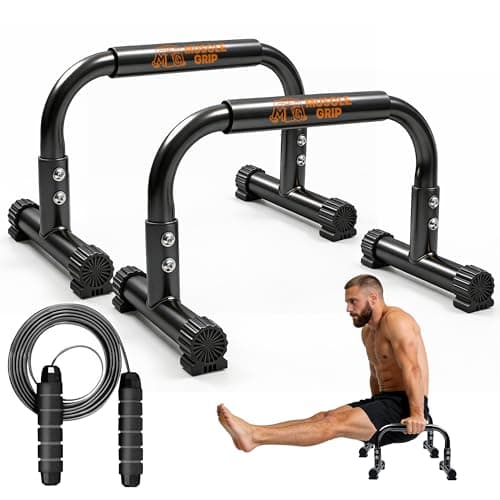
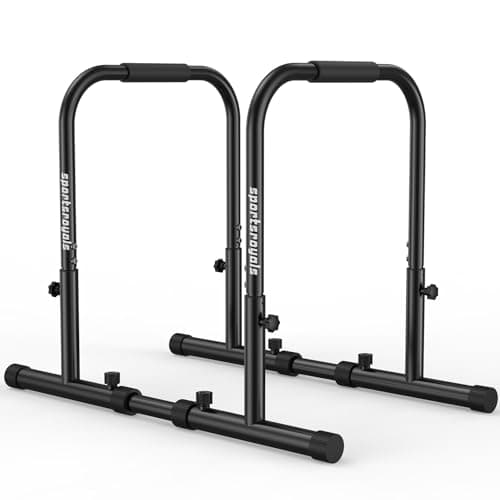
If you want dips in a small room, buy a pair of adjustable dip bars rather than a power tower — same movement, a fraction of the footprint, and they store flat against a wall. The SPORTSROYALS DP1 is our pick: a published 500 lb rating, height adjustment, and it drops low enough to double as parallettes. The RELIFE is the value route at 400 lb. Ten-inch steel parallettes are the floor of the category and fit in a drawer.
Dips are the most under-equipped movement in home training. They are one of the two great upper-body pushing patterns, they load the chest, triceps and front delts hard with nothing but your bodyweight, and they scale for years with a belt and a plate. Yet the standard recommendation is a power tower, which is a six-foot structure that never moves. In a room with a second job, that is a lot of object for one movement pattern.
Independent dip bars solve it. Two separate bases mean the whole thing carries in two trips and stores flat. The trade-off is real and worth naming: independent bases can drift apart under load in a way a welded frame cannot, which is a technique and a flooring problem rather than a fatal flaw. Below, three picks across three sizes.
How to choose between the three sizes
Full adjustable dip bars
These are what most people should buy. Height-adjustable uprights let you set a bar height that suits your torso and your ceiling, and dropping them to their lowest setting turns them into parallettes for L-sits, push-ups and tuck work. One purchase covers dips, rows under the bars, elevated push-ups, L-sits, and dip-belt work later.
The number to compare is published rated load. Dips are one of the few bodyweight movements people genuinely load heavy — a weighted dip with a belt can put 250 lb through a frame designed for 400. Take the higher published number if you plan to add weight.
Fixed-height dip bars
Cheaper, simpler, fewer parts to loosen. If dips are the only thing you want and you are not adding a belt, a well-rated fixed pair is money well saved. Check the bar height against your own height: too low and your feet touch on every rep, which is workable by bending your knees but irritating.
Parallettes
Ten inches tall, made of steel, and they fit in a drawer. They cannot do a full straight-leg dip — the height simply is not there — but they do bent-knee dips, deep push-ups, L-sits, tuck planches and handstand work. For a dorm room, a studio apartment, or anyone who moves frequently, this is the honest floor of the category and it is a genuinely useful tool rather than a compromise. See our dorm room gym guide for where they fit in a minimum kit.
What dip bars need from the room
- Floor, not wall. Nothing here attaches to anything, so there is no drill and no lease conversation. This is the same reason they suit renters that doorway pull-up bars do.
- Grip on the floor. Independent bases on laminate or tile will slide apart under load. Interlocking mats fix this completely and are worth having anyway — see apartment gym flooring.
- Ceiling: none. Unlike pull-ups, dips happen below the bar, so a low ceiling is irrelevant. In a basement or a low-ceilinged apartment where a power tower will not stand up, dip bars still work.
- About 4 by 4 feet while in use, and a wall to lean them against afterward.
Dip bars plus a pull-up bar is a complete upper body
For under a hundred dollars combined, a doorway pull-up bar and a set of dip bars cover vertical push, vertical pull, horizontal push (feet-elevated push-ups on the bars) and horizontal pull (inverted rows under them). That is the entire upper body, in a kit that stores in a closet and installs into nothing. It is the highest capability-per-dollar combination on this site, and it is the reason both pages exist.
Add a pair of adjustable dumbbells and a folding bench and you have a gym that fits in a closet. Our essentials guide sequences those purchases.
Progressing dips when you cannot yet do one
Start with negatives — step up, lower slowly, step off — and with bent-knee dips on parallettes or on the lowest setting of adjustable bars, where your feet stay on the floor and take some of your weight. That last option is why adjustable bars are worth the extra money for a beginner: they give you a built-in assistance mechanism that fixed-height bars and power towers do not.