Skip to content
RACK:RATIO

HUB 05 · Cable, All-in-One & Power Towers

Power Rack vs Power Tower

They look like the same purchase and they are not even the same system. A rack is the start of a shopping list. A tower is the end of one.

By Stephen V.Reviewed How we research
#ad

We earn a commission when you buy through our Amazon links, at no extra cost to you. It never changes our rankings, and we say so when the cheaper product is the better buy. How this works.

For most people fitting a first strength station into a small room, the power tower is the better buy, and the Sunny Health power tower is the pick: pull-ups, dips, knee raises and push-ups from one small-footprint frame, with nothing else to purchase and no plates to store. Choose the power rack instead if barbell squatting and pressing are the point — then the SPORTSROYALS cage is the one, with a published 1,200 lb rating and a plate-loaded lat pulldown in the same square of floor. Be clear-eyed about what that costs: a rack with nothing in it does nothing, and the bar, plates and bench behind it are three more purchases and three more storage problems.

We rank both categories — the power towers and the power racks for small spaces — and people keep asking us to choose between them, because in a photograph they are the same thing: a tall steel frame standing in a corner. Functionally they share almost nothing.

A rack is a holder. A tower is a machine.

A power rack does not provide resistance. It holds a barbell at the height you want, catches it if a rep fails, and gets out of the way. The load comes from the bar and the plates you put on it, which means the rack is the first item in a list: a bar, a set of plates, somewhere to store those plates, and a bench if pressing is in the plan. Our short barbell ranking, plate ranking and plate storage ranking exist because that list is real and people underestimate it.

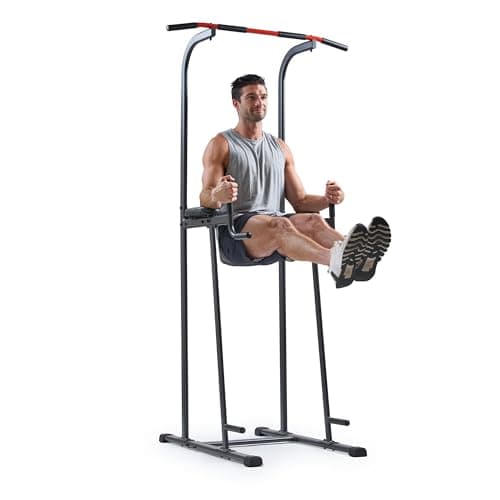
A power tower provides the whole system. The load is your body, the movements are fixed by the frame — pull-up, dip, knee raise, push-up — and there is nothing to buy afterward and nothing to store. In a small apartment, "nothing to store" is doing more work in that sentence than it looks.

The question that settles it: do you want to squat a loaded barbell? If yes, buy the rack and budget for the bar, the plates and the bench. If you are unsure, or if the honest answer is "eventually," buy the tower now — it is a complete system today, and it will still be useful when the rack arrives.

How the four compare

UnitLoad sourceMovementsPublished ratingAlso needsFolds
Sunny power towerYour bodyweightPull-up, dip, knee raise, push-upNot publishedNothingNo
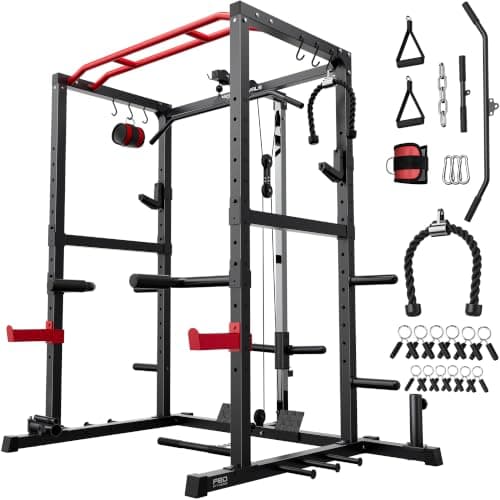
SPORTSROYALS power cageBarbell and plates you buySquat, press, pull-up, lat pulldown, low row1,200 lbBar, plates, plate storage, benchNo — permanent footprint
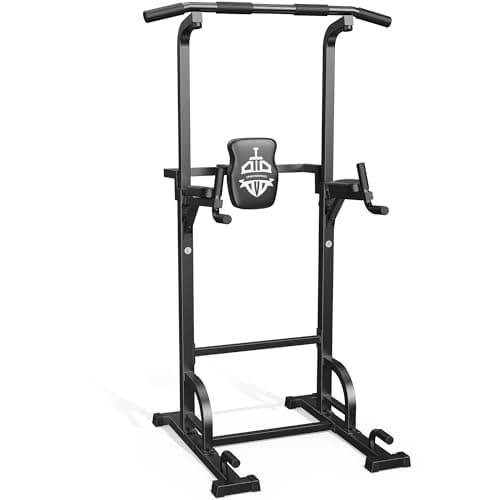
SPORTSROYALS power towerYour bodyweightPull-up, dip, knee raise, push-upNot publishedNothingNo
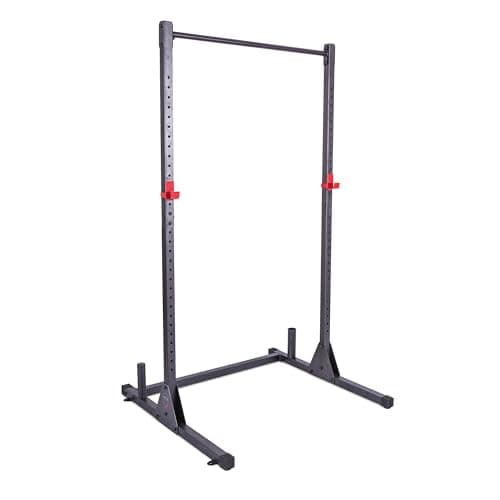
CAP power rackBarbell and plates you buySquat, press, pull-upNot publishedBar, plates, plate storage, benchNo

Three of these four publish no rated load, which is worth saying out loud on a page about steel frames. On the tower side that is category-normal and less consequential — the load is a person, and these frames are built for people. On the rack side it matters more: if you intend to load near four figures, the SPORTSROYALS is the only unit here with a published figure, and our capacity guide explains why a blank field should not be read as a high number.

Footprint: closer than you would think, with one asymmetry

Both formats occupy a corner and neither folds. A tower is a single narrow frame; a four-post cage is a box you can stand inside. The cage is larger, but not by as much as the price difference suggests — and the asymmetry is not the frame at all. It is the plates.

A rack system stores a barbell seven feet long (or five to six, if you buy a short one) and enough iron to be worth racking. That is a second footprint, it is heavy, and it is the part people forget when they measure the corner. A tower stores nothing. If your room is tight enough that this page exists for you, that difference is probably the deciding one — and our space guide and 10x10 room build both plan around it.

The ceiling applies to both, differently

Every unit on this page carries a pull-up bar, so both formats need headroom for a hanging body — the towers' own listings warn that under about 7 ft of ceiling the bar will not clear, which defeats the whole machine. A rack adds a second requirement on top: enough height to press a bar overhead from inside the frame, which is a taller number than hanging. If your ceiling is marginal, a low-ceiling rack without an overhead bar is a better bet than either, and the ceiling guide has the arithmetic for both movements.

Progression: the tower's real limit, and the fix

A tower's load is your bodyweight, which means progression has a ceiling: once ten clean pull-ups are easy, the frame cannot give you more. The fix is not a rack, it is added load — a weighted vest or a dip belt turns a bodyweight station into a progressive one, and our weighted vest ranking covers the published weights and fits. That path is far cheaper and far smaller than a barbell system, and it is the honest answer for a lot of apartments.

What it does not give you is a loaded squat or a heavy hinge, and no amount of bodyweight work substitutes for those if they are what you want. That is the real line between these two products: machines versus free weights argues the wider version, and do you need a squat rack at home is the honest test for whether the rack belongs in your room at all.

The short answer

Quick picks

#ProductBest forScorePrice
01
Sunny Health & Fitness Sunny Health Power Tower
Sunny Health Power Tower

The most capability per dollar and per square foot here: pull-ups, dips, knee raises and push-ups from one small-footprint tower. No weights, no wiring, no wall — just bodyweight strength in a corner.

Cheapest big bang for the footprint
8.5
$179.99Amazon
02
SPORTSROYALS SPORTSROYALS Squat Rack Power Cage with Lat Pulldown
SPORTSROYALS Squat Rack Power Cage with Lat Pulldown

A 1,200 lb-rated cage with a lat pulldown and low-row attachment built in, so one footprint covers squats, presses, pull-ups and cable back work. If you can commit a permanent square of floor, this is the most gym per square foot here.

Most capability per square foot
8.3
$309.99Amazon
03
SPORTSROYALS SPORTSROYALS Pull-Up Power Tower
SPORTSROYALS Pull-Up Power Tower

A heavier-gauge tower that doesn't sway on kipping pull-ups or heavy dips, with a wider base than the budget units. Worth the step up if you're above average bodyweight or train hard on it.

Sturdiest bodyweight tower
8.5
$169.98Amazon
04
CAP Barbell CAP Barbell Power Rack with Pull-Up Bar
CAP Barbell Power Rack with Pull-Up Bar

The budget way into an enclosed rack: catch bars, a pull-up bar and safety pins for a fraction of what a premium cage costs. The steel is lighter than pricier cages, but the safety geometry is the part that matters most for a solo lifter.

Cheapest real cage
7.8
$119.99Amazon

#ad · Live prices from the Amazon Product API, as of October 25, 2026. Where we have no verified live price, we show none — we would rather leave a gap than print a number that has rotted.

In detail

The picks, in full

01
Sunny Health & Fitness Sunny Health Power Tower

Cheapest big bang for the footprint

Sunny Health Power Tower

Pull-up + dipSmall footprintBodyweightCheap
8.5/10

The most capability per dollar and per square foot here: pull-ups, dips, knee raises and push-ups from one small-footprint tower. No weights, no wiring, no wall — just bodyweight strength in a corner.

Good

  • Huge functional range for the price and space
  • No weights or wall anchors needed
  • Renter-friendly and easy to move

Trade-offs

  • Bodyweight only — no external load
  • Needs real ceiling height for the pull-up bar
Fit
8
Value
10
Install
9
Build
7

Skip this if…

…your ceiling is under about 7 ft — the pull-up bar won't clear, which is the whole point of the tower.

Spec sheet

Type
Power tower (bodyweight)
Footprint
Small — single tower
Stations
Pull-up, dip, knee raise, push-up
Install / renter
Freestanding — no drilling
Noise / floor
Low — bodyweight only
Ceiling needed
Tall — overhead pull-up bar
$179.99View on Amazon

Price as of October 25, 2026. Prices change — Amazon's is the one that counts.

#ad · we may earn a commission from this link to Sunny Health Power Tower

02
SPORTSROYALS SPORTSROYALS Squat Rack Power Cage with Lat Pulldown

Most capability per square foot

SPORTSROYALS Squat Rack Power Cage with Lat Pulldown

1,200 lb ratedLat pulldown incl.Four-post cagePlate-loaded
8.3/10

A 1,200 lb-rated cage with a lat pulldown and low-row attachment built in, so one footprint covers squats, presses, pull-ups and cable back work. If you can commit a permanent square of floor, this is the most gym per square foot here.

Good

  • Cage safety plus cable work in one unit
  • 1,200 lb rating is well beyond home loads
  • No drilling despite being a full cage

Trade-offs

  • Owns its floor permanently — no fold
  • Needs real ceiling height for the pull-up bar
Fit
6
Value
9
Install
9
Build
9

Skip this if…

…you need the floor back between sessions — a folding wall rack reclaims the space this one keeps for good.

Spec sheet

Type
Freestanding power cage + lat tower
Folded depth
Does not fold — permanent footprint
Rated load
1,200 lb (per listing)
Install / renter
Freestanding — no drilling
Ceiling needed
Tall — cage uprights + pull-up bar
Cable stack
Plate-loaded lat pulldown / low row
$309.99View on Amazon

$389.9921% off

Price as of October 25, 2026. Prices change — Amazon's is the one that counts.

#ad · we may earn a commission from this link to SPORTSROYALS Squat Rack Power Cage with Lat Pulldown

03
SPORTSROYALS SPORTSROYALS Pull-Up Power Tower

Sturdiest bodyweight tower

SPORTSROYALS Pull-Up Power Tower

Heavy-gauge frameWide baseMulti-stationAdjustable
8.5/10

A heavier-gauge tower that doesn't sway on kipping pull-ups or heavy dips, with a wider base than the budget units. Worth the step up if you're above average bodyweight or train hard on it.

Good

  • Noticeably more stable than budget towers
  • Wide base resists rocking
  • Adjustable height

Trade-offs

  • Costs more than entry towers
  • Heavier to move once built
Fit
8
Value
8
Install
9
Build
9

Skip this if…

…you're on a tight budget and lighter framed — a cheaper tower is perfectly adequate at lower bodyweights.

Spec sheet

Type
Power tower (bodyweight)
Footprint
Small — wider base than budget towers
Stations
Pull-up, dip, knee raise, push-up
Install / renter
Freestanding — no drilling
Noise / floor
Low — bodyweight only
Ceiling needed
Tall — overhead pull-up bar
$169.98View on Amazon

$209.9919% off

Price as of October 25, 2026. Prices change — Amazon's is the one that counts.

#ad · we may earn a commission from this link to SPORTSROYALS Pull-Up Power Tower

04
CAP Barbell CAP Barbell Power Rack with Pull-Up Bar

Cheapest real cage

CAP Barbell Power Rack with Pull-Up Bar

Budget cagePull-up barSafety catchesFreestanding
7.8/10

The budget way into an enclosed rack: catch bars, a pull-up bar and safety pins for a fraction of what a premium cage costs. The steel is lighter than pricier cages, but the safety geometry is the part that matters most for a solo lifter.

Good

  • By far the cheapest enclosed cage here
  • Catch bars make solo lifting safer
  • Simple, proven design from a long-standing brand

Trade-offs

  • Lighter gauge steel than premium cages
  • Published capacity is unclear — verify before loading heavy
Fit
6
Value
10
Install
9
Build
6

Skip this if…

…you plan to load near four figures and want a published, warrantied capacity — spend up for a clearly rated cage.

Spec sheet

Type
Freestanding power rack
Folded depth
Does not fold
Rated load
Not published — confirm on listing
Install / renter
Freestanding — no drilling
Ceiling needed
Tall — includes pull-up bar
Includes
J-hooks, safety bars, pull-up bar
$119.99View on Amazon

Price as of October 25, 2026. Prices change — Amazon's is the one that counts.

#ad · we may earn a commission from this link to CAP Barbell Power Rack with Pull-Up Bar

Buy the power tower if…

  • This is your first strength purchase and you want a complete system on day one, with nothing else to buy.
  • You have nowhere to store plates. A tower is the only format here that creates no second footprint.
  • You rent and may move. A tower comes apart and travels; a loaded plate collection does not.
  • Pull-ups and dips are the movements you actually care about. A rack does pull-ups and does not do dips.
  • Budget is tight. The towers here are a fraction of the cage, before you even count the bar and plates the cage needs.

Buy the power rack if…

  • Barbell squats and presses are the reason you are building a gym. Nothing else does those safely alone.
  • You can commit a permanent square of floor, plus a second spot for a bar and plates.
  • You want catch bars. Training alone with a loaded bar is the one case where the cage geometry is not a luxury.
  • You want cables in the same footprint — the SPORTSROYALS adds a plate-loaded lat pulldown and low row, which covers the pulling work a bar alone does not.

The cheaper middle, which is often the right answer

If the tower appeals but the frame is too much object, a doorway pull-up bar plus a dip stationcovers most of a tower's movements with no permanent footprint at all — we compare that directly in power tower versus doorway pull-up bar. And if the rack appeals but the install does not, a folding wall-mounted rack gives you barbell work in a frame that disappears between sessions.

What both of them need under the feet

Both concentrate load on a small number of contact points, and a rack system adds dropped or set-down plates on top. On a finished floor in a rental, that is a deposit problem before it is a noise problem. Our flooring guide and mat ranking cover what actually protects a floor under a steel frame, and whether your floor can hold it covers the structural question people ask too late.

No tests, no invented ratings

Every figure on this page is the maker's published number, and three of these four products publish no rated load at all — we print that as a blank rather than estimating one. We have not loaded a frame to failure or measured a deflection; our methodology page states exactly what our scores are derived from.
How we picked

We don't run a testing lab

We compiled published specifications, manufacturer documentation and aggregated owner reviews, then scored each product against a published rubric that weights fit-for-small-space, value, install reversibility and build. The scores are judgments from documented research — they are notmeasurements we took, because we don't have a lab and we're not going to pretend we do. Every dimension is cited in Sources.

Questions

Frequently asked

Is a power rack or a power tower better for a home gym?
A power tower is better if you want a complete system in one purchase: it provides the movements and your bodyweight provides the load, with nothing else to buy or store. A power rack is better if barbell squatting and pressing are the goal — but a rack is a holder, not a machine, so budget for a bar, plates, plate storage and a bench behind it.
Can a power tower replace a squat rack?
No. A tower has no way to hold a loaded barbell, so it cannot give you a back squat or a heavy overhead press from a rack position. It covers pulling, dipping and core work that a bare rack does not. They are complements rather than substitutes, which is why our essentials guide treats them as different line items.
How do you progress on a power tower once pull-ups get easy?
Add external load rather than a new frame. A weighted vest or a dip belt turns a bodyweight station into a progressive one, and our weighted vest ranking covers the published weights and fit ranges. That path costs a fraction of a barbell system and takes a fraction of the space.
What ceiling height does a power tower need?
Enough for a hanging body under the bar — the makers' own listings warn that under about 7 ft of ceiling the pull-up bar will not clear, which defeats the machine. A power rack needs that plus room to press a bar overhead from inside the frame, which is taller. Our ceiling height guide has both calculations.
Which takes up less space?
The tower, and the gap is bigger than the frames suggest. A tower is one narrow frame and stores nothing else. A rack is a larger box plus a barbell five to seven feet long plus enough plates to be worth racking — a second footprint that is heavy and awkward. Neither format folds; if that is the requirement, a folding wall-mounted rack is the only option that does.
Do power towers publish a weight capacity?
Usually not, and neither tower in our registry does. That is category-normal and less consequential than on a rack, since the load is a person rather than a bar you can keep adding to — but if you are well above average bodyweight, buy the heavier-gauge frame with the wider base rather than the cheapest one, and read our capacity guide first.

Keep reading

Receipts

Sources

We don't run a testing lab, and we don't pretend to. Every dimension and rating traces to a manufacturer spec sheet or manual, named and linked above. Where a maker doesn't publish a number, the spec reads "Not published" rather than a guess. Read our full method.