Skip to content
RACK:RATIO

HUB 01 · Compact Racks & Squat Stands

Do You Need a Squat Rack at Home?

The question is not whether you can train legs without one. It's whether you intend to lift a barbell you cannot clean to your own shoulders — because that, and only that, is what a rack solves.

By Stephen V.Reviewed Published How we research
#ad

We earn a commission when you buy through our Amazon links, at no extra cost to you. It never changes our rankings, and we say so when the cheaper product is the better buy. How this works.

You need a squat rack if, and only if, you intend to squat or press a barbell heavier than you can lift onto your own shoulders — and you want something to catch it when a rep fails. That is the entire job. If your answer is yes and you can drill, the Mikolo folding wall rack is the pick, because it gives you a 1,000 lb-rated station during the session and a few inches of wall afterward. If you cannot drill, the PASYOU SR30Pro stands freely with a published 2,400 lb total rating and no holes. If your answer is no, you are not compromising by skipping it — you are skipping the single largest object in a home gym.

This is the companion to our cable machine question, and the answer has the same shape: a big piece of equipment exists to solve a narrow problem, and most people buying one have never named the problem. Below: what a rack actually does, the three cases where it is genuinely required, what replaces it when it is not, and the floor each option costs you.

What a rack does, stated precisely

Two things, and nothing else. It holds a loaded barbell at shoulder or chest height, so you can get under it rather than lifting it there yourself. And it catches the bar on a failed rep, via safeties set below your depth. A pull-up bar, a landmine socket and a plate peg are accessories bolted to that structure; they are not the reason it exists.

That definition has a useful consequence. The weight at which you need a rack is the weight at which you can no longer clean the bar to your own shoulders — which for most people is somewhere between a bar you can power-clean and the bar you want to squat. Below that crossover you can squat a barbell you lifted up yourself, and above it you cannot, safely, on your own.

The three cases where you genuinely need one

  1. Back squats above your clean. The textbook case. There is no safe home workaround for getting 225 lb onto your shoulders alone.
  2. Barbell bench pressing without a spotter. Arguably more important than the squat case, because a failed bench rep pins you under the bar. Safeties are not optional here.
  3. Overhead pressing heavy, from a rack position. Pressing from the floor caps you at what you can clean, which is a real ceiling for most lifters.

Notice what is not on that list: deadlifts need no rack at all, rows need no rack, and every dumbbell movement ever invented needs no rack. If your training is dumbbells plus bodyweight plus some cardio, a rack is an expensive piece of furniture.

What replaces it, if you do not need one

Two honest substitutes, and they work for different reasons.

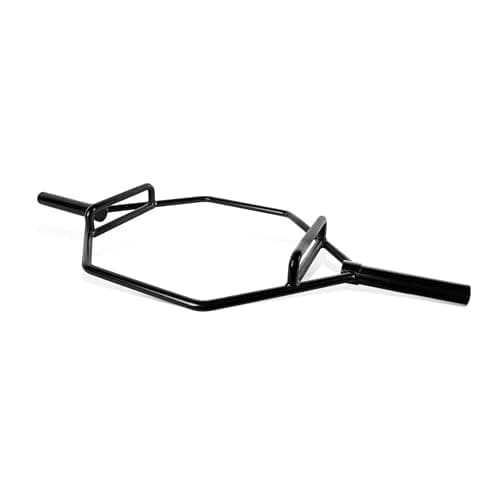
A trap bar is the one that surprises people. It loads a heavy hip-and-leg pattern from the floor, so there is nothing to unrack and nothing to fail out of — you set it down. The CAP OBIS-89HB publishes 750 lb of capacity, a 52 lb bar weight, 9 in loadable sleeves and a 25 in interior opening, and it needs about 56 in of clear floor. For a small room that is the most load per square foot available without a rack, and our trap bar ranking covers the category. What it will not do is replace a rack for squats or bench — it is a different movement, and we say so on that page too.

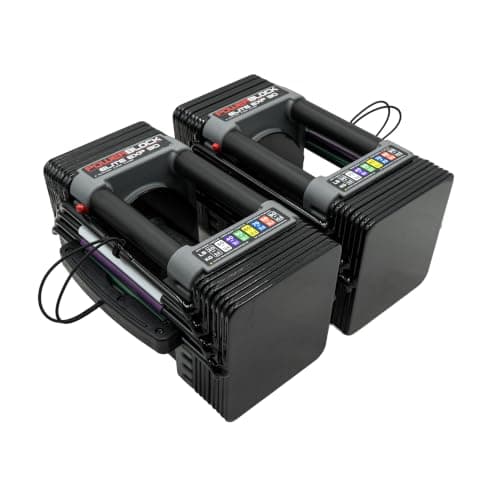
Heavy adjustable dumbbells cover squat, split squat, press and row patterns at loads most people never exhaust, and you lift them from the floor one hand at a time. The PowerBlock Elite EXP runs 5 to 50 lb per hand and expands to 70 or 90 lb with kits, in a footprint of roughly 12 by 6 in each. A 50 lb-per-hand goblet squat is real training, and it fits in a cupboard. Our adjustable dumbbell ranking has the field, and machines versus free weights argues the wider version of this trade on footprint grounds.

The floor cost, which is the real decision

OptionPublished footprintRated loadInstallCovers
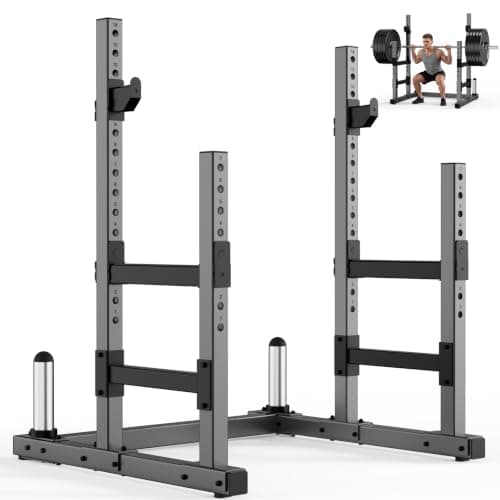
PASYOU SR30Pro squat stand36 x 43 x 58 in (about 10.8 sq ft)2,400 lb total, 600 lb on the J-hooksNone — freestandingSquat, bench, press from a rack
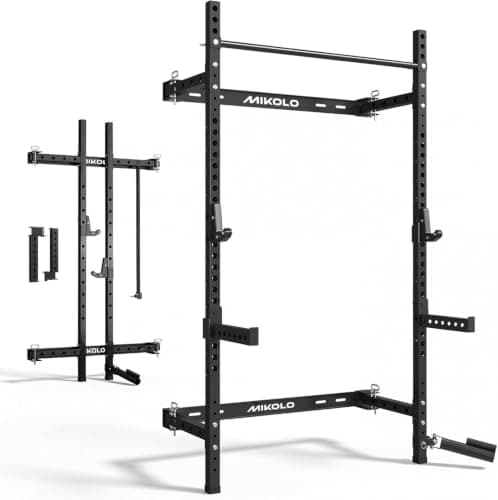
Mikolo folding wall rackFlat to the wall when folded1,000 lbLag bolts into studsSquat, bench, press, pull-ups, landmine
CAP OBIS-89HB trap barAbout 56 in of clear floor in use750 lbNone — stores against a wallHeavy hinge, carries, shrugs, presses
PowerBlock Elite EXPAbout 12 x 6 in each5-50 lb per hand, expandableNoneSquat, press, row, lunge, carry

Read the footprint column as the price of the capability column. A freestanding stand asks for about eleven square feet permanently; a folding wall rack asks for the same area during a session and almost none afterward, in exchange for holes in your studs; a trap bar asks for a strip of floor while you use it and leans against a wall when you do not; dumbbells ask for a shelf.

The renter version of the question

If you cannot drill, the wall rack is out and the decision collapses to a freestanding stand versus no rack at all. A stand is genuinely renter-safe — the PASYOU takes no fixings and comes apart to move — but it is also a permanent eleven square feet in a room that probably does not have eleven spare square feet. Many renters should buy the trap bar or the dumbbells and revisit the rack question at the next address. Our renter-friendly guide and power rack versus squat stand cover both halves.

If you do need one, buy for the failure case

One thing not to economize on: whatever catches the bar. Half-rack and squat-stand safeties are the entire reason the structure is safe to train in alone, and the published ratings are worth reading per component rather than in total — the PASYOU, for example, publishes 2,400 lb overall but 600 lb specifically on the J-hooks, which is the number that actually applies to your bar. Our capacity guide explains why those two figures get conflated, and how much weight a wall-mounted rack holds does the same for the folding kind.

The short answer

Quick picks

#ProductBest forScorePrice
01
PASYOU PASYOU SR30Pro Adjustable Squat Rack Stand
PASYOU SR30Pro Adjustable Squat Rack Stand

Two independent freestanding uprights you can set to any width, then move or store when done — no wall, no drilling, no landlord conversation. The rack for people who can't put a hole in anything.

Renters who can't drill
8.0
$219.99Amazon
02
Mikolo Mikolo Folding Wall-Mounted Squat Rack
Mikolo Folding Wall-Mounted Squat Rack

The small-space rack answer: it bolts to your studs and folds flat against the wall when you're done, giving the whole floor back. 1,000 lb rated with safeties, a pull-up bar and J-hooks — a real rack that disappears.

Reclaiming the floor completely
8.0
$264.92Amazon
03
CAP CAP Olympic Hex Trap Bar, Combo Grip (OBIS-89HB)
CAP Olympic Hex Trap Bar, Combo Grip (OBIS-89HB)

A 750 lb rated hex bar with both raised and flush neutral handles, 9 in loadable sleeves and a 25 in interior opening, for about eighty dollars. It is the heaviest bar here at 52 lb, which is good news under load and bad news when you carry it to the wall.

Most capacity and two grip heights, cheapest
9.0
$79.99Amazon
04
PowerBlock PowerBlock Elite EXP
PowerBlock Elite EXP

The most space-efficient adjustable we rank. The block shape is shorter than a dial dumbbell at every weight, there's almost no plastic to crack, and expansion kits take it to 70 or 90 lb without buying a new pair. PowerBlock has since discontinued the EXP line, so what sells now is remaining stock.

The smallest footprint
9.3
$399.00Amazon

#ad · Live prices from the Amazon Product API, as of October 25, 2026. Where we have no verified live price, we show none — we would rather leave a gap than print a number that has rotted.

In detail

The picks, in full

01
PASYOU PASYOU SR30Pro Adjustable Squat Rack Stand

Renters who can't drill

PASYOU SR30Pro Adjustable Squat Rack Stand

FreestandingNo installAdjustable height2,400 lb total
8.0/10

Two independent freestanding uprights you can set to any width, then move or store when done — no wall, no drilling, no landlord conversation. The rack for people who can't put a hole in anything.

Good

  • Zero install — the true renter rack
  • Set to any rack width
  • Can be moved out of the way or stored

Trade-offs

  • Less stable than a bolted or four-post cage
  • No pull-up bar, and nothing joins the two uprights overhead
Fit
8
Value
8
Install
10
Build
6

Skip this if…

…you lift heavy and want the security of a full cage with catch bars — freestanding stands are less forgiving of a failed rep.

Spec sheet

Type
Freestanding squat stand (pair of uprights)
Folded depth
Uprights move / store apart
Rated load
2,400 lb total — 1,800 lb on the lower bars, 600 lb on the J-hooks
Set-up footprint
36" D x 43" W x 58" H (about 10.8 sq ft, per listing)
Install / renter
Freestanding — no drilling, renter-safe
Ceiling needed
Standard — no overhead bar
Unit weight
63 lb for the pair
$219.99View on Amazon

Price as of October 25, 2026. Prices change — Amazon's is the one that counts.

#ad · we may earn a commission from this link to PASYOU SR30Pro Adjustable Squat Rack Stand

02
Mikolo Mikolo Folding Wall-Mounted Squat Rack

Reclaiming the floor completely

Mikolo Folding Wall-Mounted Squat Rack

Folds flat to wall1,000 lb rated2×2 uprightsPull-up bar
8.0/10

The small-space rack answer: it bolts to your studs and folds flat against the wall when you're done, giving the whole floor back. 1,000 lb rated with safeties, a pull-up bar and J-hooks — a real rack that disappears.

Good

  • Folds flat — the floor is fully usable between sessions
  • 1,000 lb rating is real rack territory, not a stand
  • Comes with safeties and a pull-up bar

Trade-offs

  • Must bolt into studs — not for renters who can't drill
  • Fixed to one wall location
Fit
10
Value
8
Install
5
Build
9

Skip this if…

…you can't drill into the wall, or your studs aren't where you need the rack — a freestanding stand is your path instead.

Spec sheet

Type
Folding wall-mounted rack
Folded depth
Folds flat to the wall
Rated load
1,000 lb (per listing)
Install / renter
Wall-anchor (studs) — landlord OK needed
Ceiling needed
Not published — clears a pull-up bar
Includes
Safeties, J-hooks, pull-up bar, landmine
$264.92View on Amazon

$299.9912% off

Price as of October 25, 2026. Prices change — Amazon's is the one that counts.

#ad · we may earn a commission from this link to Mikolo Folding Wall-Mounted Squat Rack

03
CAP CAP Olympic Hex Trap Bar, Combo Grip (OBIS-89HB)

Most capacity and two grip heights, cheapest

CAP Olympic Hex Trap Bar, Combo Grip (OBIS-89HB)

750 lb capacity55.71" long9" sleeves52 lb bar
9.0/10

A 750 lb rated hex bar with both raised and flush neutral handles, 9 in loadable sleeves and a 25 in interior opening, for about eighty dollars. It is the heaviest bar here at 52 lb, which is good news under load and bad news when you carry it to the wall.

Good

  • 750 lb rating is the second highest here and the highest at this price — it will not be the part of your setup that fails first
  • Two handle heights on one bar: flip it over for a lower start, which is the single most useful feature a trap bar can have
  • 25 in interior opening is genuinely roomy — wide stances and larger lifters fit inside it
  • Takes bumper plates, which the cheaper CAP bar explicitly does not

Trade-offs

  • 52 lb empty — the heaviest bar on this page, and you feel every pound of it moving the bar to storage
  • 55.71 in long: in a narrow room you will be pointing it at a wall rather than parallel to one
  • 9 in sleeves are the shortest here, so a bumper-plate setup runs out of sleeve before the bar runs out of rating
  • No published warranty term, which is standard for the category but still worth knowing
Fit
7
Value
10
Install
10
Build
9

Skip this if…

…you have to lift the bar onto a high wall hook after every session — 52 lb at shoulder height at the end of a deadlift session is a real objection.

Spec sheet

Type
Closed-frame hex / trap bar, combo (dual-height) grips
Capacity
750 lb
Bar weight
52 lb
Overall length
55.71" (Amazon item dimensions)
Overall width
24.61"
Frame height
4.72"
Interior opening
25" — the space you stand in
Loadable sleeve
9" per side, 2" Olympic
Plate fit
2" Olympic, bumper plates included (stated)
Grips
Raised and flush neutral handles, medium knurl
Finish
Black powder coat (a chrome version is sold as OBIS-89HC)
Floor length needed
About 56 in of clear floor, plus room to step in and out
Storage
Leans flat against a wall or hangs on wall hooks — it will not stand in a corner like a straight bar
Model
OBIS-89HB
Warranty
Not published
$79.99View on Amazon

Price as of October 25, 2026. Prices change — Amazon's is the one that counts.

#ad · we may earn a commission from this link to CAP Olympic Hex Trap Bar, Combo Grip (OBIS-89HB)

04
PowerBlock PowerBlock Elite EXP

The smallest footprint

PowerBlock Elite EXP

5–50 lb / handExpandable to 90 lbSelector pinAll-metal core
9.3/10

The most space-efficient adjustable we rank. The block shape is shorter than a dial dumbbell at every weight, there's almost no plastic to crack, and expansion kits take it to 70 or 90 lb without buying a new pair. PowerBlock has since discontinued the EXP line, so what sells now is remaining stock.

Good

  • Shortest handle length at every weight — best for narrow benches
  • Almost no plastic; the part that usually fails isn't there
  • Upgrade path to 90 lb without a second purchase

Trade-offs

  • The block-in-block shape takes practice to grip naturally
  • Adder weights for 2.5 lb micro-jumps are a separate purchase
  • Discontinued by PowerBlock — its current catalog is the Pro 100 EXP and the Elite USA 90, though PowerBlock still sells the EXP expansion kits
Fit
10
Value
8
Install
10
Build
9

Skip this if…

…you want the familiar round-dumbbell feel — the cage shape is polarizing, and some people never warm to it.

Spec sheet

Weight range
5–50 lb / hand (Stage 1)
Expandable to
70 or 90 lb with kits
Footprint (each)
~12 × 6 in — shortest here
Adjust
Selector pin
Install / renter
Freestanding — zero install
Noise / floor
Low — solid metal, no rattle
$399.00View on Amazon

Price as of October 25, 2026. Prices change — Amazon's is the one that counts.

#ad · we may earn a commission from this link to PowerBlock Elite EXP

A four-question test

  1. Do you own, or intend to own, a barbell? If no, stop here — you do not need a rack, and nothing else on this page applies.
  2. Will you squat or bench more than you can lift to your shoulders? If no, a bar on the floor plus a trap bar covers your training for a long time.
  3. Will you train alone? If yes and the answer above was yes, you need safeties, which means a rack rather than a pair of uprights with hooks.
  4. Can you drill into studs? If yes, a folding wall rack returns your floor. If no, a freestanding stand is the only rack option, and it is permanent.

Ceiling height, before anything else

Two of the three rack formats need overhead room you may not have: a cage needs its uprights plus the pull-up bar, and a wall rack needs clearance above the folded unit. Measure where you would actually stand, not the middle of the room. Our low-ceiling rack guide is built for rooms under 8 ft, and the ceiling height guide lists what each movement needs.

What the rack does not include

A rack is not a gym. Once you have one you still need a bar, plates, a bench and somewhere to put the plates, and that sequence is most of a budget — which is precisely why the rack question deserves an honest answer rather than a default yes. Our $1,500 build is the first budget rung where a folding wall rack, a 6 ft bar and a cast iron set all fit together, and the $500 build deliberately has no barbell in it at all.

The one answer we will not give

We are not going to tell you that you must barbell squat, or that dumbbells are "just as good." Those are training arguments and they depend on goals we cannot see. What this page settles is the equipment question underneath them: a rack solves unracking and failure, it costs about eleven square feet or a set of holes, and there are two registry-backed ways to load a heavy lower body without one.
How we picked

We don't run a testing lab

We compiled published specifications, manufacturer documentation and aggregated owner reviews, then scored each product against a published rubric that weights fit-for-small-space, value, install reversibility and build. The scores are judgments from documented research — they are notmeasurements we took, because we don't have a lab and we're not going to pretend we do. Every dimension is cited in Sources.

Questions

Frequently asked

Do you really need a squat rack for a home gym?
Only if you will lift a barbell heavier than you can get onto your own shoulders, or bench press alone. That is what a rack does: it holds the bar at height and catches it when a rep fails. Deadlifts, rows, every dumbbell movement and all bodyweight work need no rack. If a barbell is not in your plan, a rack is the most expensive piece of furniture in the category.
Can you squat without a squat rack?
Yes, several ways, and two of them are genuinely heavy. A trap bar loads a heavy hip-and-leg pattern from the floor with nothing to unrack — the one we rank publishes 750 lb of capacity. Heavy adjustable dumbbells cover goblet squats, split squats and lunges at 50 lb per hand and more. What you cannot safely do without a rack is put a barbell heavier than your clean onto your back.
What is the smallest squat rack option for an apartment?
A folding wall-mounted rack, by a wide margin — it folds flat to the wall and gives the floor back, and the one we rank publishes a 1,000 lb rating. The catch is lag bolts into studs, which needs a landlord's permission. Without drilling, a freestanding stand is the smallest rack, and the one we rank publishes a 36 x 43 in footprint, about 10.8 sq ft. Our folding rack ranking has the wall-mounted field.
Is a squat stand as safe as a power rack?
For squats with proper safeties set, a good stand is a reasonable choice; for benching alone, a full cage gives you more margin because the catch points surround you. Read the per-component ratings rather than the headline figure — the stand we rank publishes 2,400 lb total but 600 lb on the J-hooks, and the J-hook number is the one holding your bar. Power rack versus squat stand compares them properly.
Is a trap bar a replacement for a squat rack?
Not a replacement — an alternative to needing one. A trap bar is loaded and lifted from the floor, so there is nothing to unrack and no failure position to escape from, and it lets a small room load a heavy lower-body pull with no structure at all. It will not let you back squat or bench press. That is stated plainly on our trap bar page as well.
How much space does a squat rack need?
More than its own footprint. The stand we rank publishes 36 x 43 in — about 10.8 sq ft — and you need room to walk the bar out, room on both sides for plates, and ceiling clearance if there is a pull-up bar on it. A folding wall rack needs the same working area during a session and almost nothing afterward, which is the whole argument for one in a small room.
Should I buy a rack first or a bench first?
A bench first, almost always. It is cheaper, it is useful with the dumbbells you probably already own, and it is required by the rack anyway if benching is part of the plan. Our do you need a weight bench page runs the same honest test on that purchase.
If I skip the rack, should I buy dumbbells instead of a barbell?
Usually yes, and for a specific reason: a barbell without a rack has a short movement list, while dumbbells press, row, carry and load single-leg work from the first session with no structure at all. The arithmetic is closer than people expect — a dial pair is 105 lb and an entry barbell package is 103 lb — so the decision comes down to floor and to whether you train alone. That comparison is dumbbells vs barbell for a small home gym.

Keep reading

Receipts

Sources

We don't run a testing lab, and we don't pretend to. Every dimension and rating traces to a manufacturer spec sheet or manual, named and linked above. Where a maker doesn't publish a number, the spec reads "Not published" rather than a guess. Read our full method.