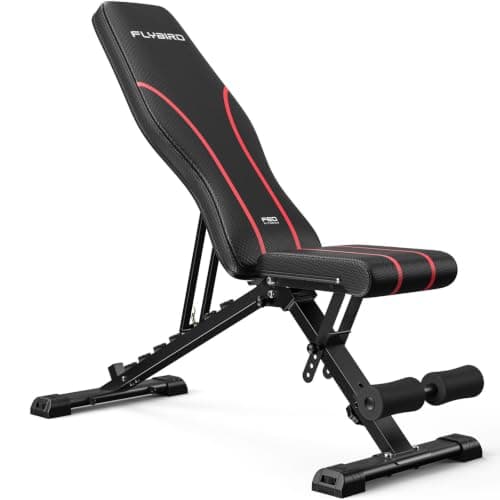
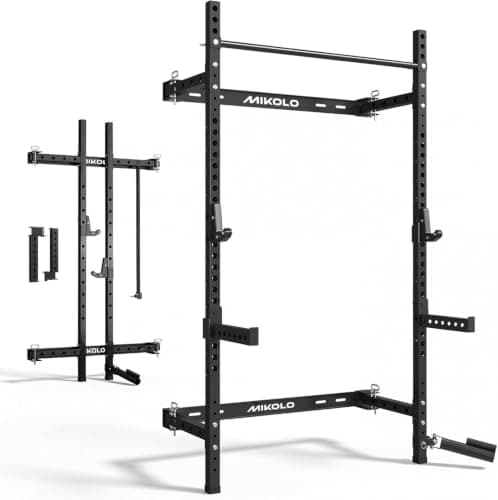
If one piece of folding equipment is going to change your room, it is the Mikolo folding wall-mounted rack: it carries a published 1,000 lb rating with a barbell, and it folds flat to the wall when you are done, which is the only way a rack and a parked car occupy the same garage. It is for someone who can put lag bolts into studs. If you cannot drill, the FLYBIRD WB2 bench is the piece that does the most for the least floor — it folds flat, stands against a wall and weighs little enough to move one-handed.
This whole site is organized around the idea that the dimension nobody publishes is the one that decides a purchase. Folding gear is where that is most true: "space saving" appears on almost every listing in this category and means almost nothing, while the number you need — the folded depth, or the stored thickness — is published perhaps half the time. So the ranking below is by what each piece becomes when it is flat, and where a maker does not publish that, we say so instead of guessing.
Folding, versus merely small
There is a real difference, and it decides which room a piece of equipment can live in. Something small has a permanent footprint you have agreed to live with. Something that folds has a temporary footprint in use and a different, smaller one afterward — which means the room can have another job. A mini stepper is small. A wall rack folds. Both are useful; only one of them lets a living room be a living room by the evening, which is the test our living room guide calls the sightline test.
The trade is almost always a hinge, and a hinge is a mechanism that can wear, rattle or be left half-deployed. Three practical consequences: folding gear usually publishes a lower rated load than its fixed equivalent, it has more parts to assemble, and it only pays off if folding it takes under a minute. If putting it away is a chore, you will not do it — and then you own something small with extra joints.
The five, ranked by what they become
| Equipment | Category | Folded | Rated load | Install |
|---|
| Mikolo folding wall rack | Squat rack | Flat to the wall; exact depth not published | 1,000 lb | Lag bolts into studs |
| FLYBIRD WB2 bench | Adjustable bench | Flat — stands against a wall | About 600 lb per listing | None |
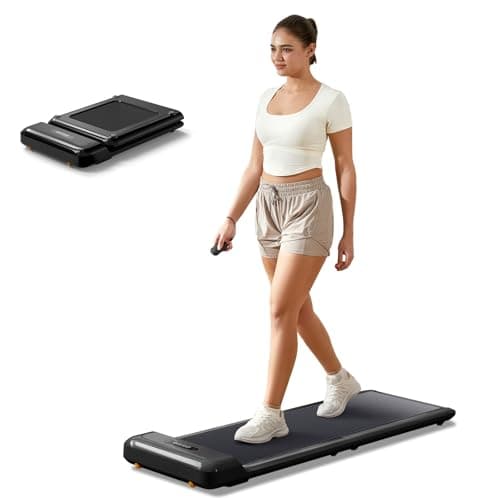
| WalkingPad C2 | Walking pad | Hinges in half, stores upright | Not published | Plug in |
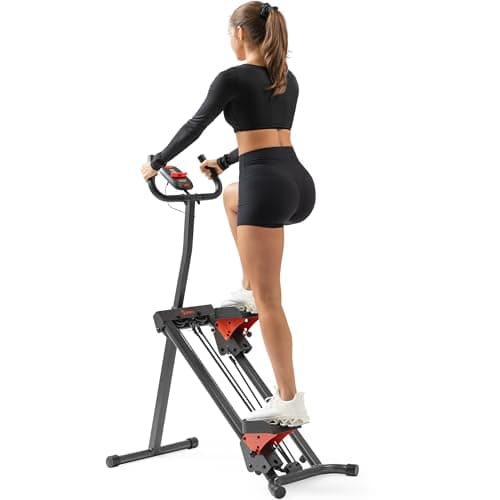
| Sunny SF-S025005 climber | Step climber | 63.4 x 18.3 x 9.6 in, lies flat | 330 lb | None, and no outlet |
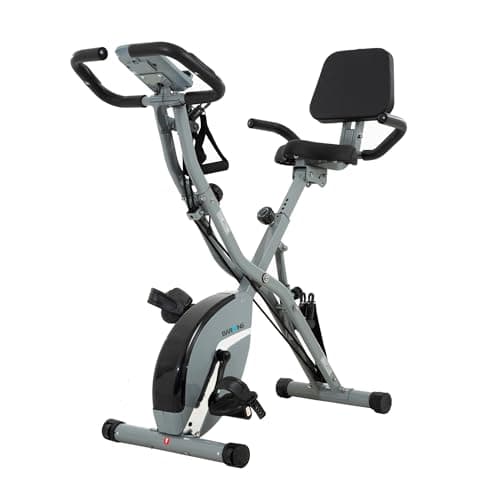
| BARWING 5-in-1 bike | Exercise bike | Folds and rolls; size not published | 350 lb | None |
The Sunny climber is the only piece in this group that publishes a complete folded dimension — 63.4 by 18.3 by 9.6 inches, lying flat — and that is why it is the one you can plan a room around with confidence. It is also the one that needs no outlet and no install at all, which in a rental is worth more than a spec sheet line.
The wall rack is the biggest change, and the biggest commitment
A folding wall-mounted rack is the single most dramatic space trade available in a home gym: a full barbell station with a pull-up bar during the session, a few inches of depth against the wall afterward. The Mikolo publishes a 1,000 lb rating on 2x2 in uprights and arrives with safeties, J-hooks, a pull-up bar and a landmine.
The price is holes. It bolts into studs, which means a landlord conversation in a rental and real patching on move-out. If that is a no, the honest substitute is not a different folding rack — it is a freestanding squat stand, which does not fold but does come apart and leaves nothing behind. Our folding squat rack ranking covers the wall-mounted field, and are wall-mounted squat racks safe answers the question everyone asks second.
What does not actually fold
Worth saying, because the word gets used loosely. Adjustable dumbbells do not fold — they are dense, not collapsible, and their tray footprint is permanent. Compact ellipticals in our registry explicitly do not fold; both Sunny machines publish a permanent in-use footprint and say so. Most walking pads do not fold either: they are flat slabs that slide under furniture, which is a different and often better trick. And a power cage does not fold in any sense — see our power rack versus squat stand comparison for what you give up by choosing one.
Two categories in our registry fold better than their reputation: benches, where folding flat is now standard rather than premium, and bikes, where an X-frame folds to roughly nothing and rolls. If you want the whole collapsible-cardio field, the compact cardio hub ranks it by stored thickness.
Building a whole gym out of folding pieces
It is possible, and this is roughly the order we would buy in: a bench that folds flat, a doorway or wall pull-up bar, one pair of adjustable dumbbells, mats that lift out, and then — if you can drill and you want a barbell — the wall rack. That sequence gives you pressing, pulling, hinging and squatting in a room that still works for something else, and it is the same logic as our small-space essentials list with the folding constraint applied on top.
The one place to not economize is the hinge on whatever carries load. A bench hinge and a rack hinge are structural; a pad hinge is a convenience. Read the published rating on the first two, and treat a missing rating as a reason to choose something else.
The four numbers to compare before you buy folding gear
- Folded dimension, all three axes. Half the category publishes it. The Sunny climber gives all three; the rack and the two bikes give none. If it is missing, measure the open frame and assume the folded object is as long as its longest member.
- Rated load. Folding costs capacity more often than it costs anything else. 1,000 lb on the wall rack, around 600 lb on the bench per its listing, 330 and 350 lb on the climber and the bike, nothing published on the pad.
- Unit weight. The real test of whether you will fold it twice a day. Thirty pounds is a one-hand job; seventy is a decision.
- What the fold needs around it. A wall rack needs wall. An upright pad needs ceiling clearance in its stored spot. A bench needs a flat wall to lean against. A bike needs a doorway wide enough to roll through.
Renting, and the install column
Only one piece on this page needs holes, and that is deliberate: four of the five install in zero minutes with no fixings at all. If you rent, that column is the ranking. Our renter-friendly guide has the full no-drill set, and wall-mounted benches covers the one piece people most often assume needs drilling and sometimes does not.
Where the folded thing goes
Folding only helps if there is a destination. Decide it before you order: the gap beside a wardrobe, the space behind a door, the clear height under a bed. Measure that destination first and shop to it, which is the reverse of how most people buy. Our small-space storage guide and under-bed storage ideas between them cover most of the destinations a small apartment actually has.
A note on prices
Each card carries its live price with the date it was checked. We do not type prices into prose anywhere on this site, because the number on the card is the one that is current — and the spread on this page is wide, from a bench to a wall rack. Buy in the order above rather than all at once; folding gear is the one category where owning less of it is often the better room.