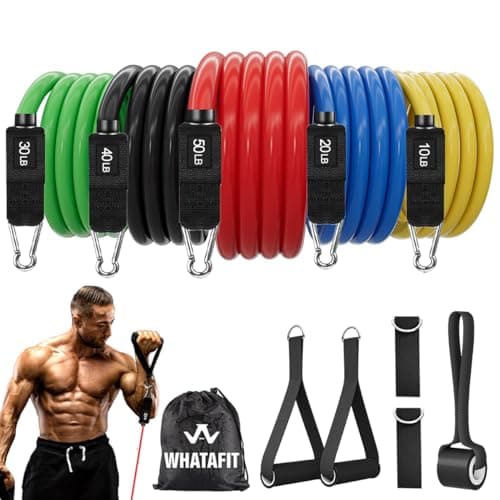
Under $300 a complete home gym is genuinely achievable, and the thing you give up is speed of adjustment rather than capability. The five pieces below cover pressing, pulling, hinging, squatting and core work in a corner of a room: a band set that anchors in a door, a 38 lb plate-loaded dumbbell set with a carry case, a flat bench rated 600 lb on its listing, a multi-grip doorway pull-up bar and interlocking mats to put it all on. The compromise is the dumbbells — threaded collars you spin rather than a dial you twist.
We publish budget builds at $500, $1,000, $1,500 and $2,000, and this is the rung below all of them. It shares nothing with the $500 build — not a single pick — because at $300 the shape of the answer genuinely changes. We never print a total in prose: add up the five live prices on the cards, which are the only current numbers.
Why the dumbbells are the whole decision
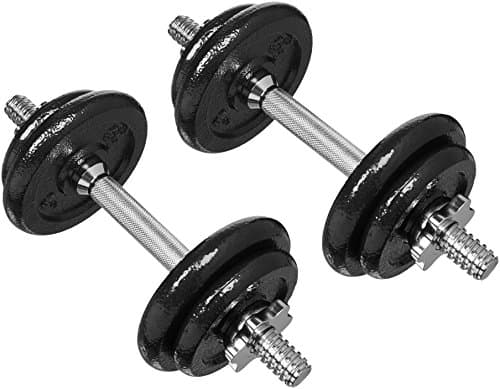
Adjustable dumbbells are where almost all of a small-space budget wants to go, and at this budget the dial-adjust kind are out of reach. What is in reach is the mechanism that preceded them: a pair of handles, a box of plates, and threaded collars. The Amazon Basics set publishes exactly what you get — two 3 lb handles, four 2.5 lb and four 5 lb plates, four 0.5 lb collars, 38 lb total, 19 lb maximum per hand — and it arrives in a hard case with a carry handle, which is the small-space feature that matters most.
Nineteen pounds per hand is the honest ceiling here, and for pressing, rowing and curling at the start that is real training. For squats and hinges it is light almost immediately, which is why bands and bodyweight carry those patterns in this build. If you know you want a 50 lb-per-hand ceiling now rather than later, the right move is to save for the $500 build rather than buy twice. Our adjustable versus fixed comparison covers what a spin collar costs you in time per set.
What each piece is doing in the build
- The band set covers everything the light dumbbells cannot: heavy pulling against a door anchor, hinge patterns, and resistance that keeps rising as the movement shortens. Five tubes rated 10 to 50 lb, stacking to a published 150 lb, in a 2 lb kit that lives in a drawer.
- The dumbbell set is the loadable weight — pressing, rowing, carrying, goblet work.
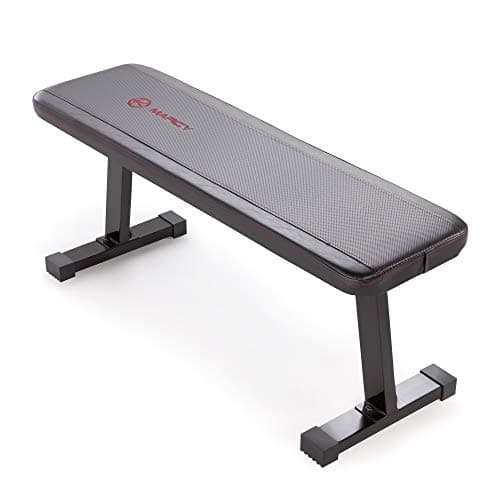
- The flat bench turns floor pressing into real pressing and publishes a 600 lb rating, which is more capacity than this build will ever use. It does not adjust, and that is the trade for the price.
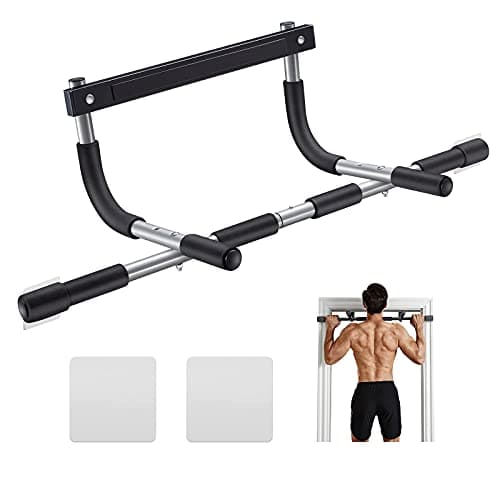
- The doorway pull-up bar is the pulling half of the body, with no holes, no footprint and multiple grip positions.
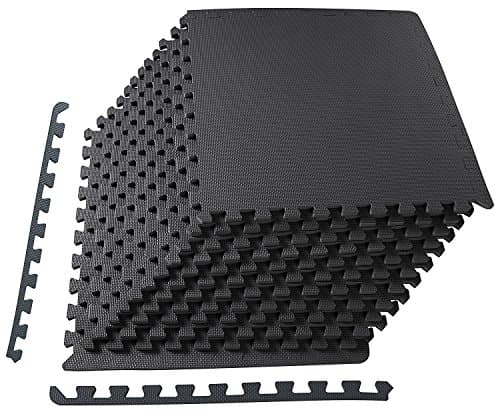
- The mats protect the floor, cut the impact the room below hears, and lift out on move-out day.
The build, at a glance
| Piece | Covers | Published spec | Install | Stores as |
|---|
| WHATAFIT band set | Pull, hinge, press, rotate | 5 tubes, 10-50 lb, 150 lb stacked | Door anchor — no marks | 2 lb pouch in a drawer |
| Amazon Basics 38 lb set | Press, row, carry, goblet | 38 lb total, 19 lb per hand | None | Included hard case |
| Marcy flat utility bench | Bench press, rows, step-ups | 600 lb rated per listing | None | Slides aside; does not fold |
| ALLY PEAKS doorway bar | Pull-ups, hangs, grip | Multi-grip; width and rating not published | Doorway mount, removable | Lifts out of the frame |
| BalanceFrom EVA tiles | Floor and noise | 1/2 in interlocking tiles | Interlock, no adhesive | Stack or roll in a closet |
One honest gap in that table: the doorway bar publishes neither a rated load nor a doorway width range, which we flag on its card. Measure your door frame before ordering, and if you want published numbers, the doorway bar ranking has two that state both — one of them at a few dollars more.
What $300 cannot buy, stated plainly
No barbell and no rack. A 6 ft Olympic bar plus even a modest plate set plus something to unrack from is most of a $500 budget on its own, and a bar with nowhere to rack it is a hazard rather than a bargain — our rack guide is where that path starts. No cardio machine either; the cheapest category in our sub-$200 cardio ranking would consume a third of this budget, and walking is free.
Also not here: a dial-adjust dumbbell, an adjustable bench, or anything that folds flat to the wall. Each of those is the first upgrade in its own category, and each is the reason the $500 build looks different rather than simply bigger.
The buying order, if you cannot buy it all at once
- Bands. Cheapest, smallest, and they cover the most patterns on day one.
- The dumbbell set. The first real load, and the piece that makes the bench worth having.
- Mats. Before the bench if you are upstairs or on a floor you do not own.
- The bench. It converts the dumbbells from a floor-press tool into a pressing station.
- The doorway bar. Last only because it is the easiest to add; if pull-ups are your goal, move it to second.
Where this build runs out, and what to add first
The ceiling is the dumbbells, at 19 lb per hand. You will notice it first on squats and hinges, then on rows. The cheapest honest fix is not more dumbbells — it is a heavier band and a slower tempo, both free. The real fix is a set with a 50 lb-per-hand ceiling, which is the headline purchase in our adjustable dumbbell ranking, and the single upgrade that takes this build the furthest.
The second thing you will want is an incline, because flat pressing is only part of pressing. An adjustable folding bench is the swap, and our bench ranking under $200 covers the field. At that point the kit is approximately the $500 build.
How much room this needs
Less than any other build we publish. Everything except the bench stores in a closet or a drawer, and the bench slides against a wall. In use, you need a clear rectangle of roughly 6 by 6 feet — measure it by sweeping a broom overhead and lunging forward and back rather than by calculating square footage, the same method our space guide uses.
Two mats' worth of tiles under the training rectangle is enough; you do not need to floor the room. If the floor is carpeted, read home gym on carpet first, because the layer stack changes. If it is hardwood, our hardwood guide explains why the material choice flips.
Renting
This is the most renter-friendly build on the site: nothing on this page needs a hole. The band anchor hooks over a closed door, the pull-up bar wedges into a door frame and lifts out, the tiles interlock without adhesive, and the bench and dumbbells are freestanding. Our renter-friendly guide has the wider set, and the dorm room build is the even smaller version of this same list.
Who should spend more, and who should not
Spend more if you already know your working weights and they are above 19 lb per hand, or if a barbell is non-negotiable for you. Do not spend more if you are starting from zero: this build covers every movement pattern, the ceiling is months away rather than weeks, and the most common mistake in this category is buying a $1,000 setup for a habit that has not formed yet. Our beginner guide makes that case at more length.