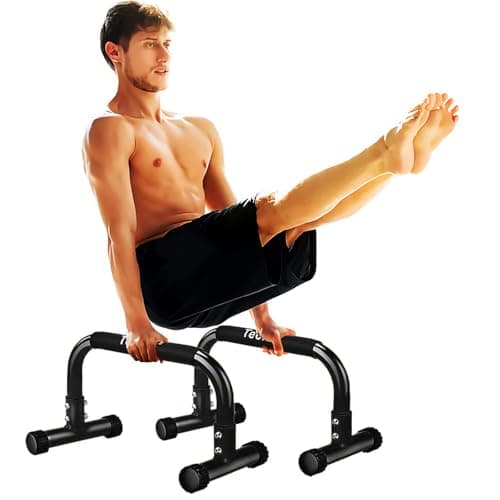
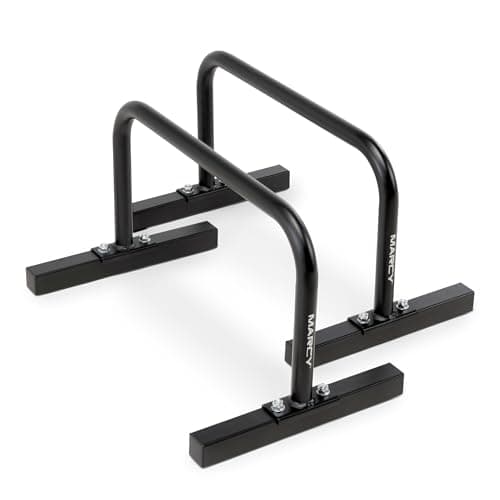
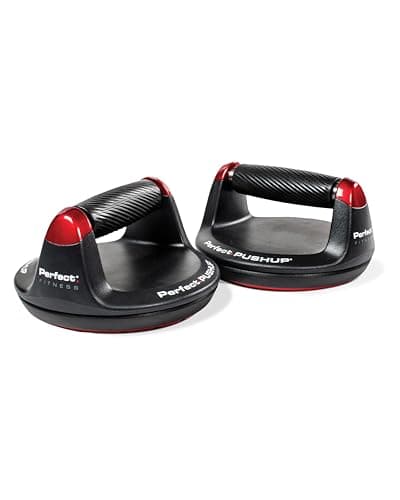
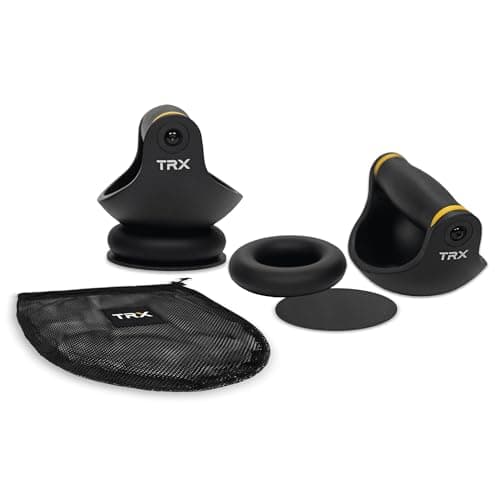
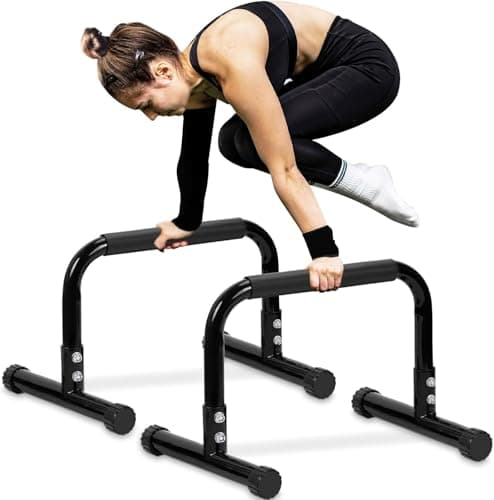
The TABEKE 14 in steel parallettes are our pick, because 14 in is the height at which this category stops being a push-up accessory and becomes a dip station — your legs clear the floor for straight-leg L-sits and bent-knee dips — and it publishes both a 660 lb rating and a 1.8 mm tube wall to back it up. The Teclor TC-123 is the pick if you want the numbers: it is the only pair here that publishes its real footprint (17 x 8.3 x 9.5 in), its wall thickness and its rating, and 9.5 in on a 17 in base is the most stable steel geometry on the page. The Marcy ACC-0333-PARA buys you a brand and a part number but publishes no load rating at all. The Perfect Pushup Elite is the wrist pick — 6.3 in, 400 lb, rotating on steel bearings — and the TRX Push-It is the same idea at the highest price on the page with no published specs whatsoever.
Everything else in the machines hub asks you for something: a doorway, a wall anchor, a ceiling joist, or a permanent square of floor. Push-up bars ask for nothing. They are the only strength equipment on this entire site that goes in a drawer — the lightest pair here weighs 1.8 lb, the heaviest 13.2 lb, and all five take up less stored volume than a pair of shoes. For a dorm room, a shared bedroom or a rental where you have decided not to drill a single hole, that makes this the first purchase rather than the afterthought.
The category sells two different products under one name
Search "push up bars" and you get two objects that do different jobs, at similar prices, with no label telling you which is which. This is the single most useful thing to understand before you spend anything:
- A rotating handle is roughly 6 in tall on a wide disc base, with a grip that turns on bearings. It changes the angle of your wrist during a push-up and lets the arm rotate through the rep. That is its whole function. The Perfect Pushup Elite and the TRX Push-It are this product.
- A steel parallette is 9.5 to 14 in tall on a long rectangular base. It changes how far off the floor you are, which unlocks a different list of movements entirely: deeper push-ups, L-sits, tuck planches, bent-knee dips, and handstand work against a wall. The TABEKE, Teclor and Marcy pairs are this product.
Neither is better. They answer different questions. If your wrists hurt on the floor, buy the rotating handle — the parallette will not help, because a fixed bar locks your wrist just as rigidly as the floor does, only higher up. If you want one cheap purchase that adds new movements to a bodyweight routine, buy the parallette, because a 6 in handle adds exactly zero new movements. The Spec Blocks below lead with handle height for this reason.
What height buys you, movement by movement
Height is not a comfort preference, it is a capability spec. Roughly where the thresholds fall, using the five products on this page:
- 6 in (Perfect Pushup, TRX): deeper push-ups than the floor, planks, mountain climbers, knuckle-free wrist position. No dips. No L-sit — your heels hit the floor before your arms lock.
- 9.5-10 in (Teclor, and the 10 in pair we already use elsewhere on the site): everything above, plus tuck L-sits, tuck planche work, bent-knee dips for most people, and a stable base for wall-supported handstand push-ups.
- 13-14 in (TABEKE, Marcy's item height): everything above, plus straight-leg L-sits for most heights and dips with the knees bent rather than tucked hard. This is the height where a parallette genuinely overlaps a dip station for a fraction of the footprint.
The trade runs the other way too, and the listings never mention it: taller is tippier. A 14 in bar on a narrow base has a shorter lean before it goes over than a 9.5 in bar on the same base, and you feel that most on a wide hand placement or the first time you kick into a handstand. That is why the shorter Teclor scores higher than the taller TABEKE on stability in the Spec Blocks, and why neither of them is the pick for someone whose only goal is a better push-up.
The five things we ranked on
- Handle height, because it is the capability spec. 6.3 in to 14 in on this page, and the difference decides whether dips and L-sits are possible at all.
- Published rated load, and whether there is one. Two pairs publish 660 lb, one publishes 400 lb, and two publish nothing — including both brand-name products. You are about to put most of your bodyweight through two welds at a strange angle, often inverted. A missing number is a real deduction here.
- Base footprint against the floor. Not for storage — all five store in nothing — but for stability. An 8.3 in wide parallette base and an 8 in diameter disc behave very differently under a wide hand.
- What the maker actually publishes. This is a category where the marketplace brands publish more than the name brands: Teclor states its tube wall in millimeters, while Marcy states no height and no rating. We rank on the data, not the logo, and we say so in both directions.
- Floor contact and what it does to a rental floor. Rubber feet that rotate to level on an uneven floor are the feature that separates a parallette that stays put from one that creeps on tile. Two of the three steel pairs here have them.
How the five compare
| Pair | Handle height | Rated load | Base / footprint | Weight |
|---|
| TABEKE 14 in steel | 14 in | 660 lb | Not published | Not published |
| Teclor TC-123 | 9.5 in | 660 lb | 17 x 8.3 in each | Not published |
| Marcy ACC-0333-PARA | Not published | Not published | 23.5 x 14.25 in (pair, as listed) | 13.2 lb |
| Perfect Pushup Elite | 6.3 in | 400 lb | 8 in disc each | 1.8 lb |
| TRX Push-It | Not published | Not published | Not published | 2 lb |
Count the "not published" cells and the picture is uncomfortable: the two most recognizable brands on the page account for five of the seven blanks, and the two cheapest marketplace pairs publish a rating, a tube wall thickness and — in Teclor's case — every dimension of the bar. That is the opposite of how this usually goes, and it is the reason our top two picks are not the two names you would recognize. Where a maker does not publish a number, the Spec Block says so rather than estimating from a product photo.
One listing artifact we flag instead of repeating: TABEKE's Amazon item dimensions read 14 x 14 x 14 in. A bar that is exactly as long as it is tall as it is wide is a package cube, not a parallette, so that field describes the box. The 14 in height comes from the maker's own copy, which is why it appears in the table and the footprint does not.
How to choose push-up bars for a small space
1. Start from the movement you are missing, not the price
These all cost about the same — somewhere between a cheap takeout order and a cheap pair of shoes — so price is not the deciding factor, and that is unusual on this site. What decides it is which gap in your training you are filling:
- "My wrists hurt doing push-ups." Rotating handle. Perfect Pushup Elite, or the TRX if you already own TRX gear and want the matching thing.
- "I want dips and I have no room for a dip station." The 14 in TABEKE. It is the only height here that does it, and a dip station is a far larger object — see best dip stations for what you are avoiding.
- "I want to start calisthenics properly." The Teclor, because L-sits, tuck planches and handstand work all want a stable low bar with a published rating, and it is the most stable steel pair here.
- "I travel and want to keep training." Either rotating handle — 1.8 lb and 2 lb respectively, and both go in hand luggage. The steel pairs break down to flat parts with a screwdriver but weigh several times as much.
2. Check the rated load, and know what you weigh on your hands
In a push-up your hands carry roughly 60 to 70 percent of your bodyweight; in a dip or an L-sit they carry all of it; in a handstand they carry all of it with a shock load on the way in. A 660 lb rating on a 2 mm steel tube is not marketing excess — it is the margin that makes a bar boring, which is what you want from something you are inverted on.
The practical rule: if you plan to do any inverted work, buy a pair with a published rating. Both 660 lb pairs here publish one. The 400 lb rating on the Perfect Pushup is genuinely high for a 1.8 lb product and covers a weighted vest on top of most lifters. The two blanks — Marcy and TRX — are the two products we would not personally kick into a handstand on, not because they are weak, but because nobody has told us what they are rated for and we do not guess.
3. Test the floor, because this is a rental-floor product
Parallettes concentrate your bodyweight onto four small rubber feet, and the floor you put them on decides whether that is fine or annoying:
- Hard tile or sealed concrete. Best case. Rubber feet grip, nothing marks. Both the TABEKE and the Teclor have feet you can rotate to different thicknesses to level a bar on an uneven floor, which is the fix for the one thing that makes a parallette feel cheap.
- Hardwood or laminate. Fine with rubber feet, but check them for grit before every session — a trapped particle under 200 lb of load is how a floor gets a scratch. Our home gym on hardwood floors page covers the broader version of this.
- Carpet. The worst surface for parallettes, and nobody says so. The feet sink unevenly into pile, so a bar that is level on tile rocks on carpet, and a rocking bar under an L-sit is the actual injury risk in this category. Put a firm mat or a board under them — home gym on carpet works through what helps.
4. Grip diameter and material matter more than you expect
Both steel pairs here publish a 1.5 in handle diameter with full-coverage foam over the top tube, which is thicker than a barbell and considerably thicker than a bare steel pipe. A thick padded grip is more comfortable for the long holds this category is used for — a 30-second L-sit is a grip event — and it is sweat-resistant in a way bare metal is not. The rotating handles take the opposite approach: a hard TPE shell on the Perfect Pushup, soft rubber on the TRX. For plank and mountain-climber work where your hands sit still for minutes, the softer surface is the kinder one. If grip strength is what you are actually after, our grip strength equipment page is the better purchase.
5. What these do not replace
Push-up bars and parallettes are a pressing and core tool. They add range of motion, they add floor clearance, and they change wrist angle. What they cannot do is pull. There is no row, no pull-up and no lat work anywhere in this category, which means a pair on its own builds a lopsided routine. The cheapest honest complement is a doorway pull-up bar (no drilling, comes down between sessions), and the next step up is a suspension trainer, which rows, presses and stores in the same drawer these do.
They also do not load progressively. Once bodyweight push-ups and dips are easy, the only way forward in this category is leverage — slower reps, harder positions — or external load. If that is where you are, weighted vests is the page for adding load without adding floor, and adjustable dumbbells is the page for adding a whole second category — and if you are choosing between that second category and a barbell, dumbbells vs barbell for a small home gym settles it on floor space. For a full picture of what fits in a very small room, home gym essentials for small spaces places parallettes in the order most people should buy things.
6. Assembly, storage and the one thing to re-check
Both steel pairs bolt together in about two minutes with an included screwdriver — the Teclor uses eight screws, two per side, and TABEKE ships the tool as well. That means they break down flat for a suitcase or a closet shelf, which is a real advantage over a welded one-piece bar. It also means there are fasteners in the load path, so re-check the screws every few weeks if you work at load, especially after any inverted session. The two rotating handles have no fasteners and nothing to check, other than keeping grit out of the bearings; a garage floor will find them eventually, and that is the one wear item in this entire category. For the rest of the small-space storage picture, see small-space weight storage.