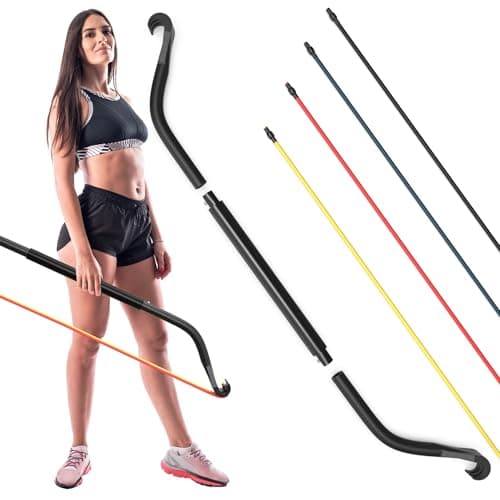
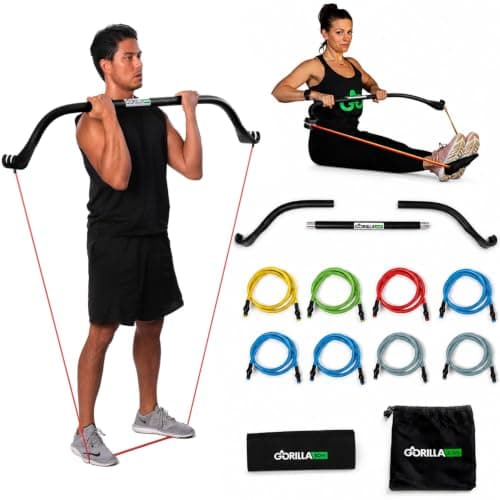
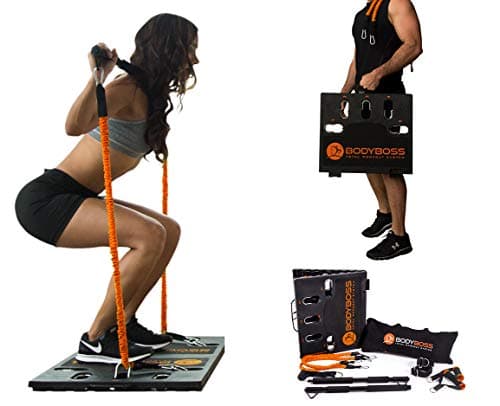
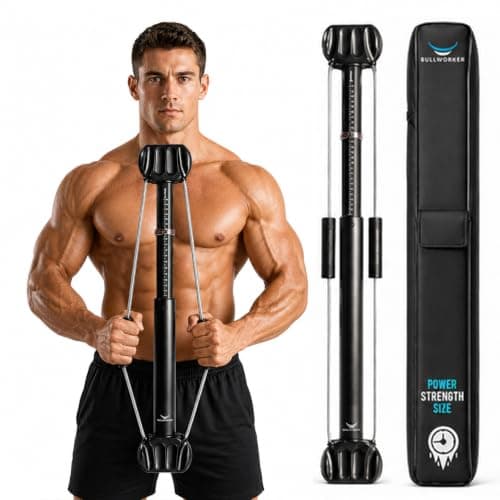
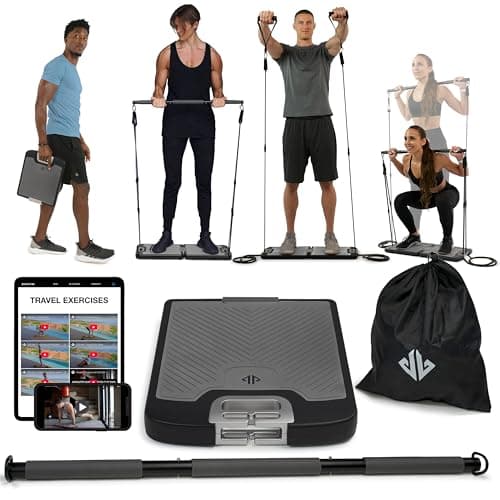
The EVO Gym is our pick, because it is the only system here that publishes what every single band weighs — 2 x 10 lb, 2 x 20 lb, 2 x 30 lb and 4 x 50 lb — so its 320 lb headline is arithmetic you can check rather than a round number in a marketing bullet. The bars and handles store inside its own base, so the gym is one object. If you want the best-documented small system instead, the Synergee Resistance Bow publishes its length, its bar diameter, every band rating and a total weight under 7 lb, at the lowest price on this page. The Gorilla Bow Travel claims the highest bow tension here at 330 lb but publishes no dimension or weight at all; the BodyBoss 2.0 is the only system that publishes a folded size (20.1 x 15.9 x 2.8 in, 16 lb) and the only one that publishes no resistance figure; and the Bullworker Bow Classic is not a band system at all — five springs, 0 to 150 lb, nothing to anchor and nothing to snap.
This is the only category on this site where the whole gym disappears. Everything else we rank — a folding rack, a folding bench, a walking pad — gets smaller. These get gone: into a drawer, a suitcase, the gap behind a door. For a dorm room, a furnished rental, a shared bedroom or a studio where the floor is already doing three jobs, that is not a small advantage. It is the whole proposition.
It comes with an equally large honesty requirement, so here it is before the rankings. Band tension is not iron. A band is slackest where most lifts are hardest — the bottom of a squat, the start of a press — and tightest at the top, where you are strongest. That makes bands excellent for some things (pulling, pressing at lockout, high-rep work, warm-ups, travel) and poor at others (heavy squatting, any lift where the bottom position is the point). A system advertising 320 lb is not a 320 lb barbell, and nobody on this page claims otherwise in a spec table — but the headline numbers invite the comparison, so we will not.
What a "portable home gym" actually is
Four distinct mechanisms share this shelf, and the search term covers all of them without distinguishing them:
- The bow. A rigid aluminum bar, usually in three pieces, with a band stretched between its ends like a bowstring. You hold the bar and the band provides the load. Gorilla Bow made the format; Synergee builds the same idea at a quarter of the price. Stores as three short tubes and a bag of bands.
- The platform system. A fold-up board you stand on, with band anchor points at your feet, plus a bar, handles and straps that clip to the bands. BodyBoss and EVO Gym are both in this family. The platform is what lets you load a squat or a deadlift pattern without a door or a wall.
- The isometric trainer. A sprung bar you press or pull against in a fixed position. No bands, no anchor, no movement — the Bullworker. Genuinely different training, and the smallest stored object here.
- Bands alone. Not on this page, because a band set with no bar is a different purchase with a different price — see best resistance bands for small spaces and resistance bands vs dumbbells.
The documentation problem in this class
We rank equipment on published numbers, and this is the worst-documented category we have covered. Of the five systems here:
- Two publish no dimensions and no weight at all. The Gorilla Bow Travel and the EVO Gym both describe themselves as packing down small — a carry-on, a large purse, a hotel room — and neither states a single inch or pound anywhere on the listing.
- One publishes no resistance figure at all. The BodyBoss 2.0 ships with a set of cloth-covered bands and never says what any of them are rated for, which makes progression untrackable and comparison impossible.
- One publishes three different weights for itself.Synergee's listing says 4.6 lb in Amazon's item-weight field, "only weighs 5 lbs" in one bullet and "only weighs 6 lbs: bow, bands, bag and all" in another.
- One has a number in its own name that its own dimensions contradict.The Bullworker Bow Classic 36" carries a published item length of 21.65 in.
So the ranking below rewards publication. A system that tells you what it weighs, what it measures and what its bands are rated for is a system you can plan a shelf and a training program around. One that tells you it fits in a purse is selling you a feeling.
How the five compare
| System | Mechanism | Max resistance | Stored size | Weight | Anchor |
|---|
| EVO Gym | Platform + bars + 10 bands | 320 lb (every band stated) | Not published | Not published | Base, door anchor, hook |
| Synergee Resistance Bow | 3-piece bow + 4 bands | 100 lb (10/20/30/40 lb) | 3 sections + band bag | 4.6-6 lb (listing disagrees) | None needed |
| Gorilla Bow Travel | 3-piece bow + bands | 330 lb (bands not itemized) | Not published | Not published | None needed |
| BodyBoss 2.0 | Fold-up platform + bar | Not published | 20.1 x 15.9 x 2.8 in | 16 lb | Platform underfoot |
| Bullworker Bow Classic | 5 springs, isometric | 0-150 lb | 21.65 x 5.51 x 2.36 in | 6.6 lb | None — resists itself |
Every resistance figure above is the maker's own rating for band tension or spring force. None of them is comparable to a plate on a bar, and none of them is a measurement we took.
Which mechanism fits your room
If you have no floor to spare and nothing to attach to — a dorm, a furnished rental, a shared bedroom — buy a bow. It needs a patch of floor while you use it and nothing at all when you do not, and the Synergee publishes every number you need to know in advance.
If you want to load the lower body properly, buy a platform system. The board under your feet is what turns a band into a squat or a deadlift pattern instead of an arm exercise, and it is the reason the EVO Gym ranks first here despite publishing no size.
If the room is shared at night and silence matters more than range of motion, the isometric Bullworker is the only product on this page with no moving load at all.
If you can give up a corner permanently, stop reading this page. A pair of adjustable dumbbells plus a folding bench is a better gym than anything here, and our what to buy first guide makes that case in order. Portable systems win on storage, not on training.
What these systems can and cannot train
What works well. Horizontal and vertical pulling (rows, pulldowns, face pulls), pressing at and near lockout, curls and triceps work, lateral raises, anything high-rep, and warm-ups before heavier work. Band tension rising through the range matches the way those movements get easier at the top.
What works poorly. Heavy squatting and hinging, where the hard part is the bottom and the band is slackest; bench-style pressing without a bench; and any lift where you want to know exactly what you lifted. Progression in this class means adding a band, not adding 5 lb, so increments are coarse.
What does not work at all. Loaded carries, drops, anything olympic. If what you actually want is a bar over your back, the honest answer is a folding rack, and we lay out the dumbbell-versus-barbell version of that choice in dumbbells vs barbell for small spaces.
Anchors: the part people underestimate
Every band system needs something to pull against, and where that something is decides what you can train and where you can train it.
- Underfoot (bow systems). You stand on the band or hook it under your feet. Zero install, zero marks on the building, and the reason bows are the renter default. The limit is that your bodyweight has to exceed the band tension, which caps the useful load.
- A platform (EVO, BodyBoss). The board holds the band ends and you stand on the board, which removes the bodyweight ceiling and lets you square up to a squat pattern. The board is also the heaviest single part in both systems.
- A door anchor (included with the EVO). A strap with a stopper that goes through the hinge side of a closed door. It is renter-safe and it is also the piece most likely to fail noisily, so read the instructions rather than improvising. If a door anchor is your main plan, a suspension trainer is a more purpose-built product than any of these.
- Nothing (Bullworker). The springs push back against your own two hands, which is why it works in a hotel room and on a sofa.
One safety note that applies to the whole class and does not apply to iron: a band under tension stores energy, and a band that lets go travels. Inspect the band where it meets the bar or the anchor before each session, keep your face out of the line of the band, and retire anything frayed. Nothing on an iron plate fails that way.
Where this class fits against the rest of the site
A portable system is the lightest rung on a ladder this site covers end to end. One rung up is a real but compact machine — a compact cable machine gives you the same pulling patterns with a stack and a frame instead of bands and a drawer. Two rungs up is the all-in-one home gym, which is the same idea again at 200 lb and permanent. On the cardio side, the equivalent trade is a spin bike: about 6 sq ft you never get back, in exchange for intensity a portable system cannot give you.
If the budget rather than the floor is the binding constraint, the $300 build and the $500 build both spend the money on iron instead, and both are more gym per dollar than anything on this page. The case for a portable system is specifically that you cannot leave anything out.
Brands in this category
Two of these are specialist brands (Gorilla Bow, Bullworker), one is a known fitness accessory maker (Synergee), one is a crowdfunded consumer brand (BodyBoss), and one is sold under a brand name that is not the manufacturer on the listing (EVO Gym / Nomadix Fitness, manufactured by EASTEEL). That spread is typical of this category and it maps almost exactly onto which listings publish real specifications — the pattern we work through site-wide in home gym equipment brands: who publishes real specs.