Pick the layout by the constraint you cannot change. If the floor must stay clear, build on a wall. If you cannot drill, build around furniture you already own. If the room has another job by evening, build something that folds. Everything else is detail.
Search for home gym ideas and you get photographs of converted garages with rubber floors and neon signs. Useful if you have a garage. Useless if what you have is a corner of a bedroom and a lease. This guide is nine layouts with the dimensions each one actually needs, ordered from smallest to largest, so you can measure your room and find the first one that fits.
Every layout here has been chosen against the same three constraints this site always uses: how much floor it holds when you are not training, whether the install is reversible, and what the ceiling has to clear.
1. The drawer gym — 0 sq ft
Bands, a doorway pull-up bar, an ab roller and a jump rope. Everything lives in a drawer or on a door frame. It covers pulling, pressing, core and conditioning, and the room is completely unchanged when you are not using it. This is the layout for a room you share, a room you rent short-term, or a room where the answer to "where would it go" is genuinely nowhere.
2. The desk gym — 2 sq ft, already occupied
A mini stepper or an under-desk pedal machine under a desk you already have, plus bands anchored to the door. This is the layout that works when the constraint is time rather than space — you accumulate movement during a working day instead of scheduling a session. See under-desk cardio machines.
3. The closet gym — 6 to 9 sq ft, behind a door
Adjustable dumbbells, a folding bench and mats stored inside a wardrobe or a reach-in closet, pulled out for a session and put back after. The whole gym is invisible between sessions. We wrote the full version of this in the closet home gym guide, including the weight-load question for closet shelving.
4. The under-bed gym — 0 sq ft visible
A flat bench that folds thin enough to slide under a bed frame, plus a compact weight set in a case. Standard bed frames give 6 to 12 inches of clearance, which is the number that decides what fits. Our under-bed storage guide lists the dimensions.
5. The wall gym — 0 sq ft when folded
A folding wall-mounted squat rack, a bench on wall brackets, and plate storage on wall pegs. Everything is on the wall; the floor is completely clear between sessions. This is the highest-capability layout that still gives the room back, and its only cost is that you have to be allowed to drill. See wall-mounted squat racks and plate storage racks.
The short answer
Quick picks
| # | Product | Best for | Score | Price |
|---|
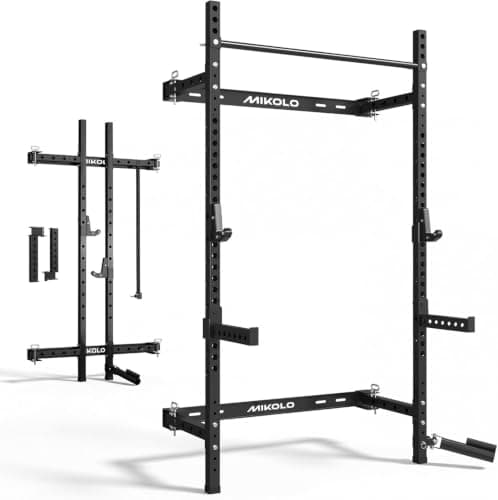
| 01 | Mikolo Folding Wall-Mounted Squat RackThe small-space rack answer: it bolts to your studs and folds flat against the wall when you're done, giving the whole floor back. 1,000 lb rated with safeties, a pull-up bar and J-hooks — a real rack that disappears. | Reclaiming the floor completely | | $264.92·Amazon |
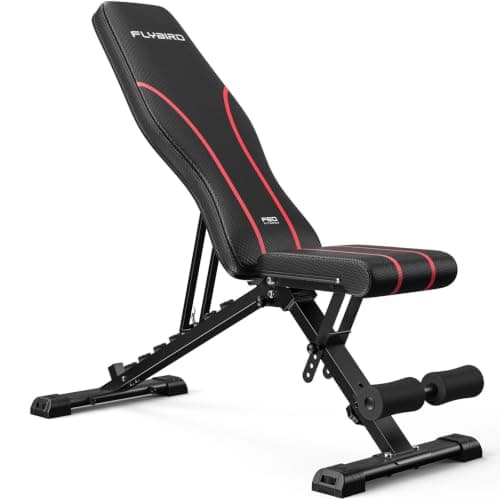
| 02 | FLYBIRD WB2 Adjustable Weight BenchThe internet's default adjustable bench, and rightly so: it folds flat to store against a wall, tilts from decline through steep incline, and costs about a hundred dollars. For a compact setup it's the obvious bench. | Most small home gyms | | $109.98·Amazon |
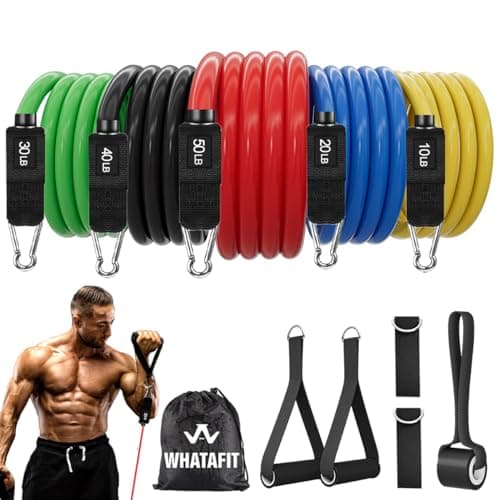
| 03 | WHATAFIT Resistance Bands Set (150 lb stacked)Five natural-latex tubes rated 10, 20, 30, 40 and 50 lb that stack to a claimed 150 lb, with a door anchor that turns any door frame into a cable column. The whole kit weighs two pounds and lives in a drawer — nothing else on this site does that. | The most resistance per cubic inch | | $22.07·Amazon |
#ad · Live prices from the Amazon Product API, as of October 25, 2026. Where we have no verified live price, we show none — we would rather leave a gap than print a number that has rotted.
In detail
The picks, in full
Reclaiming the floor completely
Mikolo Folding Wall-Mounted Squat Rack
Folds flat to wall1,000 lb rated2×2 uprightsPull-up bar
The small-space rack answer: it bolts to your studs and folds flat against the wall when you're done, giving the whole floor back. 1,000 lb rated with safeties, a pull-up bar and J-hooks — a real rack that disappears.
Good
- +Folds flat — the floor is fully usable between sessions
- +1,000 lb rating is real rack territory, not a stand
- +Comes with safeties and a pull-up bar
Trade-offs
- −Must bolt into studs — not for renters who can't drill
- −Fixed to one wall location
- Fit
- 10
- Value
- 8
- Install
- 5
- Build
- 9
Skip this if…
…you can't drill into the wall, or your studs aren't where you need the rack — a freestanding stand is your path instead.
Spec sheet
- Type
- Folding wall-mounted rack
- Folded depth
- Folds flat to the wall
- Rated load
- 1,000 lb (per listing)
- Install / renter
- Wall-anchor (studs) — landlord OK needed
- Ceiling needed
- Not published — clears a pull-up bar
- Includes
- Safeties, J-hooks, pull-up bar, landmine
Most small home gyms
FLYBIRD WB2 Adjustable Weight Bench
Folds flatMulti-angle incline~600 lb rated~Under $110
The internet's default adjustable bench, and rightly so: it folds flat to store against a wall, tilts from decline through steep incline, and costs about a hundred dollars. For a compact setup it's the obvious bench.
Good
- +Folds flat for genuine wall storage
- +Wide angle range for the money
- +Light enough to reposition one-handed
Trade-offs
- −Pad is firm and a little short for tall lifters
- −Not a commercial-grade heavy bench
- Fit
- 9
- Value
- 9
- Install
- 10
- Build
- 7
Skip this if…
…you press very heavy and want a wide, ultra-stable commercial pad — this trades some heft for foldability.
Spec sheet
- Type
- Adjustable incline bench
- Folds
- Flat — stands against a wall
- Angles
- Decline through steep incline
- Rated load
- ~600 lb (per listing)
- Install / renter
- Freestanding — zero install
- Unit weight
- Light — one-hand to move
The most resistance per cubic inch
WHATAFIT Resistance Bands Set (150 lb stacked)
5 bands, 10–50 lb150 lb stackedDoor anchor incl.2 lb total
Five natural-latex tubes rated 10, 20, 30, 40 and 50 lb that stack to a claimed 150 lb, with a door anchor that turns any door frame into a cable column. The whole kit weighs two pounds and lives in a drawer — nothing else on this site does that.
Good
- +150 lb of stacked resistance from something that fits in a drawer
- +Door anchor gives horizontal pulls and pulldowns without a cable machine
- +The only strength kit here that travels in hand luggage
Trade-offs
- −Band tension is not linear — the load changes through the range
- −Latex degrades over years; check for surface cracking before heavy use
- Fit
- 10
- Value
- 9
- Install
- 10
- Build
- 7
Skip this if…
…you want to train a measured, progressive barbell program — band poundage is a rating, not a calibrated weight, and you cannot log it the same way.
Spec sheet
- Bands
- 5 tubes rated 10 / 20 / 30 / 40 / 50 lb
- Stacked resistance
- Up to 150 lb (per listing)
- Material
- Natural latex, steel carabiners
- Included
- 2 handles, 2 ankle straps, door anchor, pouch, guide
- Kit weight
- 2 lb
- Install / renter
- Door anchor — no drilling, no marks
- Noise / floor
- Silent — nothing touches the floor
6. The corner gym — about 16 sq ft, permanent
A freestanding squat stand or compact power rack in a corner, with a bench that folds and dumbbells on a shelf. Nothing is drilled, so it works for renters, but the rack owns its corner permanently. This is the most common real small-space gym and the one most people end up with. Our compact power rack roundup covers the frames that fit.
7. The alcove gym — a recess you already have
Most flats and older houses have a chimney breast alcove, a dormer recess or a landing nook that is dead space. Those recesses are frequently 30 to 40 inches wide, which is enough for a folding wall rack or a bench on end, and they take equipment out of the visual line of the room without taking usable floor.
Measure the depth as well as the width. Anything shallower than about 18 inches is storage rather than a training station.
8. The room-divider gym — an existing piece of furniture
In a studio, a bookshelf or a wardrobe already divides the space. Putting the gym behind that divider means the training area does not have to look like a gym from the sofa. It costs no extra floor because the divider is already there, and it makes the difference between equipment reading as clutter and equipment reading as a separate zone.
Our studio apartment guide plans this in detail.
9. The garage corner — 30 to 50 sq ft, temporary daily
A single bay of a garage that still has to hold a car by evening. Wall-mounted folding rack on the end wall, mats that lift, everything else on shelves. The constraints are different from an apartment — you can drill and you can make noise, but nothing can stay on the floor. See the garage corner guide.
How to choose between them
Work through these three questions in order and stop at the first hard no.
- Can you drill into structure? If yes, the wall gym is the best capability-per-square-foot layout available and you should start there. If no, skip to the freestanding layouts.
- Does the floor have to be clear when you are not training? If yes, you need the drawer, closet, under-bed or wall layouts. If no, the corner gym gives you more for the money.
- What is your ceiling? Under about 7 ft 6 in rules out a cage and a full-height power tower. See squat racks for low ceilings.
The two mistakes that ruin small-space gyms
Buying before measuring. Almost every returned piece of home gym equipment is a dimension problem, not a quality problem. Measure the floor, the ceiling, and the doorway the box has to come through. Our space requirements guide lists what each category needs.
Building something that has to be set up. A gym that takes ten minutes to assemble gets used on the days you already felt like training. A gym that takes ten seconds gets used on the days you did not. That is the entire argument for folding and wall-mounted equipment over the cheaper alternatives, and it is worth more than any specification.
Making it look like a room, not a gym
Three things do most of the work, none of them expensive. Mats in a color close to the floor rather than black. Storage that puts steel vertically on a wall instead of horizontally on the floor — see small-space weight storage. And a mirror, which doubles as training feedback and stops the room reading as a corner of stuff: our renter-friendly mirror guide covers no-drill options.
How we picked
We don't run a testing lab
We compiled published specifications, manufacturer documentation and aggregated owner reviews, then scored each product against a published rubric that weights fit-for-small-space, value, install reversibility and build. The scores are judgments from documented research — they are notmeasurements we took, because we don't have a lab and we're not going to pretend we do. Every dimension is cited in Sources.
Questions
Frequently asked
How do you fit a home gym in a small space?+
Pick the layout by the constraint you cannot change, then buy to it. If the floor must stay clear, build on a wall with a folding rack and wall storage. If you cannot drill, build around freestanding gear that folds. If you have almost no room at all, a drawer gym — bands, a doorway bar, an ab roller — covers every movement pattern with zero footprint.
What is the smallest space you can have a home gym in?+
About thirty square feet gives you a complete dumbbell-and-bench gym. Below that, a drawer gym still works — bands, a doorway pull-up bar and an ab roller need only enough floor to lie down on, which is roughly 6 by 3 feet, and none of it stays out.
How do you make a home gym not look like a gym?+
Three cheap changes do most of it: choose mats in a color close to your floor rather than black, store weights vertically on a wall instead of horizontally on the floor, and add a mirror so the corner reads as a considered zone rather than a pile of equipment. Folding gear that disappears between sessions does the rest.
Can you build a home gym in a bedroom?+
Yes, and it is the most common small-space setup there is. The workable versions are the closet gym, the under-bed gym and the corner gym — all three keep the room usable as a bedroom. Check ceiling height before buying anything with a pull-up bar, and put mats down before the first session.
Receipts
Sources
We don't run a testing lab, and we don't pretend to. Every dimension and rating traces to a manufacturer spec sheet or manual, named and linked above. Where a maker doesn't publish a number, the spec reads "Not published" rather than a guess. Read our full method.