Skip to content
RACK:RATIO

HUB 06 · Small-Space Gym Guides

The Basement Home Gym

A slab floor means nobody below you hears anything — the one constraint every other room in the house fails. What a basement charges for that is headroom, and it charges in inches.

By Stephen V.Reviewed How we research
#ad

We earn a commission when you buy through our Amazon links, at no extra cost to you. It never changes our rankings, and we say so when the cheaper product is the better buy. How this works.

A basement is the best room in a house for a home gym, and it is not close. The floor is a concrete slab, so nothing you do transmits into somebody else's ceiling — which is the constraint that quietly rules out half the equipment in every other room we write about. In exchange it takes headroom, it is damp, and everything has to come down a staircase. Those three are the whole brief.

This completes our room series. A bedroom is upstairs over somebody and carpeted. A living room has to be invisible by the evening. A garage corner shares a slab with a car. A closetis storage you are converting. A basement is the only one of them where the floor is not somebody else's problem — and the only one where the ceiling is not really a ceiling.

Measure to the lowest thing, not to the ceiling

In a finished room the ceiling is a plane. In a basement it is the underside of the floor above with services hanging from it: ducts, waste pipes, water lines, junction boxes, sometimes a beam. The number that matters is the clear height at the spot you will train, measured to the lowest obstruction over that spot — and in most basements that is six to twelve inches less than the height you would quote if someone asked.

Take the measurement standing where you would lift, not in the middle of the room, and take it again with your arms overhead. Our ceiling height guide has the clearance each movement needs; the three that fail first in a basement are an overhead press, a pull-up and anything on an elliptical, where the pedal puts your head a foot higher than your own height. If a duct runs through the only clear corner, the honest answer is to train in the next corner rather than to buy shorter equipment.

The basement test: stand where the rack would go, hold a broom overhead at arm extension, and walk two steps in each direction. Whatever you touch is the real ceiling, and it is the number every purchase on this page has to clear.

The slab: the advantage, and its one catch

Concrete on grade is the best gym floor available in a house. It does not deflect, it does not transmit impact into a room below because there is no room below, and it will hold any load a home gym can produce. That is why a basement is the one small-space room where we do not spend the whole page talking you out of a barbell — the questions that dominate the apartment floor-load guide and the apartment noise guide simply do not arise.

The catch is that concrete is unforgiving in the other direction: it is hard on dropped plates, hard on bar ends, hard on knees, and cold. It also telegraphs sound upward through the open joists rather than downward, so the room above your basement hears more than you would expect. A layer on the floor fixes most of that, which is why the flooring pick below is first rather than last.

Damp is the constraint nobody plans for

Basements are the most humid rooms in most houses, and a slab wicks moisture up through itself even when it looks bone dry. Three practical consequences for gym equipment, all of them avoidable:

  • Bare steel rusts. Barbell knurling and plate edges are the first to go. Chrome and powder coat hold up far better than bare or black-oxide steel in a humid room, which is a reason to read the finish line on a listing rather than skip it.
  • Foam and fabric hold what the air gives them. Bench upholstery, band handles and anything with a strap stay damp longer down here. Store them off the floor rather than on it.
  • Closed-cell flooring beats open foam. A tile that does not absorb is worth more in a basement than a thicker one that does, and a layer that lifts apart is worth more than one that bonds down, because you will want to look underneath at some point.

Nothing in our registry publishes a humidity rating, so we are not going to pretend to rank for damp. What we can point to is format: interlocking tiles come apart, dry out and go back down, where a bonded roll does not. Our rubber flooring guide compares the formats in detail.

The staircase decides what you can own

This is the constraint that surprises people after they have ordered. Basement stairs are frequently narrow, often turn, and sometimes have a low soffit over the bottom steps. Measure the narrowest point and the turn, then compare them against the longest rigid member of anything you are buying — a 7 ft barbell and a power cage upright are the two that fail most often.

Two ways around it. Buy flat-pack and assemble in the room: a power cage arrives as a box of 2 x 2 in tubes that any staircase takes, and that is a genuine argument for a cage over a pre-welded frame down here. And buy flooring in tile format rather than rolls — a 24 by 24 in tile goes down a spiral staircase one at a time, where a 4 by 10 ft roll does not. Our how to move a home gym guide covers the same arithmetic in reverse, for the day you leave.

What a basement lets you own that an apartment does not

A full four-post power cage, which needs ceiling clearance for its pull-up bar and a permanent footprint — both of which a basement is more likely to have than any room upstairs. A ceiling-mounted pull-up bar, because the joists are exposed and you can see exactly what you are bolting to, rather than guessing behind drywall. Heavier plates, because the slab does not care. And a bench that stays set up, because the room does not have to become something else at six o'clock.

What it still does not let you own: anything taller than your clear height. Measure first, buy second. The four picks below are chosen for this room specifically — tile flooring that goes down a staircase, a flat-pack cage, a joist-mounted bar that publishes its drop, and a bench that folds if the room turns out to be tighter than you thought.

The short answer

Quick picks

#ProductBest forScorePrice
01
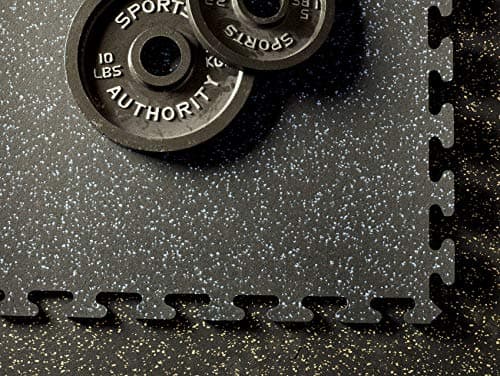
American Floor Mats American Floor Mats Fit-Lock 3/8" Interlocking Rubber Tiles (4 x 6 ft set)
American Floor Mats Fit-Lock 3/8" Interlocking Rubber Tiles (4 x 6 ft set)

The thickest true rubber on this page at 3/8 in, and the only one that arrives as six 2 ft square pieces of 4 sq ft each — which is how you get rubber flooring into an upstairs apartment without a second person or a freight elevator. Interlocking, no adhesive, with border and corner tiles for a finished edge, and you can buy more later to grow the area.

Stairs, doorways and moving out
8.5
$128.60Amazon
02
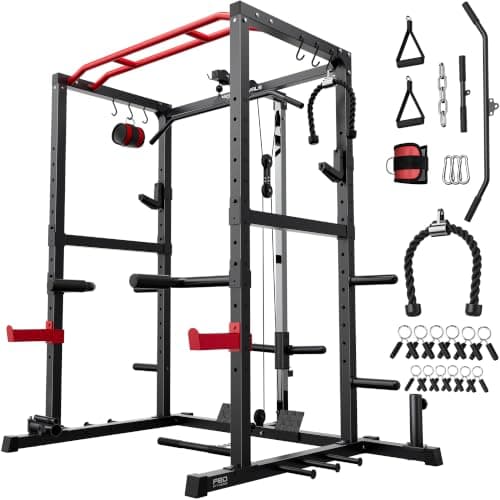
SPORTSROYALS SPORTSROYALS Squat Rack Power Cage with Lat Pulldown
SPORTSROYALS Squat Rack Power Cage with Lat Pulldown

A 1,200 lb-rated cage with a lat pulldown and low-row attachment built in, so one footprint covers squats, presses, pull-ups and cable back work. If you can commit a permanent square of floor, this is the most gym per square foot here.

Most capability per square foot
8.3
$309.99Amazon
03
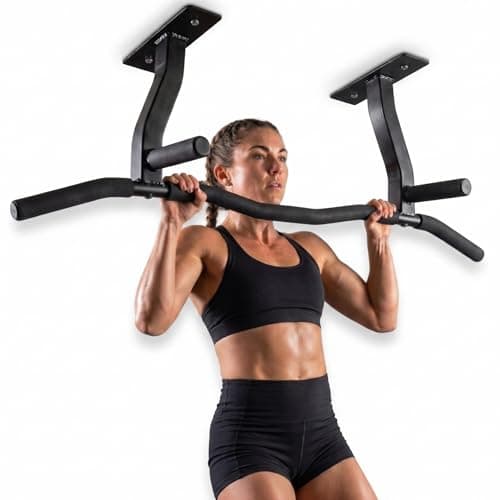
Ultimate Body Press Ultimate Body Press Ceiling Mount Pull-Up Bar (CMP)
Ultimate Body Press Ceiling Mount Pull-Up Bar (CMP)

The shortest drop here at 14 in, which is exactly what a standard 8 ft ceiling can spare — it puts the bar near 6 ft 10 in, high enough to hang with bent knees and low enough that you are not brushing the joists. Its risers flip to fit 16 in or 24 in joists, so you do not have to know your ceiling's framing before you order. The catch is a 300 lb rating, the lowest on this page.

A standard 8 ft ceiling
8.3
$95.23Amazon
04
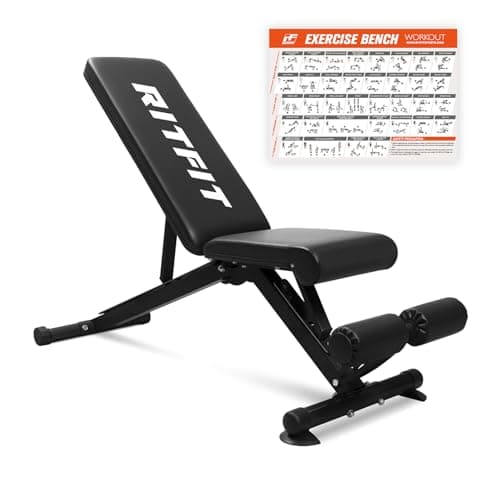
RitFit RitFit Adjustable Folding Bench
RitFit Adjustable Folding Bench

A close competitor to the FLYBIRD at a similar price: folds for storage, adjusts through incline, and adds a slightly sturdier feel. If the FLYBIRD is out of stock, this is the swap.

Value adjustable alternative
8.3
$136.99Amazon

#ad · Live prices from the Amazon Product API, as of October 25, 2026. Where we have no verified live price, we show none — we would rather leave a gap than print a number that has rotted.

In detail

The picks, in full

01
American Floor Mats American Floor Mats Fit-Lock 3/8" Interlocking Rubber Tiles (4 x 6 ft set)

Stairs, doorways and moving out

American Floor Mats Fit-Lock 3/8" Interlocking Rubber Tiles (4 x 6 ft set)

3/8" thick6 tiles, 24 sq ft24" x 24" eachNo adhesive
8.5/10

The thickest true rubber on this page at 3/8 in, and the only one that arrives as six 2 ft square pieces of 4 sq ft each — which is how you get rubber flooring into an upstairs apartment without a second person or a freight elevator. Interlocking, no adhesive, with border and corner tiles for a finished edge, and you can buy more later to grow the area.

Good

  • 3/8 in of rubber, in pieces one person can carry up a staircase
  • Comes apart at move-out and goes back together in the next place
  • Border and corner tiles give a finished edge instead of a raw cut line

Trade-offs

  • American Floor Mats does not publish a per-tile weight, which is the number an upstairs buyer needs
  • Interlocking seams can creep under a machine that vibrates, unlike a single-piece mat
  • 3/8 in is still not a platform — it protects floors, it does not absorb a dropped bar
Fit
9
Value
8
Install
8
Build
9

Skip this if…

…the area sits under a treadmill or a rower — a vibrating machine works tile seams apart over months, and a single-piece mat is the better base for anything with a motor.

Spec sheet

Format
Interlocking tiles — 24" x 24", 4 sq ft each
Coverage
4 ft x 6 ft set (6 tiles, 24 sq ft)
Thickness
3/8" (9.5 mm) — thickest here
Set contents
4 corner tiles, 2 border tiles (per listing)
Per-tile weight
Not published — assume a two-hand lift per tile
Adhesive
None — the interlock holds it
Expandable
Yes, buy more tiles to grow the area
Install / renter
Lifts apart into pieces; nothing bonds to the floor
$128.60View on Amazon

Price as of October 25, 2026. Prices change — Amazon's is the one that counts.

#ad · we may earn a commission from this link to American Floor Mats Fit-Lock 3/8" Interlocking Rubber Tiles (4 x 6 ft set)

02
SPORTSROYALS SPORTSROYALS Squat Rack Power Cage with Lat Pulldown

Most capability per square foot

SPORTSROYALS Squat Rack Power Cage with Lat Pulldown

1,200 lb ratedLat pulldown incl.Four-post cagePlate-loaded
8.3/10

A 1,200 lb-rated cage with a lat pulldown and low-row attachment built in, so one footprint covers squats, presses, pull-ups and cable back work. If you can commit a permanent square of floor, this is the most gym per square foot here.

Good

  • Cage safety plus cable work in one unit
  • 1,200 lb rating is well beyond home loads
  • No drilling despite being a full cage

Trade-offs

  • Owns its floor permanently — no fold
  • Needs real ceiling height for the pull-up bar
Fit
6
Value
9
Install
9
Build
9

Skip this if…

…you need the floor back between sessions — a folding wall rack reclaims the space this one keeps for good.

Spec sheet

Type
Freestanding power cage + lat tower
Folded depth
Does not fold — permanent footprint
Rated load
1,200 lb (per listing)
Install / renter
Freestanding — no drilling
Ceiling needed
Tall — cage uprights + pull-up bar
Cable stack
Plate-loaded lat pulldown / low row
$309.99View on Amazon

$389.9921% off

Price as of October 25, 2026. Prices change — Amazon's is the one that counts.

#ad · we may earn a commission from this link to SPORTSROYALS Squat Rack Power Cage with Lat Pulldown

03
Ultimate Body Press Ultimate Body Press Ceiling Mount Pull-Up Bar (CMP)

A standard 8 ft ceiling

Ultimate Body Press Ceiling Mount Pull-Up Bar (CMP)

14" drop16" & 24" joists300 lb rated20" parallel grips
8.3/10

The shortest drop here at 14 in, which is exactly what a standard 8 ft ceiling can spare — it puts the bar near 6 ft 10 in, high enough to hang with bent knees and low enough that you are not brushing the joists. Its risers flip to fit 16 in or 24 in joists, so you do not have to know your ceiling's framing before you order. The catch is a 300 lb rating, the lowest on this page.

Good

  • 14 in drop is the shortest here, and it is what an 8 ft ceiling can actually give up
  • Reversible risers cover 16 in and 24 in joists, so either framing works
  • Ships with a printed mounting template and all the hardware

Trade-offs

  • 300 lb rating is the lowest on this page — a weight belt eats that headroom quickly
  • 42 in bar is six inches narrower than the wall bars, so the widest grip is narrower too
  • A ceiling install is the least reversible thing on this page
Fit
9
Value
9
Install
7
Build
8

Skip this if…

…you already train weighted pull-ups — 300 lb published is you plus the belt plus whatever you hang on it, and the makers with 500 to 850 lb ratings cost barely more.

Spec sheet

Type
Ceiling / joist-mounted bar, reversible risers
Bar width
42" (per listing)
Drop
14" below the joist (Ultimate Body Press)
Joist spacing
Risers flip to fit 16" and 24" joists on center
Rated load
300 lb (maker does not say whether that includes added weight)
Grips
4 angled positions, 20" parallel spacing, high-density foam
Material
All steel, powder-coated
Weight
11.2 lb item (listing); 15 lb shipping (maker)
Included
Bar, parallel grips, mounting template, all hardware
Install / renter
Lag-bolts up into joists — permanent holes in a ceiling
$95.23View on Amazon

Price as of October 25, 2026. Prices change — Amazon's is the one that counts.

#ad · we may earn a commission from this link to Ultimate Body Press Ceiling Mount Pull-Up Bar (CMP)

04
RitFit RitFit Adjustable Folding Bench

Value adjustable alternative

RitFit Adjustable Folding Bench

FoldsAdjustable inclineSturdy frameValue
8.3/10

A close competitor to the FLYBIRD at a similar price: folds for storage, adjusts through incline, and adds a slightly sturdier feel. If the FLYBIRD is out of stock, this is the swap.

Good

  • Sturdy feel for the price
  • Folds for wall storage
  • Good incline range

Trade-offs

  • Pad firmness is polarizing
  • Fewer sold — less owner feedback than FLYBIRD
Fit
8
Value
8
Install
10
Build
7

Skip this if…

…you want the most-reviewed option with the deepest owner track record — that's the FLYBIRD here.

Spec sheet

Type
Adjustable folding bench
Folds
Yes — for storage
Angles
Flat through incline
Rated load
Not published
Install / renter
Freestanding — zero install
Unit weight
Light-to-medium
$136.99View on Amazon

Price as of October 25, 2026. Prices change — Amazon's is the one that counts.

#ad · we may earn a commission from this link to RitFit Adjustable Folding Bench

The four measurements, in order

  1. Clear height at the training spot, to the lowest service. Duct, pipe, beam, light. This rules equipment in or out before anything else.
  2. Joist direction and spacing, if a ceiling bar is in the plan. The bar we rank publishes a 14 in drop below the joist and reversible risers for 16 and 24 in spacing — subtract the drop from your clear height before you commit.
  3. The staircase: narrowest width, and the turn. Against the longest rigid member of everything on your list.
  4. Floor area, taped out. A cage plus walk-around is a bigger rectangle than the cage, and basements are full of posts and bulkheads that are not on your mental floor plan.

A ceiling bar is the basement-specific win

Nowhere else in a house can you see your own joists. That makes a ceiling-mounted pull-up bar both easier to install correctly and easier to verify, which is why it is the one piece on this page we would choose over its wall-mounted equivalent. The trade-off is honest and worth stating: it is a permanent set of lag bolts up into structure, and the drop figure — 14 inches on the bar we rank — comes straight off your clear height. In a basement with 7 ft to the joists, that leaves 5 ft 10 in under the bar, which is enough to hang from with bent knees and not enough to do a strict dead hang if you are tall. Measure, then decide. Our mounted pull-up bar ranking covers both mounting styles.

Noise still matters, just upward

You will not disturb anyone below, but open joists carry sound into the room directly above remarkably well — a dropped plate in a basement is clearly audible in the kitchen. If someone is upstairs while you train, the fixes are the same ones we recommend to apartment dwellers for different reasons: a dense layer under the lifting zone, set weights down rather than release them, and keep the heaviest work away from directly under a living space. Our soundproofing guide has the full set, and most of it applies in reverse down here.

Lighting, outlets and the things that are not gear

Three non-equipment notes that come up every time. Basement lighting is usually a single fixture in the wrong place, and a gym needs light where you train rather than where the builder put a box. Outlets are often few and on one circuit, which matters if you add a treadmill later. And if there is only one way out of the room, do not block it with a cage — this sounds obvious and is the most common layout mistake in a basement gym.
How we picked

We don't run a testing lab

We compiled published specifications, manufacturer documentation and aggregated owner reviews, then scored each product against a published rubric that weights fit-for-small-space, value, install reversibility and build. The scores are judgments from documented research — they are notmeasurements we took, because we don't have a lab and we're not going to pretend we do. Every dimension is cited in Sources.

Questions

Frequently asked

Is a basement a good place for a home gym?
Structurally it is the best room in the house. The floor is a concrete slab, so there is no room below to disturb and no floor-load question to answer, which means a barbell, a cage and heavy plates are all genuinely on the table. The costs are headroom, humidity and a staircase that limits what you can get down there.
What ceiling height do you need for a basement gym?
Measure the clear height at the spot you will train, to the lowest duct or pipe over it — not to the ceiling plane. For overhead pressing you need your standing reach plus the bar; for a ceiling-mounted pull-up bar, subtract the bar's published drop (14 in on the one we rank) from that clear height. Our ceiling height guide lists the clearance each movement needs.
Can you put gym equipment on a concrete basement floor?
Yes, and the slab will hold anything a home gym produces. Put a layer down anyway: concrete is hard on dropped plates and bar ends, cold underfoot, and it sends sound up through open joists into the room above. Interlocking rubber tiles are the format we would choose down here because they come apart to dry and go down a narrow staircase one at a time.
Will a damp basement rust my equipment?
It can, and bare steel goes first — barbell knurling and plate edges especially. Chrome and powder-coated finishes hold up much better, so read the finish line on the listing. Keep upholstery, straps and band handles off the floor, and prefer flooring that lifts apart over anything bonded down. No maker in our registry publishes a humidity rating, so we rank on format rather than pretending otherwise.
What if my basement equipment will not fit down the stairs?
Buy flat-pack and assemble in the room. A power cage arrives as a box of 2 x 2 in tubes that any staircase takes, which is a real argument for a cage over a welded frame in a basement. The two things that most often fail are a 7 ft barbell and a pre-assembled frame; for the bar, a 5 or 6 ft Olympic bar is the usual answer and our barbell guide has both.
Is a basement gym quieter than an apartment gym?
For anyone below you, yes — there is nobody below you. For the room directly above, not especially: open joists carry a dropped plate into the kitchen clearly. The fixes are the apartment ones applied upward: a dense layer under the lifting zone, set weights down rather than dropping them, and do not put the heaviest work directly under a living room.
Do I need to finish the basement first?
No, and an unfinished basement is arguably the better gym: you can see the joists you are bolting to, there is no drywall to damage, and nobody minds what it looks like. Deal with water before equipment if there is any sign of it, and get the lighting sorted — those two matter more than finishes.

Keep reading

Receipts

Sources

We don't run a testing lab, and we don't pretend to. Every dimension and rating traces to a manufacturer spec sheet or manual, named and linked above. Where a maker doesn't publish a number, the spec reads "Not published" rather than a guess. Read our full method.