If you can drill into studs, buy the wall-mounted rack — the Mikolo folding wall rack is the pick, at a published 1,000 lb rating with safeties, J-hooks and a pull-up bar, and it folds flat so the floor is completely yours between sessions. If you cannot drill, the PASYOU SR30Pro is the rack to buy: two independent freestanding uprights, zero install, a published 2,400 lb total rating, and a 36 by 43 inch setup footprint you can break down and move. If you own the room and want cables in the same footprint, the SPORTSROYALS cage with its lat pulldown is the most capability per square foot here — and it never folds.
We rank these separately: the wall-mounted racks, the folding racks and the freestanding power racks. This page is the question that comes before all of them, and it is not really about strength. Both formats are rated far beyond what a home lifter will load. It is about what you are allowed to do to the building and what you are willing to give up on the floor.
The wall rack trades a hole for the floor
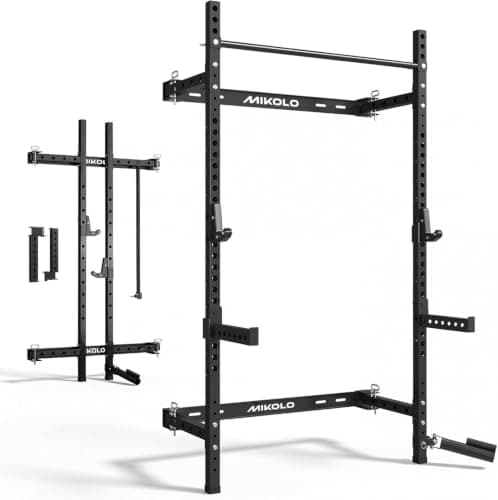
A folding wall-mounted rack bolts through your drywall into the studs, and the uprights swing in flat against the wall when you are done. The gain is total: the floor comes back, not partly but entirely, and in a room that also has to be a bedroom or a living room that is the difference between a gym you keep and a gym you resent. The Mikolo publishes a 1,000 lb rating and ships with safeties, J-hooks, a pull-up bar and a landmine, which is real rack capability rather than a stand with ambitions.
The cost is the install, and it is not negotiable. You need studs where you want the rack — not near it, at it — a stud finder you trust, and in a rental, written permission. Our installation guide walks the sequence, and are wall-mounted squat racks safe answers the question people are too polite to ask. If your studs land in the wrong place, the wall rack is simply not available to you and no amount of hardware fixes it.
The freestanding rack trades the floor for permission
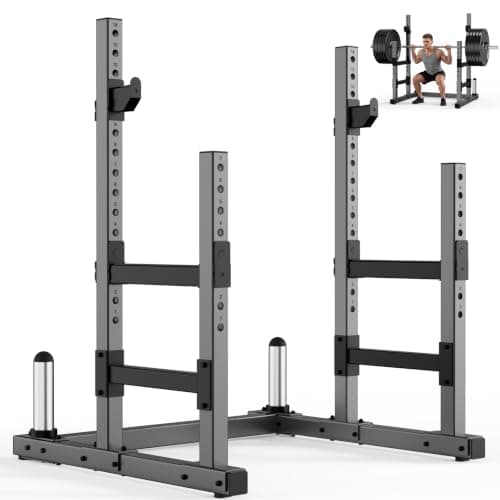
A freestanding rack asks nothing of the building. The PASYOU is a pair of uprights you set to any width, and its published setup footprint is 36 by 43 inches — about 10.8 square feet — on a 63 lb pair you can move or store apart. No drilling, no landlord, no patching when you leave. For a renter who cannot put a hole in anything, this is the whole category.
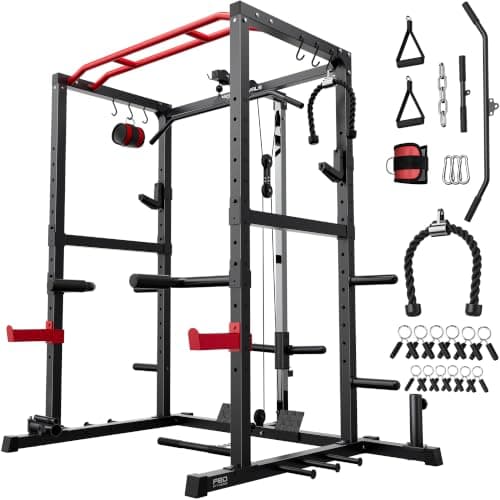
What you give up is the fold. A freestanding stand can be moved but it does not disappear, and a four-post cage like the SPORTSROYALS does not even move — it owns its square of floor permanently, in exchange for catch bars on all four sides and a plate-loaded lat pulldown and low row in the same footprint. That is a genuinely good trade in a garage corner and a bad one in a studio apartment.
The decision in two questions. One: can you drill into studs where the rack needs to go, with permission? If no, the answer is freestanding and the rest of this page is background. Two: if yes, is the room shared with another function? If it is, the wall rack wins on the fold alone. If it is not, buy the cage — you will use the cables.
How the four compare
| Rack | Install | Stored | Published rating | Pull-up bar | Cables |
|---|
| Mikolo folding wall rack | Bolts into studs | Folds flat to the wall | 1,000 lb | Yes | No (landmine included) |
| PASYOU SR30Pro stand | None — freestanding | Uprights move or store apart | 2,400 lb total; 1,800 lb lower bars, 600 lb J-hooks | No | No |
| SPORTSROYALS power cage | None — freestanding | Does not fold; permanent footprint | 1,200 lb | Yes | Plate-loaded lat pulldown and low row |
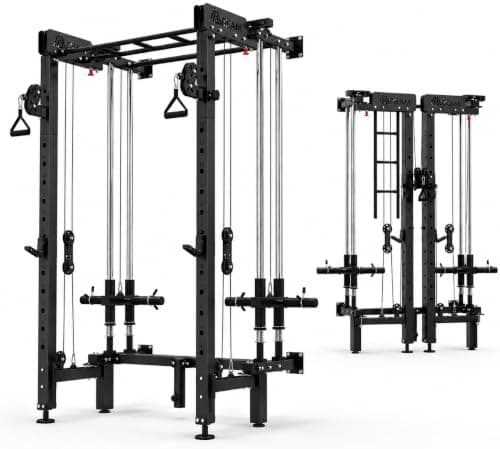
| Mdeam folding wall rack | Bolts into studs | Folds flat to the wall | Not published | Yes | Dual pulley, plate-loaded |
Two honest notes on that table. The highest number in it belongs to a freestanding stand, not to a bolted rack — and it is a total rating split across components, with 600 lb of it on the J-hooks, which is the number that actually matters when a bar is in them. And the only rack here that publishes no rating at all is the one that also carries a cable pulley; our wall rack capacity guide explains why a missing figure is not a reason to assume a high one.
Stability, honestly
A bolted rack is the most stable thing in this comparison, because the wall is doing the work. A four-post cage is next: heavy, wide-based, and with catch bars that will hold a failed rep. A pair of freestanding uprights is last — they are perfectly usable and millions of people train on them, but they are less forgiving when something goes wrong, and nothing joins them overhead. Our power rack versus squat stand page covers that fork within the freestanding category.
If you train alone and load heavy, that ordering should carry more weight than the fold. If you train alone and load moderately, the fold is probably worth more to you than the last increment of stability, and the honest answer for a lot of apartments is that neither rack gets used if it is in the way.
The ceiling, which decides this for some rooms
Both wall racks and the cage here carry a pull-up bar, which means you need headroom not just for the rack but for a hanging body and a pressing bar. The PASYOU is 58 inches tall with no overhead bar at all, which makes it the format for low ceilings — and that is not a small point in a basement or under a sloped roof. Our low-ceiling rack guide and the ceiling height guide have the arithmetic for pressing and pull-ups respectively.
Buy the wall-mounted rack if…
- You own the place, or you have written permission to drill into studs.
- Your studs are where the rack needs to be. Find them before you order, not after.
- The room has another job and you need the floor back every day.
- You want a published four-figure rating in a format that disappears — the Mikolo is the only rack here that offers both.
Buy the freestanding rack if…
- You rent and cannot drill, or you would rather not explain a hole to anyone. This is the most common reason, and it is a complete reason.
- You might move. A rack that unbolts into a pair of uprights travels; a wall rack leaves four holes behind.
- Your ceiling is low and a pull-up bar was never going to clear anyway.
- You want cables and catch bars and can commit the floor — the cage is the most gym per square foot on this page.
The renter's third option
Neither. A freestanding rack is renter-safe but it is still a large permanent object, and for a lot of small apartments the honest build is adjustable dumbbells, a folding bench and a no-drill doorway pull-up bar, with no rack at all. We argue that case properly in do you need a squat rack at home and in renter-friendly home gym ideas. A rack you cannot set up is worth less than a dumbbell you can.
If you want cables either way
Both formats have a cable option, and they are different products rather than different trim levels. On the wall side, the Mdeam folds flat and carries a dual pulley — rack and cable station in one unit that disappears, with the caveat that its rated load is not published. On the freestanding side, the SPORTSROYALS cage gives you a plate-loaded lat pulldown and low row with a published 1,200 lb rating and no fold at all. Our folding racks with cables ranking covers that sub-category, and wall-mounted cable machines covers the case where you want the cables without the rack.
What we did not test
Any of it. Every rating, dimension and inclusion on this page is the maker's published figure, and where a maker publishes nothing we print "not published" rather than an estimate. We have not pull-tested an anchor, loaded a J-hook to failure or measured a deflection — our methodology page is explicit about what our scores are derived from.