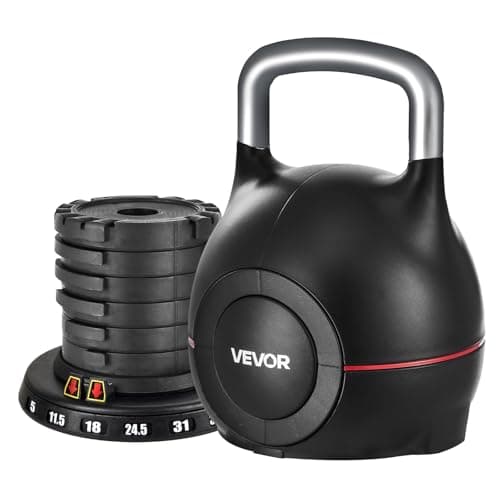
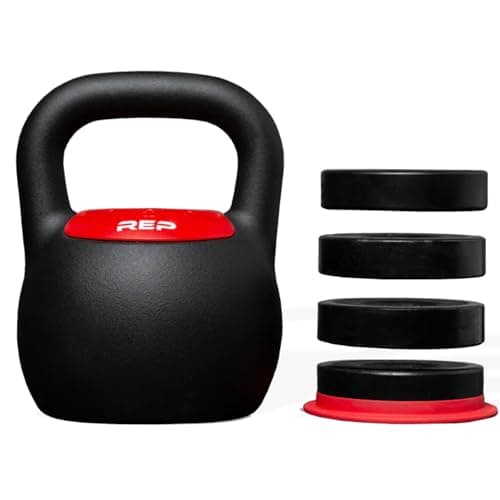
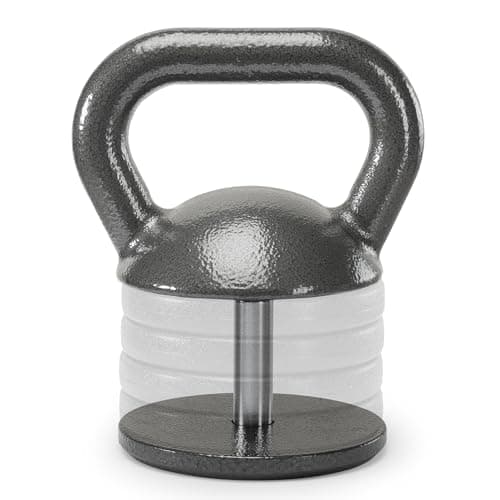
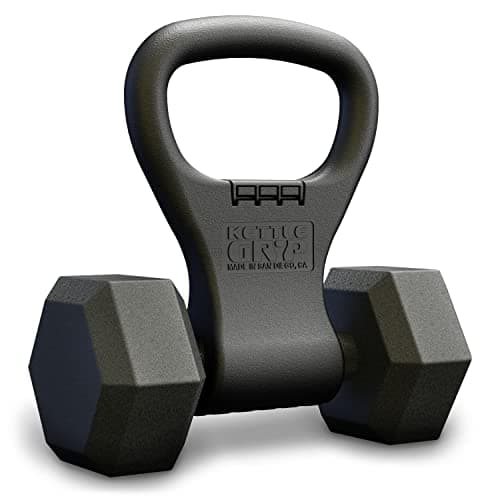
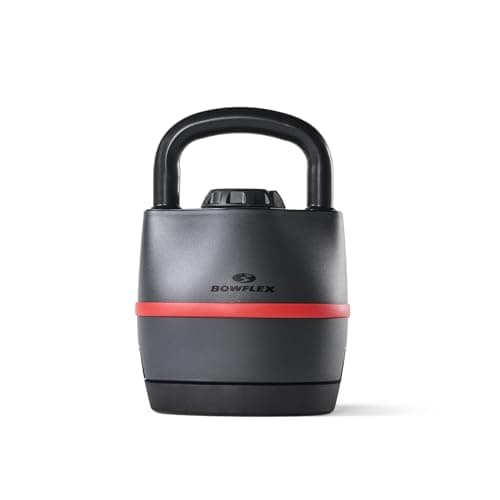
The BowFlex SelectTech 840 is our pick, because it does the thing an adjustable kettlebell exists to do in the smallest object here: six settings from 8 to 40 lb, changed with a dial while the bell is still on the floor, in a box 8.8 by 7 by 12.5 inches. The VEVOR K002 is the range pick, covering 5 lb to 44 lb in seven steps for less money; the REP 40 lb is the one with no gap anywhere in its ladder; the Apex handle is the cheapest route to a 50 lb bell if you already own 1-inch plates; and the Kettle Gryp is the only pick that takes up no shelf space at all, because it clamps around a dumbbell you already have.
This is a different page from our best kettlebells for small spaces roundup, and the split matters. That page ranks single-piece cast iron bells — one casting, one weight, nothing to fail — and for a lot of apartments one 35 lb bell on the floor is the right answer. The bells below trade that simplicity for a range, and they all pay for it in one of three currencies: a mechanism that can break, a gap in the weight ladder, or a stack of plates you have to own already. If you are still deciding between bells and dumbbells at all, start with kettlebell versus dumbbells.
The number on the box is not the number that matters
Every listing in this category leads with the same claim: replaces 6 kettlebells, 7 kettlebells in 1, 5 bells in one. That is a shelf-space claim, and it is usually true. It tells you nothing about whether the bell is usable, because what decides that is the list of settings and the gaps between them.
The BowFlex 840 is the clean example. Its six settings are 8, 12, 20, 25, 35 and 40 lb. That is a genuinely wide range in a very small object — and there is a 10 lb hole between 25 and 35 with nothing in it. If 30 lb is your working weight for swings, that bell has no setting for you. The REP bell has a narrower range and no hole anywhere: 20, 25, 30, 35, 40. Neither is wrong. They are different bells for different people, and no listing title on Amazon tells you which is which.
So the Spec Block on every pick below has a Weight settings row listing every published setting, and a Smallest step row naming the largest gap where one exists. Where a maker publishes a range but not the individual settings, the row says so rather than filling in plausible numbers.
The five things we ranked on
- The settings, then the range. A 20 to 40 lb bell with even 5 lb steps is more useful to most people than an 8 to 44 lb bell with a cliff in the middle, and we ranked it that way. Range breaks the tie, not the other way around.
- Stored footprint, measured. This is a dimension-first site, so the published length, width and height are on every card. The spread is larger than you would expect: the smallest bell here is 12.5 in tall, the largest is 14.1 in tall and 10 in across, and one pick lives in a drawer.
- How long the change takes. A dial is a second. A twist-lock is a second. Unthreading a pin and restacking plates is minutes, and that difference decides whether you superset or just pick one weight and stay there.
- What you must already own. Two of these five are not weights. The Apex handle needs standard 1-inch plates; the Kettle Gryp needs bare-metal dumbbells. Both are excellent if you have them and useless if you do not, and the cards say so first.
- What is published, and what is missing. Three of the five publish no warranty term at all; two publish no dimensions. We print the gaps instead of guessing past them, because a missing spec is itself a buying signal.
How the five compare
| Bell | Settings | Range | Biggest gap | Stored size |
|---|
| BowFlex SelectTech 840 | 6 (dial) | 8-40 lb | 10 lb (25 to 35) | 8.8 x 7 x 12.5 in |
| VEVOR K002 | 7 | 5-44 lb | 6.5 lb, even | 10 x 10 x 14.1 in |
| REP Fitness 40 lb | 5 (twist) | 20-40 lb | 5 lb, even | Not published |
| Apex APKB-5009 handle | Your plates | 15-50 lb | Your smallest plate | 8 x 6.5 x 10 in |
| Kettle Gryp | Your dumbbells | To 55 lb | Your dumbbell's step | A drawer (0.9 lb) |
One honest note on that table: the two picks at the bottom have no settings of their own, so the cells read "your plates" and "your dumbbells" rather than a number. That is not a dodge — it is the entire proposition. If you own a pair of adjustable dumbbells, the Kettle Gryp gives you a kettlebell at every weight they make for about thirty-five dollars and no extra storage.
How to choose an adjustable kettlebell
1. Write down your working weight first, then check the ladder
Pick the weight you will actually swing for most sets — not the one you aspire to — and check it appears as a setting on the bell you are considering. This sounds obvious and it is the single most common mistake in this category, because the ranges all look continuous in the title and none of them are. The BowFlex skips 30. The VEVOR lands on 11.5 and 24.5 rather than 10 and 25. The REP starts at 20, so a light get-up progression is off the table. A bell whose range contains your number but whose settings do not is a bell you will fight.
2. Decide whether you are buying a weight or an adapter
Three of these are weights: a stack of steel inside a shell, usable out of the box. Two are adapters — the Apex handle takes standard 1-inch plates, and the Kettle Gryp clamps around a dumbbell. Adapters are dramatically better value and dramatically worse if your gear does not match. The Apex trap is the common one: standard 1-inch plates are not the 2-inch Olympic plates a barbell gym owns, and if your plates came with a 7 ft bar or a trap bar, they will not fit the Apex. Our weight plate guide covers which standard your plates are if you are not sure.
3. Measure the shelf, not the floor
An adjustable kettlebell is one of the few pieces of gym equipment that genuinely lives on furniture rather than on the ground, which changes how you measure for it. A single bell wants a bay about nine inches wide and fourteen inches tall with the shelf above it clear — and a loaded shelf has a weight limit that a 40 lb bell will find. The practical answers in a small space are the bottom shelf of a bookcase, a closet floor, or a corner behind a door. Our small-space weight storage guide covers what holds and what sags, and how to store dumbbells in a small apartment applies the same tests to a bell.
- A bookshelf bay. The BowFlex at 8.8 by 7 in is the only pick here that reliably fits a standard shelf bay with room to lift it out.
- A closet floor or a corner. The VEVOR needs this — 10 in across and 14.1 in tall is a floor object, not a shelf object.
- A drawer. Only the Kettle Gryp, which is the point of it.
4. Accept that none of these can be dropped
A single-piece cast iron bell can be set down hard, dropped on a mat, and left outside for a decade. Every adjustable bell on this page has either a molded shell over a plate stack or plates on a pin, and all of them are set-down-gently objects. That is the real cost of adjustability and no maker advertises it. If you train in a way that ends with the bell leaving your hands — hard swing sets, snatch work, anything where bailing is part of the plan — buy a fixed cast bell from the cast iron roundup and keep this page for later.
The flipside is the floor underneath. Even set down carefully, 40 lb of steel on a hard floor in an apartment is a noise event the unit below can hear. A firm dense mat under the working area solves it; soft foam does not. Our apartment flooring guide covers the difference, and lifting in an apartment covers the rest of the noise question honestly.
5. Know what one bell can and cannot replace
One adjustable kettlebell is a remarkably complete piece of equipment for a small room: swings, goblet squats, presses, rows, carries, get-ups and most single-leg work all live inside a 40 lb bell for most people. What it does not replace is a loaded bar. If your lower body is the priority and you have the floor for it, the honest comparison is with a trap bar, which needs about five feet of clear floor but loads a deadlift far past anything a bell can. And if you train bodyweight movements on a doorway pull-up bar or a dip station, a weighted vest adds load to those for less money and no shelf space at all.
6. Buy the warranty you can actually read
This category is unusually bad at publishing warranty terms. On the five picks here, two publish a term on the Amazon listing (BowFlex, two years; Apex, two years), one has a manufacturer warranty published on the maker's own site but not on Amazon (REP), and two publish nothing at all (VEVOR, Kettle Gryp). On a product whose whole value is a mechanism with moving parts inside a shell you cannot inspect, that is a meaningful difference — and it is the clearest reason the branded bells cost more than the generic ones with wider ranges.