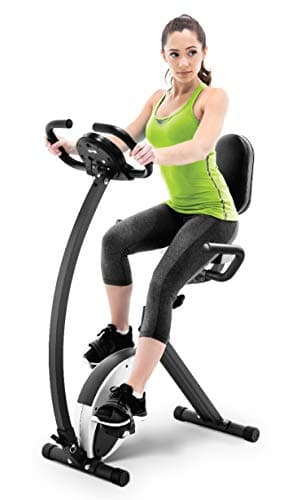
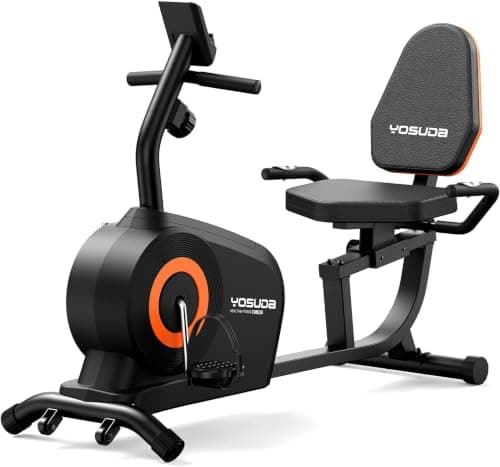
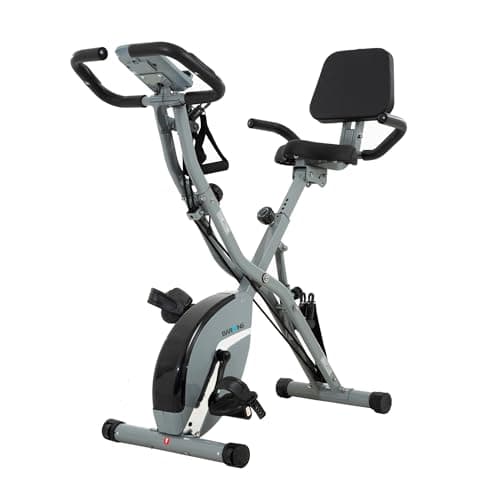
For most small rooms the answer is a folding upright, and the BARWING 5-in-1 is the pick because it refuses the choice: it folds like an upright and has an adjustable backrest for recumbent-style riding, with a published 350 lb capacity and 16 resistance levels. If you want a true recumbent and the room has another job, the Marcy NS-653 is the only one in our registry that folds — 39 inches long in use and 50 lb. If the bike can live where it stands, the YOSUDA lrc-01 is the most fully specified machine here: 350 lb, 16 levels, and a stated rider fit range of 4 ft 9 in to 6 ft 2 in, in a 55.23 inch frame that never shrinks.
We rank both categories already — the recumbent bikes and the folding uprights — and this page is the fork that comes first. Almost every other comparison of these two formats is written about comfort and joint position. In a small room it is settled before you get there, by length.
The seat rail is the footprint
A recumbent puts you in a chair behind the pedals, which means the frame has to be long enough to hold a seat, a rail for that seat to slide along, and the crank out in front of it. The published lengths in our registry run from 39 inches on the folding Marcy to 55.23 inches on the YOSUDA — nearly a foot and a half of difference inside one category, and the long end is almost five feet of floor. Four of the five recumbents we rank do not fold at all. The footprint you buy is the footprint you keep.
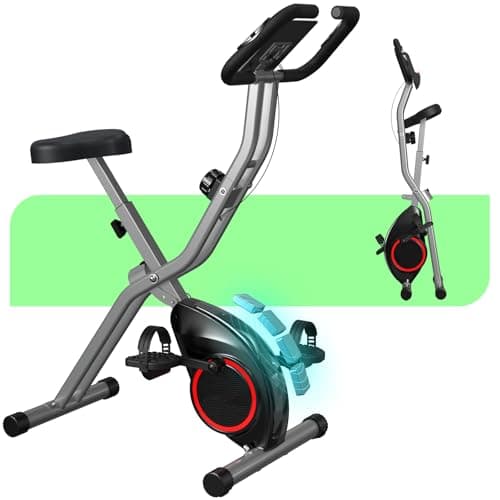
A folding upright is a different object entirely: an X-frame roughly the plan area of a dining chair, used sitting still, with nothing extending and nothing traveling. When you are done it folds and rolls out of the way. Neither of the uprights here publishes a folded size, which is irritating and worth saying plainly — but the LINBOLUSA publishes a 33 lb frame weight, and for a machine that has to be folded and carried, weight is a better proxy for "can I actually store this" than a folded depth you cannot verify.
The honest shortcut: if the bike has to share a room that does something else — a living room, a bedroom, a studio — buy a folding upright, and buy one with a backrest if the recumbent position is what you were after. If the bike gets a permanent spot, buy the recumbent, because the position is genuinely better for long seated sessions and you are no longer paying for it in floor area.
How the four compare
| Bike | Format | Length in use | Folds | Published capacity | Resistance |
|---|
| BARWING 5-in-1 | Folding upright with backrest | Not published — X-frame plan area | Yes; folded size not published | 350 lb | 16 magnetic levels |
| Marcy NS-653 | Folding recumbent | 39 in | Yes; folded size not published | Not published | Magnetic, level count not published |
| YOSUDA lrc-01 | Fixed recumbent, step-through | 55.23 in | No | 350 lb; riders 4 ft 9 in - 6 ft 2 in | 16 magnetic levels, rated to 60 lb |
| LINBOLUSA 816 | Folding upright X-frame | Not published — X-frame plan area | Yes; 33 lb frame | 260 lb; riders 5 ft 0 in - 6 ft 1 in | 16 magnetic levels |
Two things in that table are worth more than the rest of this page. First, the only machine here that publishes neither a capacity nor a resistance level count is the folding recumbent — Marcy gives you the fold and asks you to take the rest on trust, which is a real reason to hesitate if you are near any plausible weight limit. Second, resistance granularity is a tie: three of the four publish sixteen magnetic levels, so the recumbent is not the "serious" machine and the folding upright is not the toy. They are the same mechanism in two shapes.
Height: the spec that actually excludes people
Two of these four publish a rider fit range, and in both cases the range is a limit rather than a reassurance. The YOSUDA states 4 ft 9 in to 6 ft 2 in. The LINBOLUSA states 5 ft 0 in to 6 ft 1 in — so if you are 6 ft 3 in, the cheapest bike on this page has already told you to buy something else. The Marcy publishes no range at all.
This is where the formats genuinely differ in your favor if you are tall: a recumbent with a sliding seat rail adjusts over a long distance, which is why the one that states the widest range is a recumbent. On an X-frame upright you have a seat post and that is it. If you are near either end of those ranges, that is the number to buy on, ahead of price and ahead of level count.
Step-through, and why it matters more than the marketing says
The recumbents in our registry are step-through frames: you walk in, sit down, and your feet find the pedals in front of you. The folding uprights ask you to swing a leg over a frame and then sit on a saddle. That is a mechanical difference, not a medical claim — the makers' own rehabilitation and joint copy is their words, not ours, and we are not going to repeat it. What we will say is that a step-through frame with a backrest is easier to get into, and easier to get into means easier to use at the end of a long day.
If that is the reason you were leaning recumbent, note that both folding uprights here have a backrest option and the BARWING's is adjustable. That is the collapse of this entire fork for a lot of buyers: you can have the supported seated position in a frame that folds, and you give up the long seat rail you were never going to have room for.
What neither format fixes
A bike is a seated leg press, repeated. Your upper body does nothing, which is a limitation and also the reason a bike is the easiest machine in this registry to use while reading or working. If you want the pulling pattern as well, that is an argument for a rower or for pairing the bike with a doorway pull-up bar. And if the point is step count rather than seated minutes, neither of these is the machine — a walking pad is, and the walking pad versus under-desk bike page is that fork.