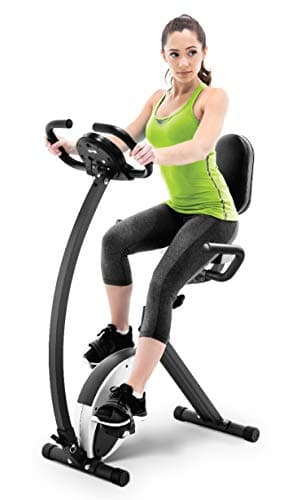
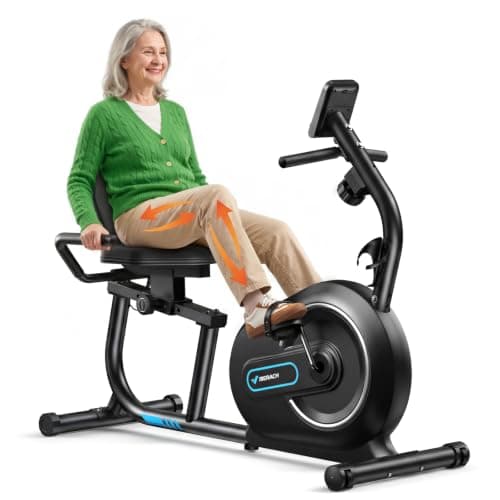
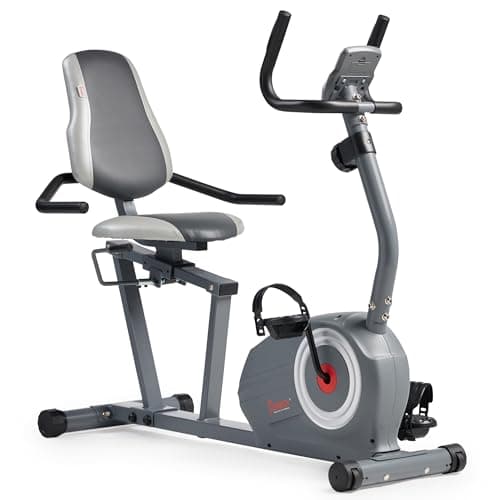
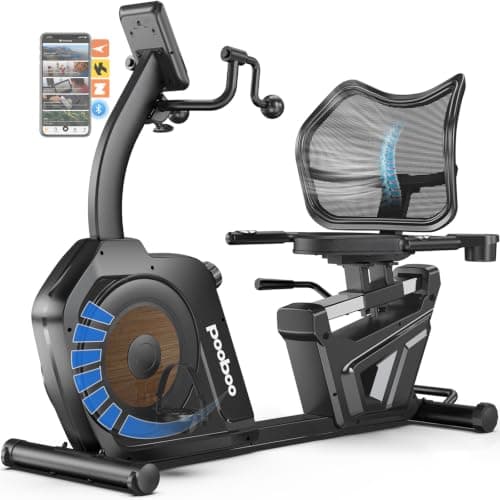
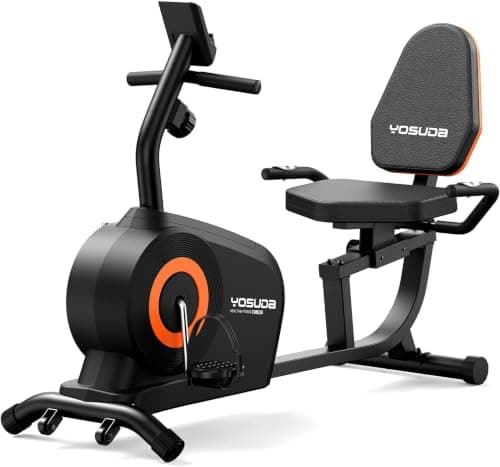
The YOSUDA lrc-01 is our pick, because it is the only recumbent here that publishes every number that decides the purchase — 350 lb capacity, 16 resistance levels rated to 60 lb, and a rider fit range of 4 ft 9 in to 6 ft 2 in — and it is the lowest machine on the page at 38.58 in tall. Its cost is length: 55.23 in, the longest frame here. If that rectangle does not fit, the Marcy NS-653 is the only recumbent on this page that folds — 39 in long, 50 lb, wheels — and it is the one a studio apartment can genuinely own. The MERACH S08 is the shortest fixed frame at 49.6 in, the Sunny SF-RB422003 publishes the inseam range so you can check fit before it arrives, and the pooboo W216 carries the only 400 lb rating and the only arm cycle.
A recumbent bike is a strange thing to put on a small-space site, and it is worth being honest about why before the rankings: it is a geometry problem. An upright exercise bike stacks itself vertically — seat above cranks, bars above seat — so it stands on roughly two square feet of floor. A recumbent lays that same machine down. The seat moves behind the cranks, a backrest goes behind the seat, and what was a tower becomes a rectangle on your floor between three and a half and five feet long. Everything you gain from the format — a backrest, a step-through frame, no weight on your wrists or your tailbone — you pay for in floor plan.
So this page ranks length first. Not resistance levels, not app features, not flywheel weight. If you want the format that is easiest to fit in a small room, our folding exercise bike roundup covers the uprights and X-frames that fold to a few inches, and under-desk machines covers the pedal units that have no frame at all. You are here because you want the seat and the back support, and that is a legitimate reason — this page is about paying the smallest possible floor price for it.
Why a recumbent cannot shrink
Two things about the format are worth understanding before you measure anything, because they are the reason a recumbent behaves differently from every other machine in the cardio hub.
First, the length is structural.On an upright bike, the distance between your hip and the pedal is vertical, so the footprint is set by the base, not by your leg. On a recumbent, that distance is horizontal: the seat rail has to be long enough for the longest leg the bike claims to fit. That is why the pooboo publishes a seated leg length of 33.36 to 43.3 in and a seat rail with 18.5 in of travel — and why its frame is nearly 50 in long on the maker's own numbers. The seat rail IS the footprint. A recumbent that fits tall riders is long by definition, and a short recumbent is quietly telling you something about who it fits.
Second, there is nothing to put away. This is the part people discover after delivery. A folding treadmill stands up. A walking pad slides under a couch. An upright bike drops its seat post. A recumbent has no fold in it — four of the five bikes here state outright that they do not fold — so the rectangle you measured is the rectangle you live with every day, including the days you do not ride. That is the single biggest reason recumbents get sold on secondhand marketplaces, and it is why the one folding bike on this page ranks second despite publishing the least data of the five.
The five things we ranked on
- Frame length, measured against a real wall. The spread here is 39 in to 55.23 in. That 16 in difference is not a detail — in a 10 ft bedroom it is the gap between a bike that sits under a window and a bike that sticks into the walking path. This is a dimension-first site, so short frames get credit for being short.
- Whether it folds, and whether the folded size is published. Exactly one bike here folds. Its maker does not publish folded dimensions, which we flag rather than estimate, but a 39 in frame on transport wheels at 50 lb is a materially different object from a 78 lb fixed machine.
- Published maximum user weight.Three of the five publish one: 220 lb, 350 lb and 400 lb. Two publish nothing. A capacity rating is the one spec on a seated machine with a cantilevered backrest that is not negotiable, and "not published" is a real mark against a bike, not a neutral blank.
- Published rider fit. Three bikes publish an inseam or height range. This is the spec that decides whether you can straighten your leg at the bottom of the stroke, and on a machine where the seat slides horizontally it cannot be fudged by raising a post.
- Resistance levels and what the maker says about them. Eight levels versus sixteen matters less than whether the maker states a load. Only the YOSUDA puts a number on it (up to 60 lb). Everyone else sells you a count.
How the five compare
| Bike | Length | Width | Weight | Max user | Levels |
|---|
| YOSUDA lrc-01 | 55.23 in | 24.88 in | 58.4 lb | 350 lb | 16 |
| Marcy NS-653 (folds) | 39 in | 22 in | 50 lb | Not published | Not published |
| MERACH S08 | 49.6 in | 24.8 in | 57.3 lb | Not published | 8 |
| Sunny SF-RB422003 | 52.4 in | 26.4 in | 60 lb | 220 lb | 8 |
| pooboo W216 | 49.84 in* | 28.78 in* | 78 lb | 400 lb | 16 |
* The pooboo listing publishes two different footprints. Amazon's structured item dimensions say 43 x 18.5 in; pooboo's own feature bullet says 49.84 x 28.78 in. Those are not rounding errors — they are nearly 7 in of length and 10 in of width apart. We print the maker's larger figure in the table and in the Spec Block below, because the failure mode of planning around the smaller one is a bike that does not fit the room you cleared.
Read the capacity column next to the length column and the pattern that matters appears: the shortest bike publishes no capacity, and the highest-capacity bike is the widest object on the page. There is no bike here that is short, strong and fully specified at once. The ranking below is about which compromise costs you least.
How to choose a recumbent for a small room
1. Measure the rectangle, then add the access lane
Put a tape on the floor and mark the full published length and width. Then add what the listings never mention: a lane down one side to get on. A recumbent is a step-through machine, which is most of its appeal, but stepping through needs roughly 18 to 24 in of clear floor beside the seat. The bike does not need that lane to exist — it needs you to be able to reach it. In practice the smallest realistic allocation for the shortest bike here is about 39 x 40 in of clear floor, and for the YOSUDA about 55 x 43 in. Our how much space do you need guide has the measuring method for the whole room, and how much space a treadmill needs works through the same four-rectangle method on a machine where it is better documented.
2. Decide, before you buy, where it lives on the days you do not ride
This is the question that decides whether a recumbent stays in the house. Four of these five bikes are permanent furniture. That is fine in a spare room and it is a serious problem in a one-room apartment, where the bike becomes the thing you walk around for eleven months of the year. Be honest about which situation you are in:
- You have a dedicated corner. Buy on specs and ignore the fold. The YOSUDA or the pooboo, depending on whether you want the published fit data or the 400 lb rating.
- The bike shares a living room or a bedroom. The fold is worth more than any spec on the page, which is why the Marcy NS-653 is ranked second with the thinnest spec sheet here. A 39 in frame at 50 lb on wheels goes behind a door; a 78 lb fixed frame does not.
- You will not put it away even if it folds. Most people will not, and that is worth admitting to yourself before you pay a premium for a hinge. If the bike is going to stay out either way, buy the better-specified fixed frame and put it somewhere deliberate. Our living room home gym guide covers how to place a machine you have accepted is staying.
3. Check the capacity rating, and treat a blank as a red flag
A recumbent holds a seated adult on a cantilevered seat with a backrest behind it, which puts a bending load on the frame that an upright bike never sees. Published ratings here run from 220 lb (Sunny) to 400 lb (pooboo), and two bikes publish nothing — including the folding Marcy, which also has a hinge in the load path.
We are not going to tell you an unpublished frame is safe at a given weight, because we have not tested it and no maker on this page has stated it. What we will say is the shopping rule: if you are within about 30 lb of a published limit, buy the next rating up, and if there is no published limit at all, treat that as a reason to choose a bike that has one. The 220 lb figure on the Sunny is the lowest on this page by 80 lb and it is the single reason that bike is not ranked higher — it is a good machine with a narrow audience. For the broader version of this question, see home gym equipment for heavier users, which collects every published capacity on the site in one place.
4. Match the seat rail to your leg, not to your height
On an upright bike you set the seat post height and you are done. On a recumbent the seat slides horizontally, so what matters is the distance from your hip to your heel with the leg nearly straight — your inseam, not your overall height. Three of these bikes publish something useful:
- Sunny SF-RB422003: 25.2 to 34.3 in inseam, plus the seat size (17 x 12 x 2 in). The most checkable fit data on the page.
- pooboo W216: 4 ft 9 in to 6 ft 3 in rider height, 0 to 18.5 in of seat travel, and a seated leg length of 33.36 to 43.3 in.
- YOSUDA lrc-01: 4 ft 9 in to 6 ft 2 in, on an infinitely adjustable rail with a knob-and-hole lock.
The MERACH and the Marcy publish neither an inseam range nor a height range. If you are taller than about 6 ft or shorter than about 5 ft, that blank is the whole decision: buy a bike that states its range and includes you in it, because a recumbent that is too short for your leg cannot be fixed with an adjustment.
5. Noise, floors and neighbors — the honest version
A magnetic recumbent is the quietest thing in the cardio hub. There is no belt slapping a deck, no impact, no flywheel roar — the pedals turn against a magnet and the loudest part of the session is usually the chair. That makes it a genuinely good apartment machine, and unlike a treadmill it does not transmit footfall into the floor below. Our quietest cardio machines for apartments page ranks the whole category on this axis.
Two cautions. The ~20 dB figure in the pooboo listing is a marketing claim, not a measurement — 20 dB is roughly a quiet library, and no belt-driven machine with a 15 lb flywheel is that quiet in a real room. Treat it as "quiet for the category" and nothing more. And none of these bikes needs a mat for impact reasons, but a mat is still worth having for two unglamorous ones: it stops 60 to 78 lb of steel feet from printing marks into a floor, and it keeps the machine from walking under a hard pedal stroke. Best home gym mats covers what actually works, and home gym on hardwood floors is the version for a finished floor you care about.
6. What a recumbent is actually for — and what it is not
A recumbent puts your back against a pad and your hands on nothing in particular. That makes it the easiest machine in the house to use for a long, dull, low-effort session while reading or watching something, and the easiest to get on and off without balance. What it is not is a strength machine, and it is not a replacement for the free weights versus machines decision — this is cardio, and if the room only has space for one machine, a bike that cannot be put away is a large commitment to one kind of training. The strength-side version of the same floor-space argument is dumbbells vs barbell for a small home gym, where the whole decision also turns on how much wall you have.
We are also not going to make a health claim for the format. You will see a lot of copy — including in the feature bullets quoted in the Spec Blocks above — about joints, rehab and who the format is "designed for". Those are the makers' words, not ours. The mechanical facts are that a recumbent removes your bodyweight from your wrists and your tailbone, supports your lower back, and keeps both feet on pedals you cannot fall off. What that means for a specific knee or a specific back is a question for the person treating it, not for a product page. Our low-impact cardio page defines "low impact" the same mechanical way.
7. If length is the dealbreaker, buy a different format
The most useful thing this page can tell some readers is not to buy a recumbent at all. If your constraint is that the machine has to disappear between sessions, the format is fighting you, and three alternatives do that job better:
- A folding upright or X-bike folds to a few inches and several come with a backrest — a semi-recumbent compromise that costs you the step-through seat but keeps the back support.
- An under-desk pedal unit has no frame, no seat and no footprint beyond the pedals; you supply the chair.
- A walking pad stores flat under furniture, which no recumbent on this page can do.
And if you are weighing the format against the two other seated machines, our rower versus exercise bike and elliptical versus exercise bike pages make the same comparison on lane length and ceiling height respectively.