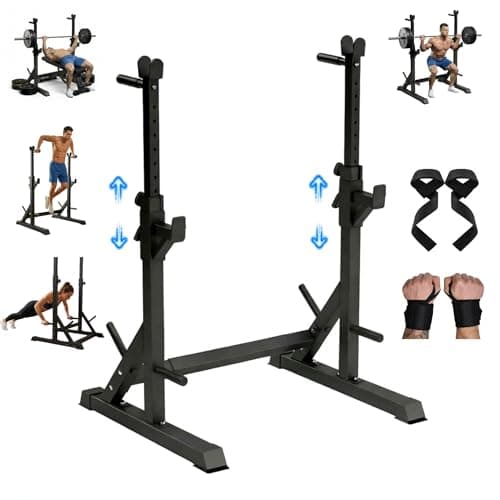
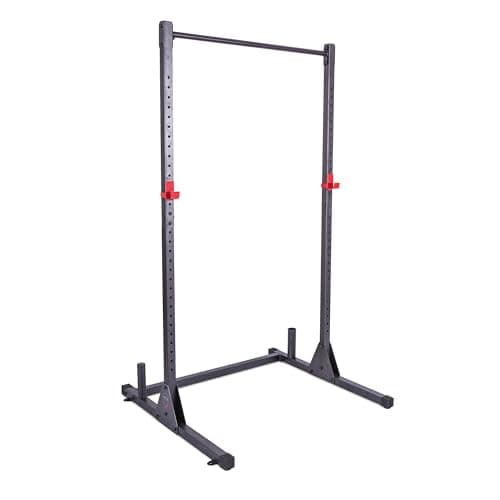
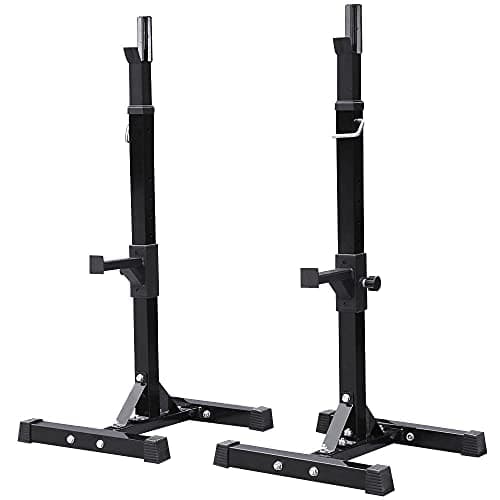
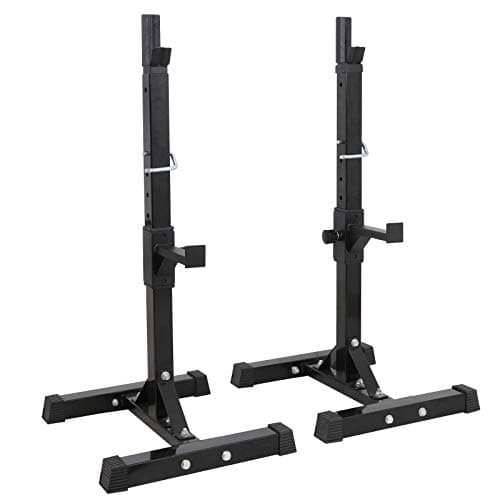
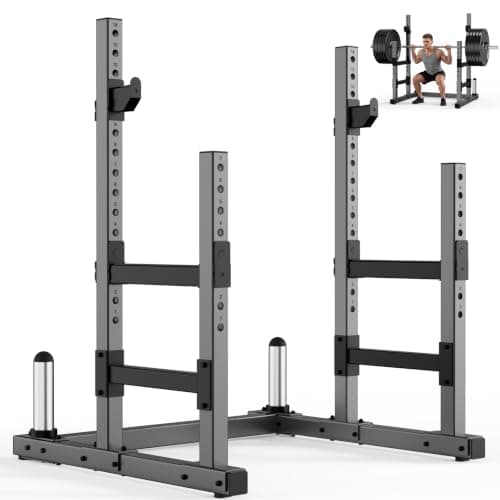
The PASYOU SR30Pro is the squat rack to buy under $200: it publishes the highest and most specific load figures of any rack here — 2,400 lb total, split as 1,800 lb on the lower bars and 600 lb on the J-hooks — in a 36 x 43 in setup footprint, and it needs no ceiling clearance because there is no overhead bar. Our budget pick is the F2C pair, the cheapest rack on this site that publishes a load number at all. If you want a joined base and a long height range, the LINBOL LIN-201 publishes 700 lb with J-hooks from 41.9 to 61.4 in and eight spotter-arm positions. The CAP power rack is the only four-post cage under the cap and the only pick with a pull-up bar. The Yaheetech YT-2073 has the tallest range at 44 to 70 in — with a load figure its own listing contradicts, which we print rather than resolve.
The cap is a design constraint, not a promise: every pick was under $200 on the live price layer when this page was published on November 7, 2026, and the as ofdate under the quick-picks table is the price layer's own stamp. What does not change is the published steel: that is what this ranking is built on.
Who each rack is for
- PASYOU SR30Pro — for the lifter who wants the most specific published capacity under the cap and a standard ceiling.
- LINBOL LIN-201 — for the lifter who wants a joined base, dip handles and plate pegs on one frame.
- CAP power rack — for the garage that has the height, and the only pick here with a pull-up bar overhead.
- Yaheetech YT-2073 — for a tall lifter who needs J-hooks above 61 in and will plan around the lower of two contradictory load figures.
- F2C pair — for the lowest price that still publishes a rated load; our budget pick.
Joined base or independent uprights
This is the real fork under $200, and it is a safety decision rather than a price one. A joined base — the PASYOU, the LINBOL and the CAP cage — ties the two uprights together, so the rack cannot drift out of alignment and a bar racked unevenly does not try to tip one post. Independent uprights, which is what the Yaheetech and the F2C are, cost less, store apart in two smaller pieces and adjust to any bar width you like, but nothing stops you setting them at slightly different heights or knocking one out of position mid-set. Both designs are used in real gyms; only one of them forgives inattention.
Published load, and the listings that argue with themselves
At this price, the published rated load is the entire specification — and the honesty varies wildly. The PASYOU breaks its 2,400 lb figure into the two places load is actually applied. The LINBOL publishes 700 lb and qualifies it: fully assembled and used as directed. The F2C publishes 550 lb unqualified, with nothing stating what the 550 lb is on. The Yaheetech title says up to 550 lb while its own bullet says 441 lb, so we rank it on 441 lb and say why. And CAP publishes no rated load at all for its cage, which is a strange omission on the only four-post frame here.
Footprint, height and the pull-up bar problem
A stand pair takes less floor than a cage but the floor it takes is in two places: the Yaheetech publishes 21.46 x 19.88 in per upright, about 2.96 sq ft each, and the F2C publishes 17.7 x 20.1 in, about 2.47 sq ft each. The PASYOU's set-up envelope is 36 x 43 in, roughly 10.8 sq ft, because the uprights are joined. Height matters as much: a stand with no overhead bar works under a low ceiling, whereas the CAP cage puts a pull-up bar above your head and therefore needs the cage height plus your hanging length. If your ceiling is the constraint, start with squat racks for low ceilings.
How the five compare
| Rack | Design | Published load | Height / J-hook range | Base |
|---|
| PASYOU SR30Pro | Joined pair of uprights | 2,400 lb total (1,800 lb bars / 600 lb J-hooks) | 58 in set-up height | 36 x 43 in (about 10.8 sq ft) |
| LINBOL LIN-201 | Connected H-base | 700 lb (assembled, as directed) | J-hooks 41.9-61.4 in; 8 catch positions | Width adjusts 21.9-51.9 in |
| CAP power rack | Four-post cage + pull-up bar | Not published | Full cage height | Does not fold |
| Yaheetech YT-2073 | Independent uprights | 441 lb per bullet (title says 550 lb) | 44-70 in, 14 pin positions | 21.46 x 19.88 in each |
| F2C pair | Independent uprights | 550 lb (unqualified) | 40-66 in per bullet (title says 41 in) | 17.7 x 20.1 in each |
Two of these listings also publish a unit weight that cannot be right: Amazon lists 18.5 lb for the F2C pair, which is not credible for two 66 in steel uprights and is almost certainly one carton. We print the figure and call it what it is rather than quietly using it as evidence of portability.
What $200 does not buy
Safeties you would trust on a maximal bench press, a published capacity on every pick, 11-gauge steel, or a bar. None of these racks includes a barbell, and none includes plates — budget for both, because a rack on its own trains nothing. Our short-bar shortlist is best barbells for small spaces and the plate side is best weight plates for small spaces. What the cap does buy is an adequate frame for squats, overhead press and rack pulls at loads most home lifters will never exceed.
Spotter arms are the feature to insist on
If you train alone — which, in a home gym, you do — the catches are the difference between a failed rep and a trapped lifter. Three picks publish a catch count and range: the LINBOL with eight positions from 23.0 to 35.4 in, the F2C with 13 spotter-arm positions per side, and the Yaheetech with 14 pin positions per post at about 2 in spacing. Set them before every set, not after. The honest limit of a stand pair is that its catches are short arms rather than a full cage crossmember; if you are benching near your limit, the cage format exists for exactly that reason — best power racks for small spaces covers it.
Where it goes when you are done
Nothing under $200 folds against a wall. The independent-upright pairs are the closest thing to storable — two pieces you can stand in a corner or a closet — and the PASYOU splits into uprights that store apart. The cage does not move once it is built. If reclaiming the floor between sessions is the requirement, the format you want is a folding wall-mounted rack, which costs more and needs studs: best folding squat racks and best wall-mounted squat racks are the pages for that, and are folding squat racks worth it is the honest argument about whether the premium is worth paying.
Floor protection is not optional
Every rack here concentrates its load — yours plus the bar — onto four or eight small feet, and most publish anti-skid pads rather than a load-spreading plate. On a wooden floor that is a dent per session. Put rubber under the feet and under the bar path; rubber gym flooring for apartments has the thickness answer, and can your apartment floor hold a home gym is the structural one.