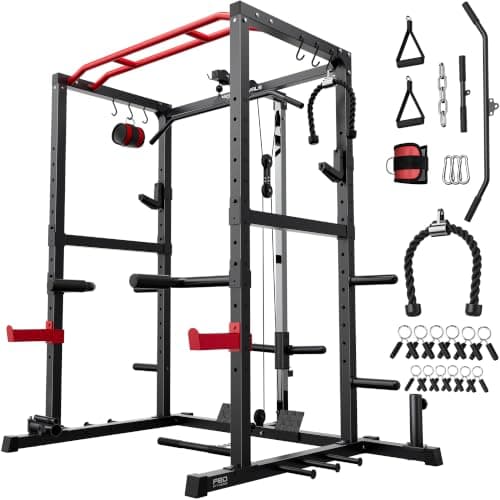
The SPORTSROYALS power cage with a lat pulldown is the home gym machine to buy if you are buying one: it is the only pick here that gives you barbell safety and cable work in the same frame, it publishes a 1,200 lb rating, and it needs no drilling. If the appeal of a machine is that you never load a plate, the Marcy MWM-8147 is the pin-selected 150 lb stack to buy, and it is the only Marcy that publishes both a 300 lb user capacity and a warranty term. For cables and nothing else, the Mikolo functional trainer gives 17 pulley heights freestanding. The OPPSDECOR Smith machine is the guided-barbell answer and the tallest object on this page at 86.22 in. Our budget pick is the Sunny Health power tower — the cheapest machine here that does a real job, which in its case is every bodyweight pull and dip you can do.
A "home gym machine" is not one product category. It is five, they cost different amounts, they occupy wildly different rectangles, and they are bad at different things. The reason this page exists is that every other machines page on this site ranks within a class — cable machines against cable machines, towers against towers — and none of them answers the question people actually type, which is which kind of machine should be in my room at all.
Who each one is for
- SPORTSROYALS cage with lat tower — for the person who wants to squat and bench with safeties and still do pulldowns and rows, and who has a permanent corner to give.
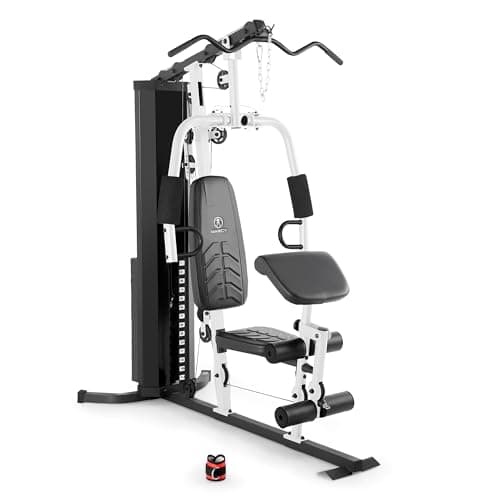
- Marcy MWM-8147 — for the person who does not want plates in the house at all, and who has a garage or basement rather than a bedroom.
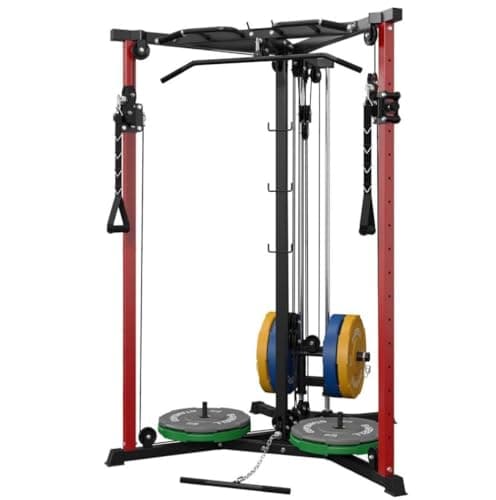
- Mikolo functional trainer — for the person who already owns a bench and dumbbells and is only missing cables.
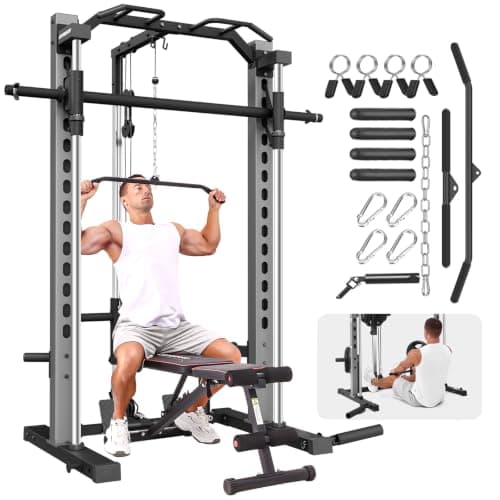
- OPPSDECOR Smith machine — for the person who wants to press and squat a bar on rails without a spotter, and who has an 8 ft ceiling to spare.
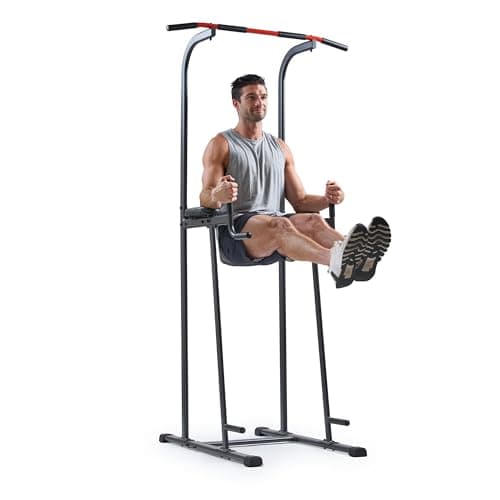
- Sunny Health power tower — for the person spending the least who still wants a machine, and who trains pull-ups, dips and knee raises.
The four numbers that decide it
Floor area comes first because it is permanent. Not one machine on this page folds: the Marcy publishes 68 x 43.3 in, which is 20.45 sq ft before you add the space you stand in, and the OPPSDECOR publishes 51.97 x 70.47 in. That is a dedicated room corner, forever.
Heightis the number that kills these purchases after delivery. The Marcy stands 78.1 in and the OPPSDECOR 86.22 in, and both the cage and the tower put a pull-up bar overhead, which means you need the machine's height plus room to hang under it. Measure before you buy, and read ceiling height for a home gym if your room has ducts or a sloped ceiling.
Published rated load separates the honest listings from the rest. The OPPSDECOR publishes 1,400 lb, the SPORTSROYALS 1,200 lb, and the Marcy publishes a 300 lb maximum user weight. The Mikolo trainer and the Sunny tower publish no load figure at all, which is worth knowing before you load them.
What it cannot train is the number nobody prints. A single-stack machine gives you guided paths and no free-weight skill; a cable trainer has no pressing path for heavy work; a tower has no external load whatsoever. We argued that trade in full in machines vs free weights for a small home gym.
How the five classes compare
| Machine | Class | Published size | Published load | Trains |
|---|
| SPORTSROYALS cage | Power cage + lat tower | Not published | 1,200 lb | Barbell + plate-loaded cables |
| Marcy MWM-8147 | 150 lb selectorized stack | 68 x 43.3 x 78.1 in (20.45 sq ft) | 300 lb max user | Press, fly, pulldown, curl, legs |
| Mikolo trainer | Functional trainer | Not published | Not published | 17 pulley heights, high and low |
| OPPSDECOR | Smith + cage + crossover | 51.97 x 70.47 x 86.22 in | 1,400 lb | Guided bar + crossover + landmine |
| Sunny tower | Power tower | Not published | Not published | Pull-up, dip, knee raise, push-up |
Two of the five publish no assembled dimensions and two publish no load rating. We are not going to invent either. Where a maker stays silent, the card says Not published, and you should treat that silence as information: a frame whose maker will not commit to a number in writing is a frame to load conservatively.
If you only have one corner, buy the cage
The cage-plus-lat-tower format wins this page for a boring structural reason: it is the only one of the five that does not force a choice between free weights and cables. A stack machine cannot hold a barbell. A functional trainer cannot catch a failed squat. A tower cannot add load. The cage does all three jobs adequately and none of them perfectly, which is exactly what a single-machine room needs. The cost is that it is plate-loaded, so you are buying plates and finding somewhere for them — plate storage racks is the page for that problem.
What a weight stack actually buys you
Convenience, and a room with no iron on the floor. A pin-selected 150 lb stack changes weight in two seconds and stores all of its own resistance inside the frame. What it does not buy is 150 lb in your hands: on a single-stack machine the pulley ratio means the load at the handle is lighter than the number on the plate, which is why an experienced lifter often finds a home stack machine easy. It is also why the stack machines are a garage decision rather than an apartment one — 20 sq ft and 78 in of permanent steel. The brand-level comparison lives on Marcy home gyms, and the format argument is on the all-in-one home gym buying guide.
Cables only, if cables are the only gap
If you already own a bench and adjustable dumbbells, a machine that duplicates pressing is money spent twice. A freestanding functional trainer adds the one thing free weights cannot do — constant-tension pulling and pressing from 17 heights, including the cable row and the face pull that nothing else in a small room covers. Cheaper and smaller still is a wall-mounted unit, and the full class ranking is on best compact cable machines and best wall-mounted cable machines.
The honest case against all of them
Every machine on this page asks for 20 to 25 sq ft of permanent floor and most of your ceiling. For a bedroom, a studio or a shared living room, the correct answer to "which machine" is usually "none of them" — a folding bench, a pair of adjustable dumbbells and a doorway bar train more of your body in a quarter of the space and disappear between sessions. If that is your room, start at best home gym for small spaces instead, and come back to this page when you have a garage.