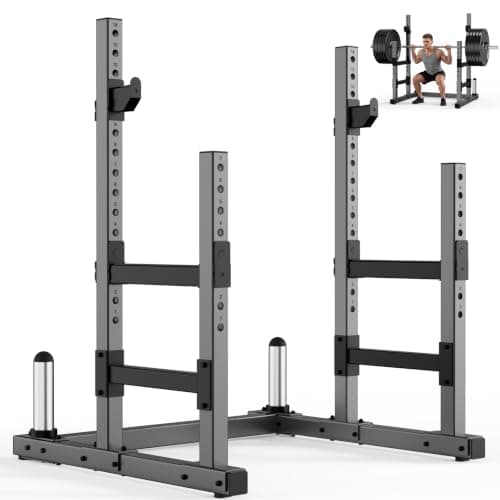
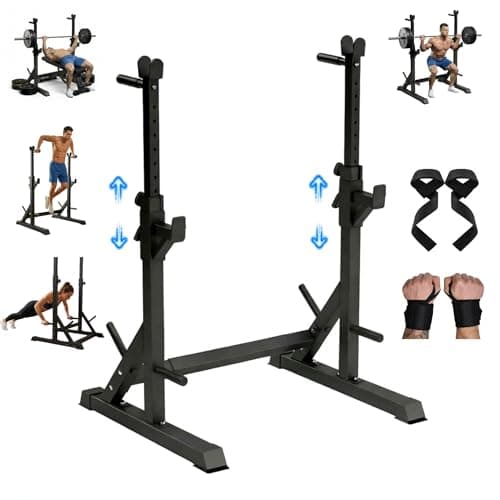
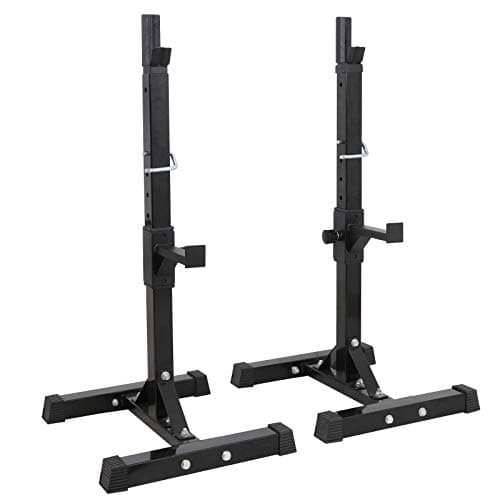
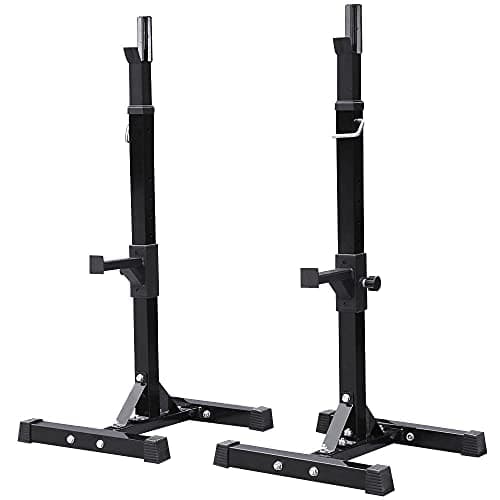
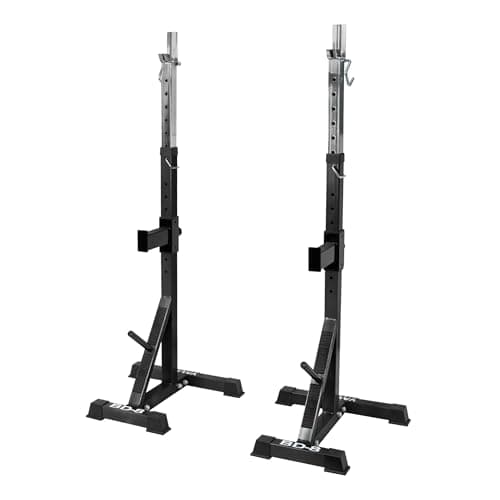
The Valor Fitness BD-8K is our pick, and the reason is the number nobody else wants to print: 350 lb. It is the lowest published capacity on this page, from the only maker here that also publishes a safety-catch range (seven positions, 22 to 36 in), a J-hook range (41.75 to 71 in) and an adjustable base width (20 to 28 in). If you want the biggest published rating instead, the PASYOU SR30Pro splits 2,400 lb into 1,800 lb on the lower bars and 600 lb on the J-hooks — the only honest way to publish a figure like that. The LINBOL LIN-201 narrows to 21.9 in to park against a wall and opens to 51.9 in for a 7 ft bar. The F2C pair is the cheapest stand here with real spotter arms. The Yaheetech YT-2073 racks a bar higher than anything else at this price, with a capacity contradiction we spell out on its card.
A squat stand is two uprights and a pair of J-hooks. There is no cage around you, no pull-up bar overhead and usually nothing joining the two halves. That sounds like a downgrade from a power rack until you notice what it buys in a small room: the stands move. A cage is a permanent square of floor whether you are training or not. Two uprights go into a closet, a corner or the gap beside a bookcase, and the room goes back to being a room. On a site about apartments and garage corners, that is the whole argument.
The thing nobody tells you: the barbell sets the footprint
Every listing in this class advertises a small footprint, and every one of those numbers is beside the point. The uprights themselves are tiny — the F2C stands occupy about 2.47 sq ft each, the Yaheetech about 2.96 sq ft each. What you actually have to find room for is the rectangle a loaded barbell sweeps:
- Width. A standard 7 ft Olympic bar is 86 in long. The bar has to clear the hooks at both ends, so you need roughly 7.5 ft of wall-to-wall width no matter which stand you buy. A 6 ft bar brings that down to about 6.5 ft, which is why short barbells are a small-space decision rather than a compromise.
- Depth. You walk the bar out of the hooks, squat, and walk it back. Two to three feet in front of the uprights, plus your own depth. Call it 4 ft.
- So the working rectangle is about 7.5 x 4 ft — roughly 30 sq ft — for every stand on this page, from the $40 pair to the branded one. The difference between them is not how much floor they need while you lift. It is how much floor they need while you are not.
That reframes the whole category. Judge a stand on what it does between sessions (can it move? does it narrow? will you actually bother?) and on whether it is safe while you are under the bar. Those are the two axes this page ranks on.
What we ranked on
- What the capacity number is FOR.This class publishes load ratings the way a cereal box publishes serving sizes. "550 lb" appears in two titles here with nothing stating whether that is per upright, per pair, on the J-hooks or on the spotter arms. PASYOU is the only maker on the page that splits the figure by position (1,800 lb low, 600 lb on the hooks). Valor is the only one whose number is low enough to be a real engineering limit rather than a marketing one. Where a listing contradicts itself, we print both figures and plan around the smaller.
- The published safety-catch range. If you bench alone, the catch height is the most important number in this entire category — it is the difference between a failed rep and a bar on your chest. Valor publishes 22 to 36 in across seven positions; LINBOL publishes 23 to 35.4 in across eight; F2C publishes thirteen positions without stating the range; Yaheetech has pins rather than a separately adjustable arm. One of those sentences should decide your purchase.
- Height range against your ceiling and your press. The spread here is 40 in at the bottom to 71 in at the top. You need the hooks at about mid-chest for a squat walk-out, and higher than that if you want to rack a bar for a standing press. Low ceilings change this — see squat racks for low ceilings.
- Whether the uprights are connected. Independent uprights are more flexible (any width, any room) and more work (you set the gap every session, and an out-of-square setup is how a bar ends up off a hook). A connected base is a fixed rectangle that is always square. Two of the five here are connected.
- Stored width and weight. The point of a stand is that it leaves. A 40 lb pair of uprights stacks in a closet; a 63 lb connected frame on a 36 x 43 in base does not, it just slides to the wall.
How the five compare
| Stand | Published rating | Catch range | Hook height | Connected? | Weight |
|---|
| Valor BD-8K | 350 lb | 22-36 in, 7 positions | 41.75-71 in | No — base adjusts 20-28 in | 50 lb |
| PASYOU SR30Pro | 2,400 lb total (1,800 low / 600 hooks) | Spotter arms, range not published | Adjustable, range not published | Yes — 36 x 43 in | 63 lb |
| LINBOL LIN-201 | 700 lb, unqualified | 23-35.4 in, 8 positions | 41.9-61.4 in | Yes — width 21.9-51.9 in | 47 lb |
| F2C pair | 550 lb, unqualified | 13 positions, range not published | 40-66 in | No | Not credibly published |
| Yaheetech YT-2073 | 550 lb title / 441 lb bullet | Pins only, 14 positions | 44-70 in | No | 40.79 lb |
Read the first column with suspicion. A 700 lb rating on a 47 lb frame and a 2,400 lb rating on a 63 lb frame are not describing the same kind of number, and neither is describing a tested limit the way a published 350 lb on a 50 lb frame plausibly is. None of these ratings comes with a stated test standard or a warranty term tied to it. Our rule across the site is to stay well under any published figure; in this class we would add that the figure you can trust most is usually the smallest one on the page.
Stands against the other two ways to hold a barbell
This site has ranked the alternatives, so here is the honest placement rather than a sales pitch.
| Format | Floor when idle | Install | Catches | Pull-up bar |
|---|
| Squat stand | Moves or stores | None | Sometimes, adjustable | No |
| Folding wall rack | Folds to 4-6 in of wall | Bolted into studs | Usually optional extra | Often |
| Power cage | Permanent square | Freestanding, heavy | Yes, full length | Yes |
If you can drill into studs and you want the safest setup per square foot, a folding squat rack beats every stand here, and wall-mounted vs freestanding is the page that argues it out. If you cannot drill — a rental, a lease clause, a concrete wall, a landlord — a stand is not a compromise, it is the answer, and power rack vs squat stand covers the format decision in full.
Considered and not ranked
- PASYOU SR20.The SR30Pro's cheaper sibling, published at 1,200 lb total (600 lb upper, 600 lb lower) on the same 36 x 43 in base. A legitimate buy, but ranking two PASYOU frames with the same footprint would waste a slot — if the SR30Pro is beyond budget, this is the one to look at.
- CANPA adjustable squat stand. Published at 600 lb with 2 x 2 in tube and a 35.1 to 41.8 in width range, but the hook height tops out at 57 in and the listing publishes no unit weight at all.
- BangTong&Li squat rack stand. Title says 550 lb, bullet says 500 lb, and Amazon publishes no dimensions whatsoever — not length, width nor height. We cannot place a rack in a room we cannot measure.
- Saturnpower pair.The cheapest stands on Amazon, published at 550 lb with 14 holes per column and a 41 to 66 in range. Dropped because the brand field reads Saturnpower while the manufacturer field reads "Cascade Store" — a relabel with no accountable maker behind the capacity figure.
- Second Yaheetech listing. A near-identical pair at a slightly different price with the same 550 lb title claim. One entry per product, so we rank the one with the fuller published spec.
Everything above was verified live and In Stock on 2026-10-29. Prices on the cards come from the live price layer, never from this text — the bare upright pairs sit in the under-$100 bracket, the branded and connected-base stands in the $150 to $250 bracket, and a bar and plates are always a separate purchase on top.
Buying a squat stand: the order to do it in
1. Decide if you will ever bench on it
This is the fork in the whole category. For squats and overhead presses, a stand with pins is fine — if a rep fails you step forward and dump the bar. For bench pressing alone, you need catches that sit below the bar on your chest and above the floor, which means an adjustable arm in roughly the 20 to 36 in band. Valor and LINBOL publish exactly that range; two stands here do not publish it at all. If you plan to bench alone and the listing does not state a catch height, treat the stand as a squat-only purchase.
2. Measure the 7.5 x 4 ft rectangle, not the stand
Chalk it on the floor before you buy. Width for the bar, depth for the walk-out. If that rectangle does not exist in your room, no stand on this page fixes it — but a shorter barbell might, and a 10 x 10 room plan shows what else has to move. Our full measuring method, including the walk-out lane, is in how much space do you need for a home gym.
3. Check the hook height against your own chest, and the ceiling above it
Hooks want to be at roughly mid-chest for a squat — a couple of inches below where the bar sits on your back, so you can unrack by standing up rather than by tiptoeing. If you want to rack a bar for a standing press, you need a top position above your head height with the bar on your shoulders, which on this page means the Yaheetech (70 in) or the Valor (71 in). Then check overhead: a press needs the bar to travel a foot above your reach, and ceiling height for a home gym has the arithmetic.
4. Work out how it gets out of the way
Independent uprights stack in a corner or a closet, but you re-set the gap each session — mark the floor with two small pieces of tape and the job takes five seconds. A connected base is always square but moves as one 47 to 63 lb object. The LINBOL is the only stand here that does both: narrow to 21.9 in against a wall, wide to 51.9 in to lift.
5. Budget for the floor
A loaded bar coming back onto steel hooks is the loudest thing that happens in a home gym, and the feet of a stand concentrate the whole load into four small pads. Interlocking tiles or a rubber mat under the uprights protect the floor and take the edge off the clank — best home gym mats ranks them, and can your apartment floor hold a home gym does the load arithmetic for an upstairs room.
What a squat stand will never do
Three limits, stated plainly, because none of these listings will state them for you:
- It will not catch a bar you have failed overhead. No stand here has full-length catch bars at press height. That is a cage feature, and it is why heavy solo pressing belongs in a power rack.
- It will not give you pull-ups. Nothing joins the uprights overhead. A doorway bar costs very little and solves it with zero extra floor.
- It will not make a bar and plates appear. Every stand on this page is uprights only. A bar plus a starter plate set is usually more money than the stand — best weight plates for small spaces and the under-$500 build show what a complete barbell setup actually costs.