Skip to content
RACK:RATIO

HUB 05 · Cable, All-in-One & Power Towers

The Best Dip Belts

The highest progression-per-square-foot purchase in a small home gym: 50 to 150 lb of added load that lives in a drawer. Ranked on chain length, waist range and the hardware — because the load ratings in this class cannot be checked.

By Stephen V.Reviewed How we research
#ad

We earn a commission when you buy through our Amazon links, at no extra cost to you. It never changes our rankings, and we say so when the cheaper product is the better buy. How this works.

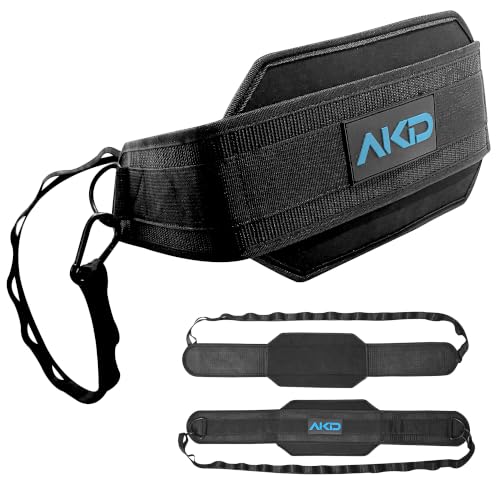
The Gymreapers dip belt is our pick on the two things in this category you can actually check: a published 300 lb rating and the longest published chain here at 38 in, which is what keeps plates off the floor and out of your shins. The DMoose DP-1 publishes a higher 350 lb figure and is the only belt with credible published dimensions. The AKD strap belt replaces the chain with nylon, which is the apartment answer — no metal to clang between sets. The MAXRANK DB-001 is the budget pick with the longest total drop. The Iron Bull Advanced Dip Belt V2 ships a chain and a strap with three anchor points, so it also does belt squats and sled work.

A dip belt is the best value in this entire website, and it is worth being clear about why. Every other way to make a home gym harder costs floor area: a heavier dumbbell set, more plates, a bigger machine. A dip belt costs nothing — it is a padded strap and a chain, it stores in a drawer or hangs on a nail, and it converts the pull-up bar or dip station you already own into a progressive strength machine that scales for years. If your doorway pull-up bar or power tower has stopped being hard, this is the cheapest fix on the site, and it is the one we have recommended in passing on four other pages without ever ranking the belts themselves.

The honest problem with this category: nothing is verifiable

We rank gear on published specifications, and dip belts publish almost nothing worth trusting. Across five listings from five makers:

  • Published load ratings run from 300 lb to 550 lb, and not one listing states how the figure was obtained. There is no test standard named, no safety factor, no breaking strength versus working load distinction. The two most established brands here publish the lowest numbers (300 lb and 350 lb) and the cheapest belt publishes the highest (550 lb). Read that pattern the way it reads.
  • Two of the five publish no rating at all, including the most expensive belt on the page.
  • One listing's Amazon dimension fields are physically impossible— a belt weighing 100 kg and measuring a meter on two sides. That is a data-entry error rather than a lie, but it means there is nothing to verify on size, and we print "Not published" rather than repeat it.
  • Only two publish a waist range, which is the single most useful number for a product you wear and the one that drives returns.

So the ranking runs on the parts that are checkable: chain length and total drop, waist range, whether the attachment is a locking carabiner or an open hook, whether a strap option exists, and whether the maker publishes a warranty. Where a figure is a bare marketing claim we say so on the card instead of scoring it.

What we ranked on

  • Chain length, and the total drop with the carabiners. This is the spec that decides whether the page is usable at all, and it is covered below in its own section. Published figures here are 36 in, 37 in (42 in total with hardware) and 38 in, with one belt not publishing it.
  • Waist range, published. The AKD states 28-50 in and the MAXRANK states 22-46.3 in. Nobody else states anything, which on a worn product is the difference between a purchase and a return.
  • The attachment hardware. Locking carabiners beat open hooks on a belt holding a plate above your feet. Four of these five use carabiners; one uses a coated D-ring with carabiners, which is the gentlest arrangement on the hardware over hundreds of sessions.
  • Whether the load path is metal or fabric, and how it is stitched. A chain-free belt puts the entire load through webbing and stitching, so the reinforcement at the D-rings is the whole product. The AKD publishes triple bartack stitching, which is the correct answer.
  • Belt body and padding. A contoured, padded back spreads 90 lb across your hips instead of concentrating it on a 2 in strip. On light loads it is irrelevant; at three plates it is the difference between a set and a grimace.
  • Noise, which nobody in this category discusses. A steel chain hanging between your legs with two plates on it is a loud object in a quiet apartment — on the bar, off the bar, and every time it touches the floor. Exactly one belt here removes the metal entirely, and that is why it is ranked third rather than fifth.
  • Whether it does more than dips. Three anchor points and an included strap turn a dip belt into a belt-squat and sled-pull harness, which matters in a room with no barbell.

The measurement nobody warns you about: floor clearance

This is the one thing that sends dip belts back, and no listing on Amazon mentions it. The belt hangs the weight below your hips, on a chain of 36 to 42 in. Your plate then occupies a radius below that. The arithmetic you need before buying is simple and you can do it in two minutes with a tape measure:

  1. Measure the height of your bar or dip handles from the floor.
  2. Hang from it and have someone measure your hips — the distance from the floor to the belt line, not to your feet.
  3. Measure your heaviest plate and halve it to get its radius. A big Olympic plate is a surprisingly large object; a smaller plate or a kettlebell hangs much lower in exchange for less reach.
  4. Subtract: belt line minus chain drop minus plate radius. If that is less than zero, the plate sits on the floor before you do a single rep.

Three practical consequences. On a doorway pull-up bar, clearance is usually the binding constraint, and the fix is to shorten the chain by hooking a closer link rather than to buy a different belt — which is a reason to prefer a chain over a fixed strap. On a dip station or power tower, you have more room because your knees bend behind you. And for belt squats, the whole point is that the weight hangs near the floor, so a long chain is an asset rather than a problem.

Chain or strap?

A genuine fork, and it is the most useful decision on this page.

A chain adjusts in a second and survives anything.You hook a different link to change the drop, you thread it through a plate's center hole, and there is nothing to wear out. Against it: steel against cast iron is loud, a bare chain can take skin off a thigh at the top of a dip, and the chain is the part that scratches a hardwood floor when you put the belt down. Four of our five picks are chain belts.

A strap is quiet, kind and slower. The AKD belt replaces the chain with reinforced nylon through steel D-rings, and its own listing is refreshingly specific about why: no metal to cut your palms or shred a shirt. In a shared building, between sets, that is a real difference — and so is not dropping a steel chain on the floor above a sleeping neighbor at 6 a.m. The cost is adjustment speed: changing the drop means re-threading rather than re-hooking, and fabric is the part that eventually frays.

Or both. The Iron Bull V2 ships a chain and a strap in the same box with three D-ring anchors, which is the completist answer and costs roughly twice the budget pick.

What to hang on it

Whatever you already own. The three normal answers, in order of how well they work:

  • Weight plates, threaded onto the chain through the center hole. The cleanest option and the quietest, since the plate sits flat against the chain rather than swinging. If your plates are the 1 in standard rather than Olympic, check the chain passes through — the holes are smaller.
  • A kettlebell, clipped by the handle. It hangs lower than a plate of the same weight, which costs you floor clearance, but it is the fastest to attach and most small-space gyms already own one — ours are ranked in best kettlebells for small spaces.
  • A dumbbell, clipped at the handle or sat in a loop. Workable with a fixed dumbbell, awkward and genuinely risky with an adjustable one — nothing about a dial mechanism is designed to be loaded sideways while swinging from a chain. Do not do this with adjustable dumbbells.

The amount that matters is smaller than people expect. Going from bodyweight dips to bodyweight plus 25 lb is a large jump in relative load, and most readers will spend a year between 10 lb and 60 lb. You do not need a plate collection to make a dip belt worthwhile; one 25 lb plate and one 10 lb plate covers a long stretch of progress.

Dip belt or weighted vest?

Both add load to bodyweight work and they are not interchangeable.

A weighted vest carries the weight on your torso, so it stays out of the way completely: you can walk, run, do push-ups and climb stairs in it, and nothing hangs or swings. Its ceiling is low — most vests top out well below what a dip belt handles — and the load is fixed in small increments.

A dip belt hangs the weight below your hips, which is exactly what you want for dips, pull-ups and belt squats and exactly what you do not want for anything involving locomotion. Its ceiling is as high as your plate stack and its increments are whatever plates you own.

For a small home gym built around a bar and a station, the belt is the better first purchase and the vest is the better second one. Both are in best bodyweight home gym equipment, and the spending order for a whole room is in what to buy first for a home gym.

Considered and not ranked

  • AQF dip belt with 36 in chain. Verified live and in stock, neoprene-backed and contoured, with a published 5-gauge chain and two straight-gate locking carabiners at the lowest price we found. Left off for one reason: it publishes no load rating at all, and its Amazon dimension fields (13.9 x 9.8 in) describe the folded package rather than the belt. At this price it is a reasonable buy if our budget pick is out of stock.
  • DMoose DP-2.0. The step-up version of our second pick, with a 36 in chain, loading straps and the same published 350 lb. It costs meaningfully more than the DP-1 for a longer chain and an extra strap, which is a fair trade — but the DP-1 publishes its own dimensions and weight and the DP-2.0 does not.
  • Generic and unbranded chain belts under $20.Several are live and in stock. They publish no model number, no capacity and no waist range, and some list a manufacturer of "Generic". Saving five dollars on the component that holds a plate above your feet is the wrong place to economize.
  • Belt-squat-specific harnesses. A real category and genuinely useful in a room with no barbell, but they are a different product with a different anchor geometry. The Iron Bull V2 on this page covers the overlap with three D-rings.
  • A loaded backpack. Free, and better than nothing for pull-ups. It is also unstable, it limits you to what fits in a bag, and it puts the weight high on your back where it changes your position on a dip. Fine as a first step; a $25 belt beats it.

Everything above was verified live on 2026-11-12 and every ranked belt showed in stock. Prices on the cards come from the live price layer, never from this text — as a bracket, this whole class sits between about twenty and fifty dollars, which makes it the cheapest category on this website and the one with the best return on a square foot of floor.

The short answer

Quick picks

#ProductBest forScorePrice
01
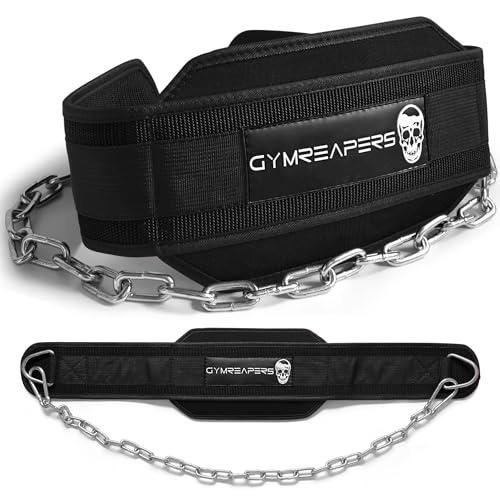
Gymreapers Gymreapers Dip Belt with Chain
Gymreapers Dip Belt with Chain

Our pick on the two things that are checkable in this category: a published 300 lb rating and a 38 in chain, the longest here, which is what lets you hang two or three plates without them swinging into your shins. Contoured padded back, and a model number that still exists if you need to replace it.

A named brand with a published rating
8.3
$31.18Amazon
02
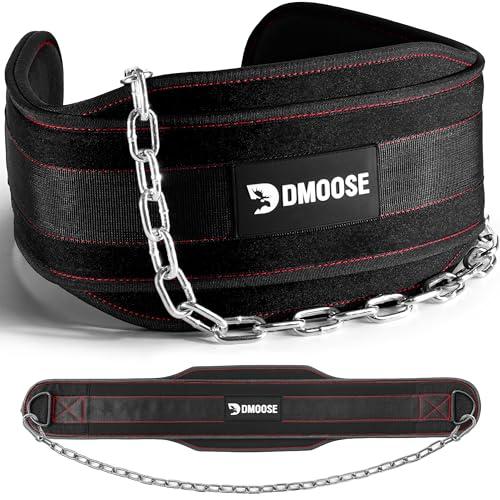
DMoose Fitness DMoose Fitness Dip Belt (DP-1)
DMoose Fitness Dip Belt (DP-1)

Publishes 350 lb — 50 lb more than the Gymreapers — on a stainless steel chain with a coated D-ring and locking carabiners, and it is the only belt here whose own dimensions and weight are published and plausible: 33 x 6 x 2 in at 0.79 lb. Thick padding, reinforced stitching, nothing exotic.

The highest published rating from a named brand
8.3
$26.99Amazon
03
AKD AKD Dip Belt, No-Chain Nylon Strap (AKD-DB-001)
AKD Dip Belt, No-Chain Nylon Strap (AKD-DB-001)

The one belt here with no chain at all: a reinforced nylon strap through steel D-rings with triple bartack stitching and a spring carabiner, adjusting from 28 to 50 in. No metal over your hip, nothing to clang on the floor between sets, and nothing to shred a shirt — which is the whole argument for it in an apartment.

A quiet belt for a shared building
7.8
$29.74Amazon
04
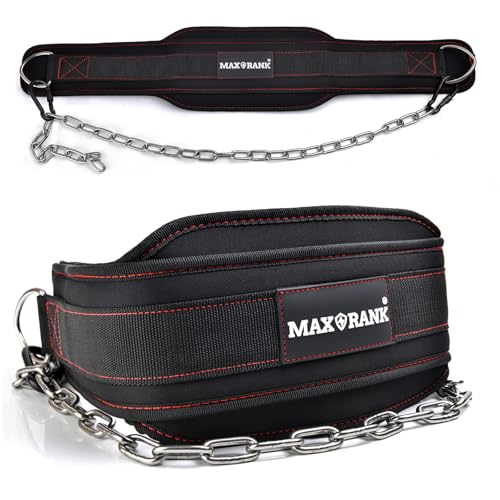
MAXRANK MAXRANK Dip Belt with 37 in Chain (DB-001)
MAXRANK Dip Belt with 37 in Chain (DB-001)

The budget pick, and the one that publishes the most about its own geometry: a 37 in chain of 5 mm links reaching 42 in total with the two locking carabiners, and a stated waist range of 22 to 46.3 in. Its 550 lb figure is the largest claim on the page and the one we would trust least.

The budget pick
8.0
$16.98Amazon
05
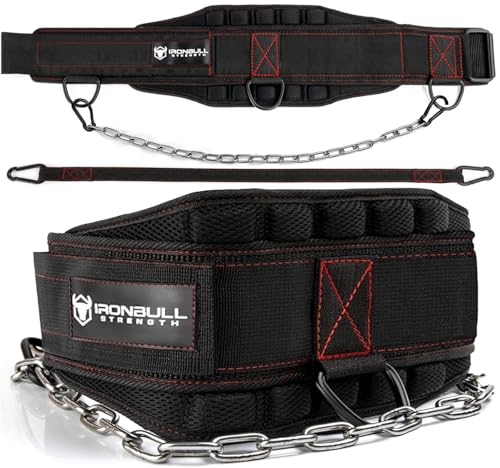
Iron Bull Strength Iron Bull Strength Advanced Dip Belt V2
Iron Bull Strength Advanced Dip Belt V2

The most versatile belt here and the only one that ships both a steel chain and a nylon strap, with three D-ring anchors instead of two — so it covers sled pulls, cable rows and belt squats as well as dips. It is also the only belt on the page with a published lifetime warranty, and it is sized rather than one-size.

Belt squats and sled work too
7.3
$49.95Amazon

#ad · Live prices from the Amazon Product API, as of November 24, 2026. Where we have no verified live price, we show none — we would rather leave a gap than print a number that has rotted.

In detail

The picks, in full

01
Gymreapers Gymreapers Dip Belt with Chain

A named brand with a published rating

Gymreapers Dip Belt with Chain

38" steel chain300 lb publishedPadded contoured backModel GR-DIPBELT-BL
8.3/10

Our pick on the two things that are checkable in this category: a published 300 lb rating and a 38 in chain, the longest here, which is what lets you hang two or three plates without them swinging into your shins. Contoured padded back, and a model number that still exists if you need to replace it.

Good

  • Longest published chain here at 38 in, which is the difference between loading two plates and fighting them
  • Publishes a load rating and a real model number, so spares and warranty claims are possible
  • Contoured padding is the most comfortable arrangement for heavier loads in this group

Trade-offs

  • 300 lb is the LOWEST published rating on this page, and no listing in the class states how it was tested
  • Amazon's dimension fields for this listing are physically impossible (a 100 kg belt), so there is nothing to verify on size
  • No published waist range — measure yourself against the product images before ordering
Fit
9
Value
8
Build
9
Load
7

Skip this if…

…you want the cheapest honest belt — the MAXRANK does the same job for about half as much, with a longer total drop.

Spec sheet

Type
Chain dip belt
Chain
38" heavy-duty steel chain (published)
Published load
Up to 300 lb (published; no test standard stated)
Belt
Contoured, cushioned padded back support
Attachment
Chain through the D-rings; works on dips, pull-ups, chin-ups and belt squats
Waist range
Not published
Dimensions
Not published — the Amazon fields for this listing (100 kg, 100 cm) are not credible
Stored size
Rolls into a drawer; the chain is the only bulky part
Install / renter
No install at all — it hangs off you, not the building
$31.18View on Amazon

$39.9922% off

Price as of November 24, 2026. Prices change — Amazon's is the one that counts.

#ad · we may earn a commission from this link to Gymreapers Dip Belt with Chain

02
DMoose Fitness DMoose Fitness Dip Belt (DP-1)

The highest published rating from a named brand

DMoose Fitness Dip Belt (DP-1)

350 lb publishedStainless chain0.79 lbCoated D-ring
8.3/10

Publishes 350 lb — 50 lb more than the Gymreapers — on a stainless steel chain with a coated D-ring and locking carabiners, and it is the only belt here whose own dimensions and weight are published and plausible: 33 x 6 x 2 in at 0.79 lb. Thick padding, reinforced stitching, nothing exotic.

Good

  • Highest published load rating of the two established brands here, at 350 lb
  • The only belt on this page with credible published dimensions and a published weight
  • A coated D-ring is a small thing that stops the chain chewing the hardware over a few hundred sessions

Trade-offs

  • Chain length is not published, which is the one spec that decides how many plates clear the floor
  • No published waist range
  • Same price as the Gymreapers with a shorter published belt body, so the 350 lb figure is the only reason to prefer it
Fit
8
Value
8
Build
8
Load
9

Skip this if…

…the chain is the thing you object to — the AKD strap belt does the same job with no metal running over your hip.

Spec sheet

Type
Chain dip belt
Chain
Heavy-duty stainless steel chain (length not published)
Published load
Up to 350 lb (published; no test standard stated)
Belt
Thick padding, heavy-duty nylon strap, reinforced stitching
Attachment
Coated D-ring plus strong carabiners for plates or kettlebells
Waist range
Not published
Dimensions
33" x 6" x 2" (published)
Unit weight
0.79 lb (published)
Stored size
Folds flat into a gym bag
Install / renter
No install
$26.99View on Amazon

$38.9931% off

Price as of November 24, 2026. Prices change — Amazon's is the one that counts.

#ad · we may earn a commission from this link to DMoose Fitness Dip Belt (DP-1)

03
AKD AKD Dip Belt, No-Chain Nylon Strap (AKD-DB-001)

A quiet belt for a shared building

AKD Dip Belt, No-Chain Nylon Strap (AKD-DB-001)

No chain — nylon strapFits 28-50"Triple bartack stitchingSpring carabiner
7.8/10

The one belt here with no chain at all: a reinforced nylon strap through steel D-rings with triple bartack stitching and a spring carabiner, adjusting from 28 to 50 in. No metal over your hip, nothing to clang on the floor between sets, and nothing to shred a shirt — which is the whole argument for it in an apartment.

Good

  • The only published waist range in the class, 28-50 in, which removes the main returns risk
  • No chain means no clang on a hard floor between sets and no torn shirts — the apartment answer
  • Triple bartack stitching at the D-rings is the correct reinforcement for a fabric load path

Trade-offs

  • Publishes no load rating at all, which is the number you most want on a fabric belt
  • A strap is slower to adjust between weights than a chain — you re-thread rather than re-hook a link
  • Newest listing here and the least established brand, so there is no track record to lean on
Fit
10
Value
8
Build
7
Load
6

Skip this if…

…you load three or four plates and want the fastest possible weight changes — a chain belt hooks a different link in a second.

Spec sheet

Type
Strap dip belt (no chain)
Strap
Reinforced nylon, adjusts 28-50 in (published)
Published load
Not published
Belt
Padded neoprene, sits flat across waist and hips
Attachment
Steel D-rings with triple bartack stitching; spring-loaded carabiner
Waist range
28-50" (published) — the only belt here that states one
Dimensions
31.9" x 6.7" (published)
Noise
No chain, so no metal-on-plate or metal-on-floor noise between sets
Stored size
Flattest belt here; it is fabric and a carabiner
Install / renter
No install
$29.74View on Amazon

Price as of November 24, 2026. Prices change — Amazon's is the one that counts.

#ad · we may earn a commission from this link to AKD Dip Belt, No-Chain Nylon Strap (AKD-DB-001)

04
MAXRANK MAXRANK Dip Belt with 37 in Chain (DB-001)

The budget pick

MAXRANK Dip Belt with 37 in Chain (DB-001)

37" chain, 42" totalFits 22-46.3"5 mm links550 lb claimed
8.0/10

The budget pick, and the one that publishes the most about its own geometry: a 37 in chain of 5 mm links reaching 42 in total with the two locking carabiners, and a stated waist range of 22 to 46.3 in. Its 550 lb figure is the largest claim on the page and the one we would trust least.

Good

  • Longest total drop here at a published 42 in with the carabiners, which keeps plates off the floor on dips
  • Publishes a waist range and credible dimensions at the lowest price on the page
  • Locking carabiners rather than open hooks, which is the right call on a loaded belt

Trade-offs

  • The 550 lb claim is nearly double the established brands' published ratings with no stated method behind it — we rank it on the hardware, not the number
  • No brand history and no warranty term published
  • Thin belt body compared with the contoured Gymreapers, so heavy loads concentrate more pressure
Fit
9
Value
10
Build
7
Load
6

Skip this if…

…you want a figure you can lean on — buy the published 300 lb or 350 lb from a brand that stakes its name on it.

Spec sheet

Type
Chain dip belt
Chain
37" long, 5 mm thick; 42" total drop with the two carabiners (published)
Published load
550 lb claimed (published; no test standard stated — treat as marketing)
Belt
Double-layered military-grade nylon, double-stitched in multiple places
Attachment
Two high-hardness locking carabiners through a D-ring
Waist range
22-46.3" (published)
Dimensions
36" x 7" x 0.79" (published)
Stored size
Rolls up small; the chain is the bulk
Install / renter
No install
$16.98View on Amazon

$24.9832% off

Price as of November 24, 2026. Prices change — Amazon's is the one that counts.

#ad · we may earn a commission from this link to MAXRANK Dip Belt with 37 in Chain (DB-001)

05
Iron Bull Strength Iron Bull Strength Advanced Dip Belt V2

Belt squats and sled work too

Iron Bull Strength Advanced Dip Belt V2

Chain AND strap3 D-ring anchorsLifetime warrantySized by waist
7.3/10

The most versatile belt here and the only one that ships both a steel chain and a nylon strap, with three D-ring anchors instead of two — so it covers sled pulls, cable rows and belt squats as well as dips. It is also the only belt on the page with a published lifetime warranty, and it is sized rather than one-size.

Good

  • Both attachment styles in one box, so you can run the chain for dips and the strap for belt squats
  • A third D-ring opens up sled and cable work that no other belt here handles cleanly
  • The only published warranty in the class, and it is a lifetime one

Trade-offs

  • Publishes no load rating and no dimensions — on the most expensive belt on the page
  • Sized rather than one-size, so a wrong measurement is a return rather than a tighter buckle
  • Costs roughly twice the MAXRANK for versatility most readers training in a spare room will not use
Fit
7
Value
7
Build
9
Load
6

Skip this if…

…all you will ever do is weighted dips and pull-ups — a one-size chain belt at half the price does exactly that.

Spec sheet

Type
Chain-and-strap dip belt, sized
Included
Heavy-duty steel chain plus a high-strength nylon strap (published)
Published load
Not published
Belt
Ultra-durable nylon webbing with a reinforced back section
Attachment
Three D-ring anchors — dips, pull-ups, sled pulls, belt squats, cable rows
Waist range
Sized; the maker publishes a size chart and says to measure true waist, not pants size
Dimensions
Not published
Warranty
Lifetime replacement warranty (published)
Stored size
Folds flat; two attachment options to store with it
Install / renter
No install
$49.95View on Amazon

Price as of November 24, 2026. Prices change — Amazon's is the one that counts.

#ad · we may earn a commission from this link to Iron Bull Strength Advanced Dip Belt V2

Before you buy: three checks

1. Check what you are going to hang from

A dip belt is an accessory to a frame, and the frame has to be rated for your bodyweight plus the load. A doorway pull-up bar that is fine at 180 lb is a different proposition at 240 lb, and published capacities on bars and towers vary enormously — the numbers, maker by maker, are in best doorway pull-up bars, best wall-mounted pull-up bars and best power towers. If you are renting and the bar is a pressure-fit doorway unit, start with light plates and be honest with yourself about the mounting.

2. Do the clearance arithmetic above

Bar height, hip height while hanging, chain drop, plate radius. Two minutes with a tape measure saves a return. If clearance is tight, hook a shorter link or use a smaller, heavier plate rather than a wide light one.

3. Measure your waist, properly

Two of these belts publish a waist range (28-50 in and 22-46.3 in) and the Iron Bull is sold in sizes with the maker telling you in its own listing to measure your true waist and not your pants size. That is good advice and the reason it is on the listing is that people ignore it. For the one-size chain belts, measure anyway: a belt that only just closes puts the load in the wrong place on your hips.

How to actually use it

Three things that are not obvious the first time:

Load the belt on the floor, then step into it. Thread the plates, lay the belt down with the chain between your feet, step over it, pull it up and clip. Trying to hold a loaded belt while fastening it is how people drop plates on their feet.

Let the chain hang in front, not between your knees. On dips the weight wants to swing; a shorter drop with the plate just below your knees swings less and keeps your form honest. On pull-ups a slightly longer drop is more comfortable.

Go up in small steps. Adding 10 lb to a set of eight dips is a real increase. The failure mode with a dip belt is not the belt breaking; it is adding 45 lb at once, losing depth, and training a worse version of the movement than you were doing with no weight at all.

Where a dip belt sits in a small gym

Way to add loadFloor costLoad ceilingNoiseBest at
Dip beltNone — it lives in a drawerYour plate collectionChain on plate, unless you buy the strapWeighted dips, pull-ups, belt squats
Weighted vestNone — it hangs on a hookLow, and fixed in small stepsSilentPush-ups, walking, anything moving
Heavier dumbbellsA tray or a rack, permanentlyHigh, expensive per poundQuiet if you do not drop themPressing and rowing
A bigger machine15-40 sq ft, permanentlyHighVariesGuided movement patterns

That first row is the argument for this whole page. Nothing else on this website adds progression without adding floor, which is why the belt belongs in the first fifty dollars of a small gym rather than the last. The cheapest complete setup we can build around that idea is best home gym under $100, and the bodyweight-only version is best bodyweight home gym equipment.
How we picked

We don't run a testing lab

We compiled published specifications, manufacturer documentation and aggregated owner reviews, then scored each product against a published rubric that weights fit-for-small-space, value, install reversibility and build. The scores are judgments from documented research — they are notmeasurements we took, because we don't have a lab and we're not going to pretend we do. Every dimension is cited in Sources.

Questions

Frequently asked

What is the best dip belt?
On published specifications, the Gymreapers: a 300 lb rating, a 38 in chain — the longest published here — a contoured padded back and a real model number for spares. The DMoose DP-1 publishes a higher 350 lb figure and credible dimensions for the same money, so it is a fair swap. If you train in an apartment, the AKD strap belt is the one we would choose anyway, because it removes the steel chain and the noise that goes with it. The honest caveat on all of them is that no listing in this category states how its load rating was tested.
How much weight can a dip belt hold?
Published figures across the five belts here run from 300 lb to 550 lb, and two publish nothing at all. Not one listing names a test standard, a safety factor, or whether the number is a working load or a breaking strength — so treat them as indications rather than specifications. The practical answer for almost every reader is that any of these belts handles far more than you will hang on it: most people spend a year between 10 lb and 60 lb of added load, and the frame you hang from will be the binding constraint long before the belt is.
Will a dip belt work with a doorway pull-up bar?
Usually, with two checks. First, the bar's published capacity has to cover your bodyweight plus the plates — read best doorway pull-up barsfor the maker-by-maker numbers. Second, floor clearance: a doorway bar is lower than a power tower, and a chain of 36 to 42 in plus a big plate can put the weight on the floor before you start. Measure the bar height, your hip height while hanging, and half your plate's diameter. If it is tight, hook a shorter link in the chain or use a smaller, denser plate.
Dip belt or weighted vest?
Belt first for a gym built around a bar or a dip station: it hangs the load below your hips, which is right for dips, pull-ups and belt squats, and its ceiling is whatever plates you own. Vest second, for everything that moves — push-ups, walking, stairs — because nothing swings and nothing hangs. Vests have a much lower load ceiling and fixed small increments. Our ranking of the vests is best weighted vests for small spaces.
Is a chain or a strap dip belt better?
A chain adjusts in a second, threads straight through a plate's center hole and never wears out; it is also loud against cast iron, it can graze a thigh at the top of a dip, and it scratches a floor when you put the belt down. A nylon strap is quiet and kinder to skin and shirts, which matters in a shared building, but changing the drop means re-threading rather than re-hooking a link. Four of our five picks are chain belts, one is strap-only, and the Iron Bull ships both in the same box.
Can you use a dip belt for squats?
Yes, and in a room with no barbell it is one of the most useful things a dip belt does. A belt squat hangs the load from your hips rather than loading your spine, so you stand on two raised surfaces — a pair of steps or plyo blocks — and squat with the weight hanging between your feet. The long chain that is a liability on a doorway bar is an asset here. The Iron Bull V2 publishes three D-ring anchors specifically for belt squats, sled pulls and cable rows; the chain belts all work with a longer drop.
What do you hang on a dip belt?
Weight plates threaded onto the chain are the cleanest and quietest option, and if your plates are the 1 in standard rather than Olympic, check the chain passes through the hole. A kettlebell clipped by the handle is the fastest to attach but hangs lower, costing you floor clearance. A fixed dumbbell works at a push. Do not hang an adjustable dumbbell from a dip belt — a dial or pin mechanism is not designed to be loaded sideways while swinging.
Why do dip belt load ratings vary so much?
Because nobody is measuring the same thing, and nobody says which thing they measured. The two most established brands here publish the lowest figures (300 lb and 350 lb) and the cheapest belt publishes 550 lb, which is close to double. No listing names a test standard or distinguishes a working load from a breaking strength. We rank these belts on the parts we can check — chain length, waist range, hardware, stitching, published warranty — and we print the ratings as the claims they are.

Keep reading

Receipts

Sources

We don't run a testing lab, and we don't pretend to. Every dimension and rating traces to a manufacturer spec sheet or manual, named and linked above. Where a maker doesn't publish a number, the spec reads "Not published" rather than a guess. Read our full method.