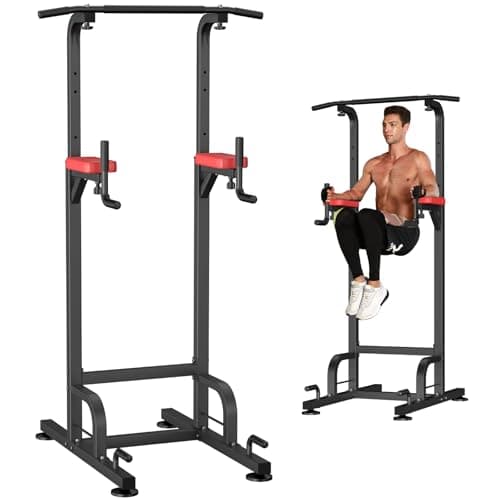
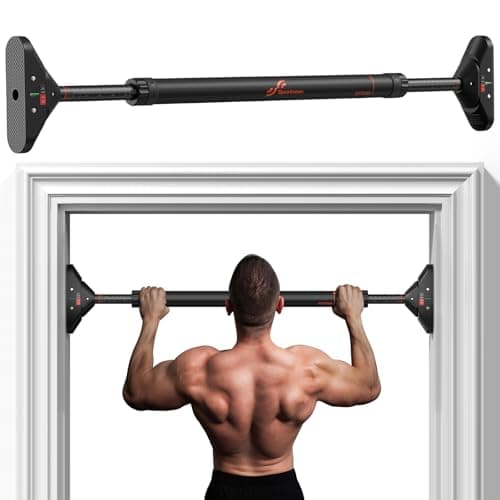
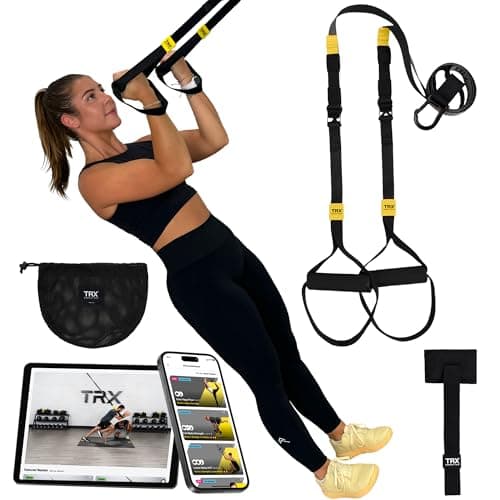
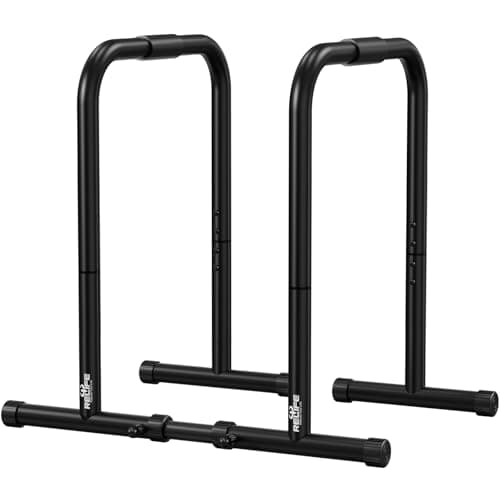
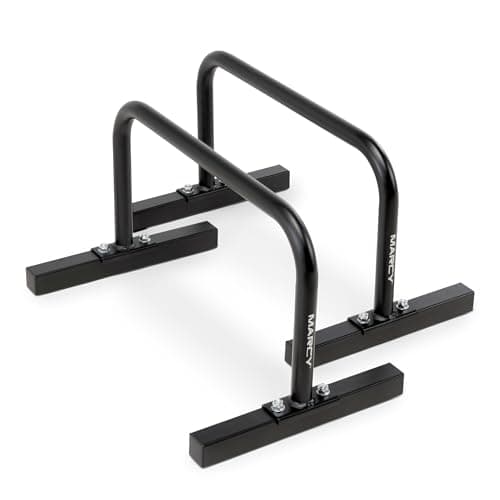
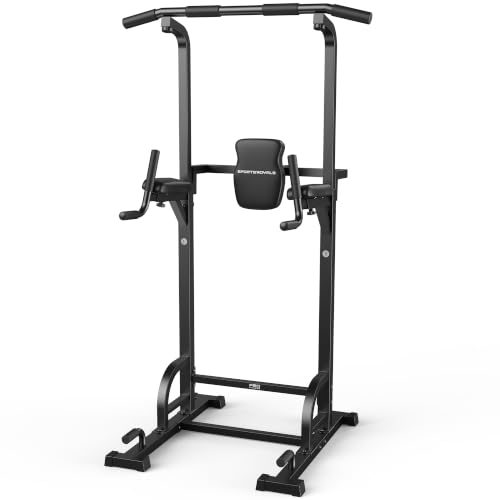
The SPORTSROYALS power tower is the one piece to buy if you buy one: a wider base and a heavier frame than the budget towers, with pull-up, dip, knee-raise and push-up stations in a single footprint and no drilling. Our budget pick is the RELIFE power tower — the same four stations on a lighter frame for the lowest price here, and genuinely adequate at lower bodyweights. If your ceiling is too low for a tower, the Sportneer doorway bar publishes a 440 lb rating, fits 29.5 to 37 in door frames and leaves nothing behind. The TRX GOis the renter's answer to rows at 1.5 lb and a published 700 lb rating. The RELIFE dip bars publish 400 lb and cost less than a month of gym membership, and the Marcy ACC-0333-PARA parallettes are the only pair here from a brand with an orderable part number.
Bodyweight training is the cheapest real strength training there is, and it is the only kind that works in a room where you cannot put 200 lb of iron on a wooden floor. But the equipment question is not "what is best" — it is "which movement am I missing". There are exactly three movements a bodyweight room struggles to cover: a vertical pull, a horizontal pull, and a deep dip. Everything on this page exists to solve one of those three.
Who each piece is for
- SPORTSROYALS power tower — for the person with 7 ft of ceiling who wants every bodyweight station in one object and intends to use it for years.
- RELIFE power tower — for the person spending the least who still wants a tower; the budget pick on this page.
- Sportneer doorway bar — for renters and low ceilings: the vertical pull with zero footprint and zero install.
- TRX GO — for the person whose missing movement is the row, and who needs the whole gym to fit in a drawer.
- RELIFE dip bars — for the person who wants dips, inverted rows and L-sits at floor level without a tower.
- Marcy parallettes — for handstand, L-sit and deficit push-up work, and for anyone who wants a part number they can quote in five years.
Published rated load is the only spec that matters
A bodyweight frame has one job: hold a person who is moving. So the published rating is the whole specification, and this category is unusually split on whether makers print one. The Sportneer bar publishes 440 lb, the TRX GO publishes 700 lb and the RELIFE dip bars publish 400 lb. The two towers publish no figure at all, and the Marcy parallettes publish no rated load either — which, as the card says, is the single number you want before you put a handstand on a bar. A pair of unrated bars is not automatically unsafe; it is simply unverifiable, and we will not convert silence into a number.
Where each piece lives between sessions
This is the second ranking axis, because a bodyweight room is usually a room that has another job. The TRX GO stores in its own mesh bag in a drawer. The doorway bar comes out of the frame in seconds and stands behind a door. The dip bars and the parallettes are two light objects you can stack in a closet — the Marcy pair publishes 13.2 lb for the two of them. The towers do not move: they are the only pieces here that own their floor permanently, and both put a pull-up bar overhead, so they need real ceiling height.
How the six compare
| Piece | Movement it adds | Published load | Install | Stores |
|---|
| SPORTSROYALS tower | Pull-up, dip, knee raise | Not published | Freestanding, no drilling | No — permanent footprint |
| RELIFE tower | Pull-up, dip, knee raise | Not published | Freestanding, no drilling | No — permanent footprint |
| Sportneer doorway bar | Vertical pull | 440 lb | Leverage mount, no drill | Yes — behind a door |
| TRX GO | Horizontal pull (rows) | 700 lb | Door anchor, nothing left behind | Yes — mesh bag, 1.5 lb |
| RELIFE dip bars | Dip, inverted row | 400 lb | Freestanding, zero install | Yes — two light bases |
| Marcy parallettes | L-sit, handstand, push-up | Not published | Freestanding, zero install | Yes — 13.2 lb for the pair |
The cheapest complete kit is two items, not six
You do not need this whole page. A doorway bar and a suspension trainer together cover the vertical pull, the horizontal pull, the single-leg work and the core work, cost less than one tower, install in seconds and both store in a cupboard. That is the entire bodyweight gym for a rented bedroom. Add the dip bars when you want dips and deficit push-ups, and add a tower only when you have decided the room is a gym room.
What bodyweight training cannot do
Load your legs. There is no bodyweight squat progression that matches a loaded barbell or even a pair of heavy adjustable dumbbells, and pretending otherwise is the main dishonesty in this category. If leg strength is the goal, the honest sequence is to buy bodyweight gear for the upper body and adjustable dumbbells for everything below the waist — or to add a squat stand when the room allows. A weighted vest is the cheapest way to add load to pull-ups and dips without adding any floor area at all.
Towers, bars and ceiling height
Every tower here puts its pull-up bar overhead, which means your ceiling has to clear the frame and your hanging height. Under roughly 7 ft, the tower stops being a pull-up station and becomes a dip station with a bar you cannot use — the RELIFE card says so outright. A doorway bar sidesteps the whole problem because it mounts at door height and you hang in the doorway. The full head-to-head is power tower vs doorway pull-up bar, and the mounted options are ranked on best wall-mounted pull-up bars.
Floors, noise and neighbors
Bodyweight work is the quietest training in this niche — nothing is dropped and nothing hits the floor except you. The exceptions are jumping variations and the moment you step off a tower, so a mat under the frame is still worth the money on an upper floor. Best home gym mats covers the thickness question, and lifting in an apartment without annoying the neighbors covers the rest.