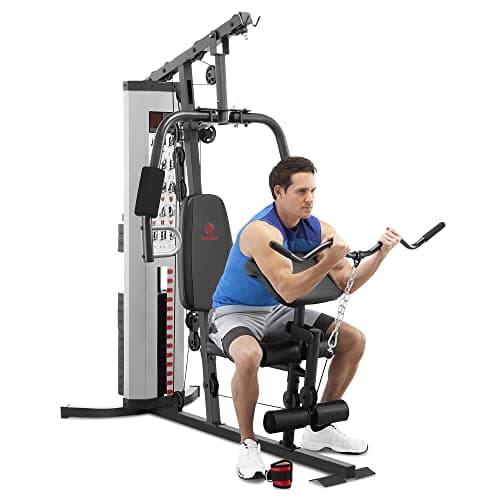
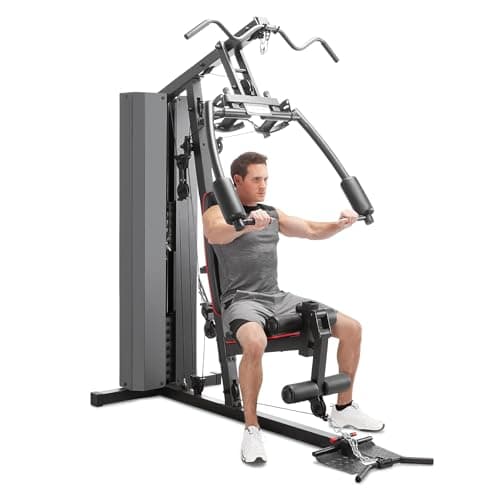
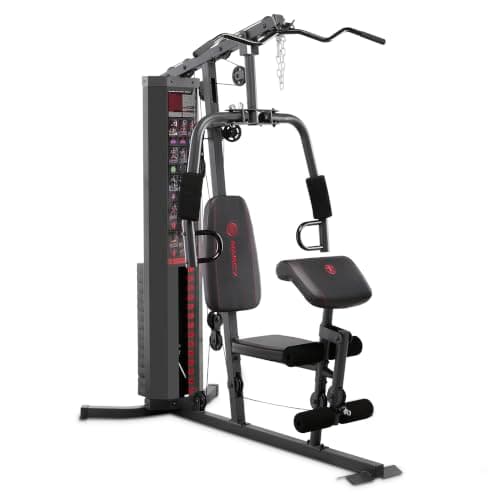
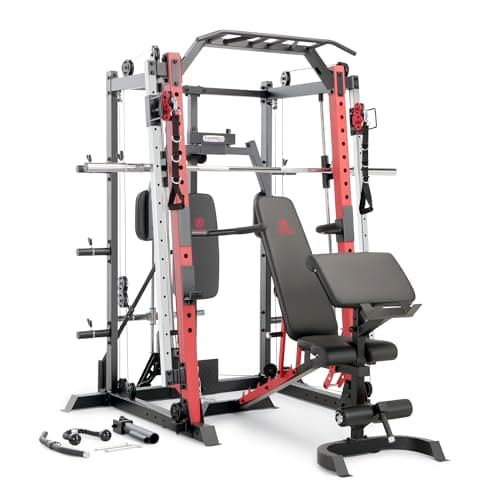
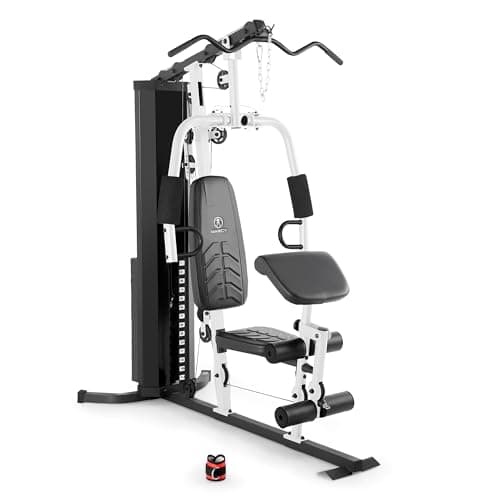
If you are buying a Marcy stack machine, buy the MWM-8147. It is the only one of the four that publishes both a user capacity (300 lb) and a warranty term (2 years), it ships a lat bar and an ankle strap in the box, and it is the newest listing in the range. The MWM-988 is the model most people mean when they search for a Marcy home gym, and it is the only one that publishes its 280.5 lb assembled weight. The MKM-81010 is the 200 lb stack for anyone who would reach the top of 150 lb, at the cost of 85 in of height. The MWM-989 is the cheapest route to the same frame. The SM-4033 Smith cage is the Marcy for people who would rather load a barbell than pull a pin.
Marcy has been selling the same model numbers for over a decade, which on this site counts for something: we rank equipment on what its maker publishes, and a brand whose MWM-988 spec sheet has not moved in ten years is a brand you can plan a room around. This page is about the machines people mean when they search for a "Marcy home gym" — the selectorized stack stations and the Smith cage. Marcy's smaller gear appears elsewhere on the site and we link it at the bottom.
The finding: three of these are the same machine
The MWM-988, MWM-989 and MWM-990 all publish:
- Identical assembled dimensions — 68 in long, 42 in wide, 78 in high.
- An identical 150 lb selectorized stack with a safety lock on the pin.
- Identical station lists — dual-action press arms for chest press and vertical butterfly, high and low pulleys, a removable preacher curl pad, a leg station.
- Five identical feature bullets, word for word, including the same typo ("REMOVEABLE CURL PAD").
They sit at three different prices. We are not going to tell you the frames are physically identical, because we have not had three of them in a room; we are telling you that nothing in the published specifications distinguishes them, so nothing in the published specifications justifies paying more. Buy on price and availability between those three — or step up to the MWM-8147, which publishes two numbers none of them do.
One more detail worth having. The MWM-990's Amazon item weight field reads 125 lb while the MWM-988's reads 280.5 lb, for a frame both listings describe with the same dimensions. Those cannot both be right. The MWM-990 listing also shows its manufacturer as "IMPEX INC - DROPSHIP" — Impex is Marcy's parent company, and the suffix tells you how the unit reaches you. Neither fact is damning. Both are reasons we rank the listings that publish cleaner numbers above the ones that do not.
What we ranked on
- Published footprint, and the ceiling above it. These machines run 19.83 to 20.78 sq ft of permanent floor and 78 to 85 in of height. There is no folded state and no transport wheel in the range. The footprint is the purchase.
- What the listing publishes. Four specs decide a stack machine — stack weight, assembled dimensions, maximum user weight, warranty term — and across these five listings not one publishes all four. The MWM-8147 publishes three.
- Stack weight against the honest feel of a pulley. 150 lb on a single-stack machine is not 150 lb in your hands; the pulley ratio means the handle is lighter than the plate number. That is normal for the class and it is why 150 lb is enough for most people far longer than they expect — and why a strong lifter should look at the 200 lb machine rather than assume they will outgrow it in a year.
- What is in the box. One listing publishes a lat bar and an ankle strap as included. On the others you find out on assembly day.
- Availability, checked the day we wrote this. Two show In Stock; three show a 2-to-5 day dispatch. All five were purchasable on 2026-11-05.
How the five compare
| Machine | Stack | Footprint | Height | Max user | Warranty |
|---|
| MWM-8147 | 150 lb | 20.45 sq ft | 78.1 in | 300 lb | 2 years |
| MWM-988 | 150 lb | 19.83 sq ft | 78 in | Not published | Not published here |
| MKM-81010 | 200 lb | 20.78 sq ft | 85 in | Not published | Not published |
| MWM-989 | 150 lb | 19.83 sq ft | 78 in | Not published | Not published |
| SM-4033 Smith cage | Barbell — no stack | About 39 sq ft (cage) | 86.2 in | 300 lb | Not published |
Footprint is length multiplied by width from each listing's own published dimensions, divided by 144. The Smith cage figure uses the cage dimensions Marcy states in its bullet (67.8 x 83.5 in); Amazon's dimensions field for the same product gives 84 x 70 in, and its item weight of 140 lb cannot describe a cage, a bench and a Smith bar. Where a listing gives two numbers we print the one the maker wrote in prose and say so.
The part a small-space site has to say out loud
This is 20 sq ft of steel that never moves, under a ceiling that needs to clear 78 to 86 in, assembled in the room it will die in. On a site about apartments and garage corners, that makes a Marcy stack machine a garage, basement or spare-room purchase and nothing else. Three specific consequences:
- Access space is on top of the footprint. You sit down at it, pull a bar overhead, and extend your legs forward. Add about 2 ft in front of the seat and 1 ft either side to the published rectangle, and you are planning for closer to 30 sq ft. The measuring method is in how much space do you need for a home gym.
- Ceiling first, not last. The MKM-81010 is 85 in tall. A standard 8 ft ceiling is 96 in, and a finished basement is often 84 to 90 in. Measure before you order — ceiling height for a home gym has the full arithmetic, and home gym in a basement covers the ducts and beams that take the number lower still.
- It is not renter-reversible. Nothing is drilled, so your deposit is safe — but a 280 to 369 lb machine built in a bedroom has to be dismantled to leave it. If you move every year, the honest alternatives are adjustable dumbbells and a folding bench, or the whole disappearing kit in the hidden home gym.
Marcy's other equipment, and where it is ranked
If you came here for the brand rather than for a stack machine, the Marcy gear that suits a small room is spread across the site:
Considered and not ranked
- Marcy MWM-990. Verified live at a 3-to-5 day dispatch. Left off because its published specification is identical to the MWM-988 and MWM-989 at a higher price, with the 125 lb item weight contradiction described above. Covered in prose rather than given a slot, because a third card for the same published machine would pad the page.
- Non-Marcy stack machines at the same price. Mikolo, JELENS, GOIMU and several unbranded 100-to-152 lb stations were live and in stock while we wrote this. They belong on the class page, not the brand page — best all-in-one home gyms for small spaces ranks the format across brands, and the all-in-one buying guide explains what a stack machine does and does not train.
- Marcy's discontinued stack machines. Several older MWM and MKM numbers still return results but resolve to third-party listings with no live price. We do not rank a listing the price layer cannot confirm.
Every machine above was verified live on 2026-11-05. Prices on the cards come from the live price layer, never from this text — the 150 lb stack machines sit in the $450 to $600 bracket, the 200 lb machine around $750, and the Smith cage in the $1,500-plus bracket.
Which Marcy, in four questions
1. Do you want a stack or a barbell?
A stack machine fixes the movement path and changes weight with a pin: safe to use alone, no plates to store, no technique to learn, and no way to train a free squat or a deadlift. A Smith cage gives you a guided barbell plus a bench, a pull-up bar and a landmine, with real skill and real spotting requirements. If you want to lift rather than to exercise, it is the cage — and if you want the cage without the Smith rails, a power rack costs less and does more. The format argument in full is machines vs free weights for a small home gym.
2. Will you reach the top of a 150 lb stack?
Most people take years, and the pulley ratio means the handle feels lighter than the stack number — which cuts both ways: it is why 150 lb lasts, and why a strong presser can hit the pin at the top sooner than expected on the chest station. If you already press a loaded barbell, buy the 200 lb machine and accept the 85 in height. If you are starting out or returning, 150 lb is not the constraint on your progress.
3. Measure the room twice — ceiling, then floor
Height first, because it is the one you cannot work around: 78 in for the MWM machines, 85 in for the MKM-81010, 86.2 in for the cage, which Marcy itself says wants 9 ft of clearance around it. Then the floor: 20 sq ft published, roughly 30 sq ft in practice once you can get in and out of the seat. On an upper floor, check the load question in can your apartment floor hold a home gym — a 369 lb machine on four feet is a concentrated load, not a distributed one.
4. Plan the assembly before the delivery
These ship as flat-packed steel and need full assembly in the room where they will stay. Published assembled weights here are 280.5 lb and 369 lb; the boxes are heavy, long and delivered to your door rather than your basement. Two people and an afternoon is the honest estimate, and a stack machine is not something you carry downstairs after it is built. Getting an assembled machine out of a house later is its own project — how to move a home gym.
What a stack machine does not train
Worth knowing before 20 sq ft disappears:
- Nothing that requires balance. The seat and the fixed path do the stabilizing for you. That is the safety feature and the limitation in one sentence.
- No loaded squat or hinge. A leg developer trains knee extension and flexion; it is not a squat and it is not a deadlift. If those matter, you want a bar — squat stands start at a small fraction of a stack machine.
- No pull-up, on the MWM machines. There is a high pulley, not a bar. The cage has multi-grip pull-up bars; a doorway bar solves it for the others at no extra floor.
- No cardio. Marcy makes cardio machines, and they are different purchases — see the fan bike and recumbent links above.