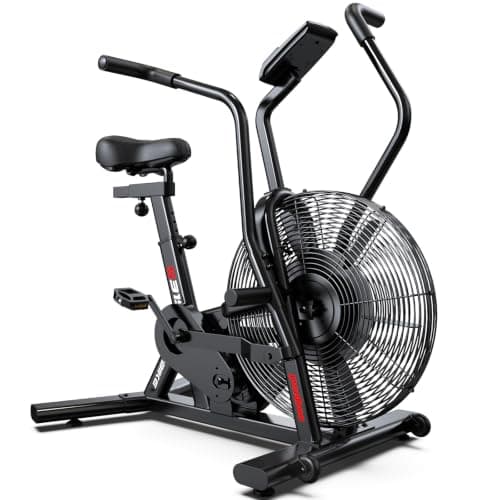
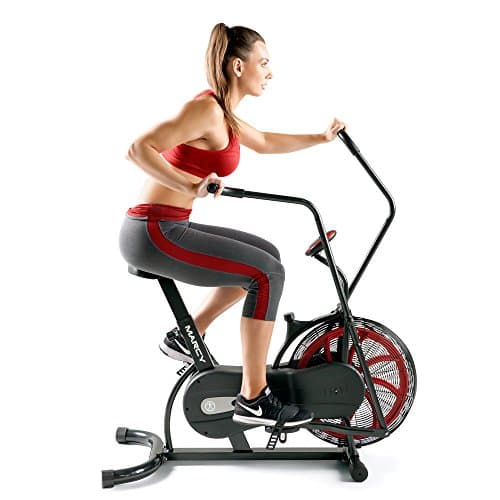
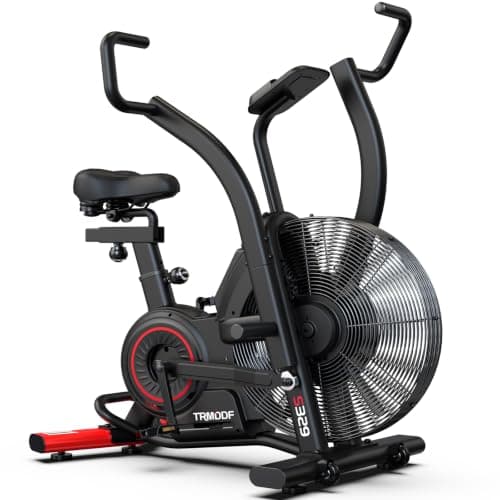
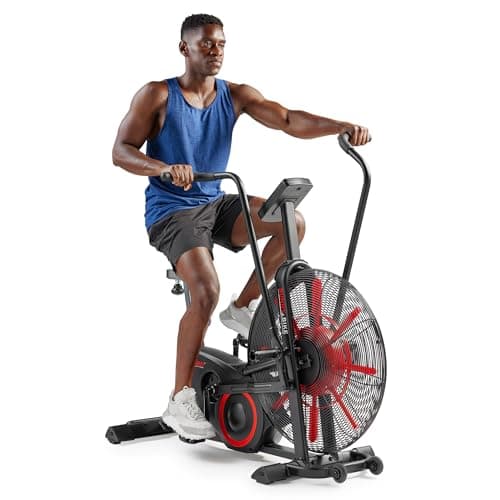
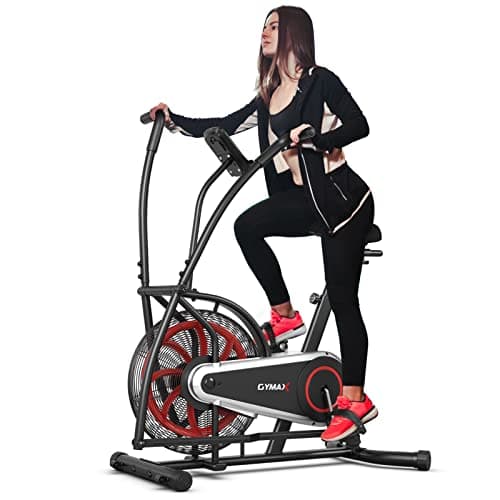
The GYMAX fan bike is our pick for a small room, because it wins the only contest that matters in this class: 6.55 sq ft of published floor area, which is more than a square foot less permanent rectangle than anything else here. If you want a published capacity figure instead, the pooboo S319 states 350 lb, stands 44 in tall and takes 7.81 sq ft. The Marcy NS-1000 is the cheapest way into the class and the only listing that publishes a frame gauge. The TRMDDF S329 is the only air bike here that tells you what size rider it fits. The Sunny SF-B223018 is the garage-corner choice: watts on the console, a belt drive instead of a chain, and the biggest footprint on the page.
Before the rankings, the part most air-bike roundups leave out. An air bike has no resistance setting. The fan is the resistance: push harder, the blades move more air, the air pushes back. That is why the class is loved by people who train intervals and why it is the single worst-matched machine to a quiet apartment on this entire site. It is not a floor-noise problem — there is no impact, so nothing travels down through the ceiling of the unit below, which is the failure mode we spend most of quietest cardio machines for apartments warning about. It is an airborne noise problem, and airborne noise is what goes through a shared wall, an open plan room and a bedroom door at 6 a.m.
Why this page exists on an apartment-first site
Because half of this site is the garage corner, and the garage corner is where an air bike is the right answer. In a detached garage, a basement or a spare room with a door that closes, the fan noise costs you nothing and you get the one piece of cardio equipment that cannot be cheated: no gears, no electricity, no ceiling on the intensity, and a session that can be over in ten minutes. Our garage-corner home gym guide is the room this machine is for.
If you live in an apartment with shared walls and a sleeping household, read this page as a reference rather than a shopping list, and then go and look at a compact rowing machine (comparable full-body work, folds upright, no fan) or a spin bike (quieter, smaller, and the resistance mechanism is the spec that decides it). We would rather lose the commission than sell you a wind tunnel for a studio apartment.
What we ranked on
- Published floor area, calculated from published dimensions. Not one of these five folds, and none has a folded figure to publish, so length multiplied by width is the rectangle you give up permanently. The spread on this page is 6.55 to 9.71 sq ft — a 48 percent difference between the smallest and largest machine for sessions that are functionally identical.
- Published maximum user weight. Two of the five publish one (350 lb and 330 lb); three publish nothing at all. On a machine you stand up on and haul at with both arms, a missing capacity figure is a mark against the listing. Home gym equipment for heavier users collects every published capacity on this site in one place.
- Drive type, where it is published. Most air bikes drive the fan through a two-stage system: a chain from the pedals and a belt to the fan, or a chain for both. One bike here is belt-only. A chain is the only part on an air bike that wants occasional attention, so belt-only is a genuine maintenance advantage — not a noise advantage, because the fan drowns out everything either way.
- Published rider fit. Exactly one listing on this page publishes a height range. For a machine with a fixed handlebar arc, that omission is the difference between a bike that fits and a return shipment of 90 lb of steel.
- What the listing publishes at all. Fan diameter, blade count, frame gauge, gear ratio, warranty term: five specs that decide how an air bike feels and lasts, and no listing here publishes all five. We rank the ones that publish more above the ones that publish less, because a number you can check is worth more than a number you are told to trust.
How the five compare
| Bike | Floor area | Height | Weight | Max user | Drive |
|---|
| GYMAX fan bike | 6.55 sq ft | 50 in | 58 lb | Not published | Belt + chain |
| pooboo S319 | 7.81 sq ft | 44 in | 90 lb | 350 lb | Belt + chain |
| Marcy NS-1000 | 8.69 sq ft | 49.5 in | Contradicted (see card) | Not published | Not published |
| TRMDDF S329 | 9.17 sq ft | 54.1 in | 91 lb | 350 lb | Belt + chain, 12:1 |
| Sunny SF-B223018 | 9.71 sq ft | 50.6 in | 108.9 lb | 330 lb | Belt |
Floor area is length multiplied by width from each listing's own published dimensions, divided by 144. It is the honest number for this class because there is no second number — no folded depth, no stored footprint, no upright park position. Whatever rectangle the bike arrives as, that is the rectangle it stays.
The noise question, answered properly
Not one of the five listings on this page publishes a decibel figure. That is unusual — walking pad and spin bike listings quote 20 to 25 dB constantly, and we routinely flag those numbers as unmeasured marketing claims. Here the silence is the more honest position, because there is no single number to give: an air bike at an easy spin is quieter than a conversation, and the same bike in the last ten seconds of a sprint is the loudest object in the house. The volume is a function of your effort, not a property of the machine.
What that means practically, with no number invented:
- Downstairs neighbors are fine. You are seated, nothing strikes the floor, and the frame weighs 58 to 109 lb spread over four feet. This is the quietest machine on the site for structure-borne noise. A mat under the feet is still worth it for the floor finish and the small amount of frame vibration.
- Anyone in the same room is not fine. You cannot hold a conversation or hear a television over a hard interval, and that includes a partner working at a desk ten feet away.
- Shared walls are the real risk.Airborne noise is exactly what a stud-and-drywall party wall passes. If your gym wall is a neighbor's bedroom wall, this is the wrong machine, and no mat fixes it — see lifting in an apartment without annoying the neighbors.
What the listings do not tell you
Three gaps repeat across this entire class, and no amount of reading fixes them, so plan around them instead.
Fan size is barely published. One listing on this page states its blade geometry (TRMDDF: six blades at 6 in, with a 585 mm guard); one states a blade count (GYMAX: eight). The rest describe the fan in adjectives. Fan diameter and blade count are what set the resistance curve, so the class is sold on feel while withholding the two numbers that produce the feel.
Nobody publishes a resistance scale, because there is not one.If you see a "level" on an air bike listing, it is a console display setting, not a brake. The Marcy is the one exception here: its bullet describes an adjustable tension knob alongside the air resistance, which is unusual in the class and which we report because Marcy states it, not because we have confirmed how much it does.
Assembled weight figures are unreliable.Amazon's item weight field is filled by the seller and routinely carries a carton weight, a single-component weight or an outright error. On this page the Marcy NS-1000 publishes both "Weight of 250 pounds" in its own bullet and 17 lb in Amazon's item weight field, which cannot both describe the same 14-gauge steel bike. We print both figures on its card and use neither.
Considered and not ranked
Four more air bikes were live and in stock on the day this page was written, and each was left off for a stated reason:
- GMWD AB01.Well specified on paper — 25 in fan, nine blades, 12-gauge steel, twenty sealed bearings — but it publishes three different footprints. Amazon's dimensions give 47.6 x 23.8 in (7.87 sq ft), the listing's own bullet gives 51.6 x 24.4 in (8.74 sq ft), and the same bullet claims "8.57 sq ft," which matches neither. That bullet also calls it a "Mikolo machine," a different brand entirely. We will not build a floor plan on a listing that cannot keep its own dimensions straight.
- Goplus air bike. Published dimensions identical to the GYMAX down to the seat range (41 x 23 x 50 in, 10 seat heights, 17 to 21 in fore-aft) — the same frame wearing a second brand. We rank one of them rather than filling two slots with one product, and we chose the one whose published item weight is at least plausible.
- Titan Fitness fan bike. The best-known name in the group, with turf tires and a removable fan guard, but at 51 x 37 in it needs 13.1 sq ft — twice the GYMAX — and its published height is 10 in, which is impossible. Wrong machine for a page about small rooms.
- Marcy AIR-1.A sibling of our third pick at roughly twice the price, with a listing that calls an upright fan bike a "recumbent bike" twice. The NS-1000 is the same maker, the smaller rectangle and the clearer page.
Everything above was verified live and In Stock on 2026-10-29. Prices on the cards come from the live price layer and never from this text — if a card shows "Check price," the feed could not confirm a price that day.
Buying an air bike for a small room: the short version
An air bike is a 7 to 10 sq ft permanent commitment that does one thing better than anything else on this site, and nothing else at all. Here is the sequence that stops the purchase going wrong.
1. Measure the rectangle, then add the arms
The published length and width describe the frame. They do not describe the handlebars at full travel, and on an air bike the handlebars travel through roughly the length of your forearm, forward and back, on both sides. Leave a foot clear in front of the machine and a foot behind the seat, and remember you will be mounting from the side. A bike with a 6.55 sq ft frame wants about 15 sq ft of room to be usable, which is still less than a treadmill needs. Our method for this is in how much space do you need for a home gym.
2. Decide whether you need a published capacity
Three of the five bikes here publish no maximum user weight. Our standing rule across the site is to stay at least 30 lb under a published rating and to prefer a machine that publishes one at all. On an air bike that rule tightens, because you spend a lot of the session out of the saddle pulling on the bars — the load is dynamic in a way a recumbent bike's never is. If you are over about 250 lb, buy one of the two bikes that publishes a number.
3. Check the height, not just the floor
The spread here is 44 to 54.1 in, and the taller bikes are taller because the fan cage is bigger. A 54 in machine under a basement stair, a sloped attic ceiling or a wall-mounted television is a different problem from a 44 in one. Measure up as well as across.
4. Expect to assemble it, and expect it to stay put
Every bike here arrives in a box, is built by you and weighs 58 to 109 lb once assembled. Transport wheels on an air bike let you tip and roll it across a hard floor; they do not let you carry it upstairs or lift it onto a shelf. If the machine has to leave the room between sessions, this class is the wrong answer and foldable home gym equipment is the right page.
5. Know what it does not train
An air bike is conditioning. It does not load your spine, it builds no strength you can measure in pounds, and the grip work from pulling the handles is incidental. In a small room the honest shopping list is one conditioning machine and one loadable thing — see home gym essentials for small spaces and what to buy first for a home gym.
Air bike against the rest of this site's cardio
| Machine | Permanent floor | Folds? | Main noise path | Best at |
|---|
| Air bike | 6.55-9.71 sq ft | No | Airborne (the fan) | Short, brutal intervals |
| Spin bike | 5.71-6.88 sq ft | No | Almost none | Seated endurance work |
| Rowing machine | Folds upright | Yes | Chain / flywheel | Full body, lowest permanence |
| Walking pad | Slides away | Yes | Footfall through the floor | All-day easy movement |
Read that table as a single sentence: the air bike is the least storable and loudest machine in the house, in exchange for the hardest ten minutes available at home. If that trade reads badly to you, it is the correct instinct, and rowing machine vs exercise bike and best low-impact cardio machines both lead somewhere better.