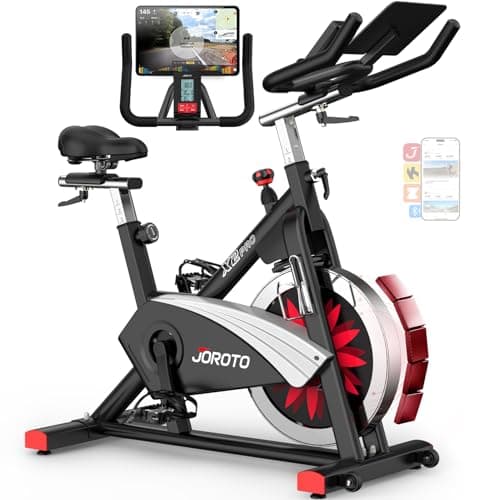
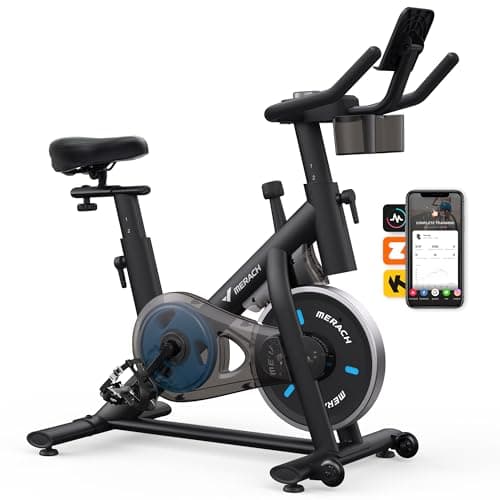
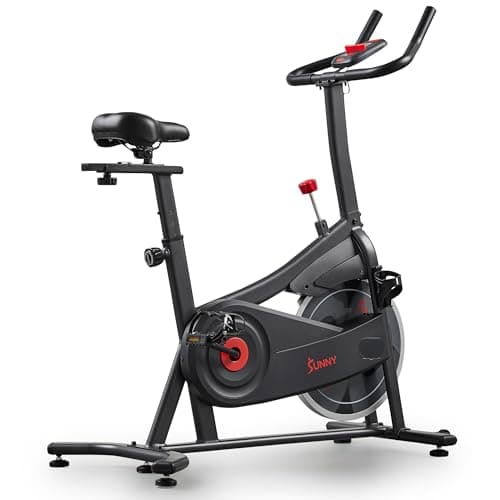
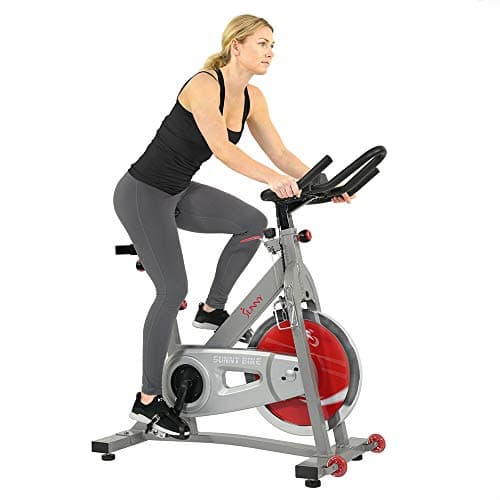
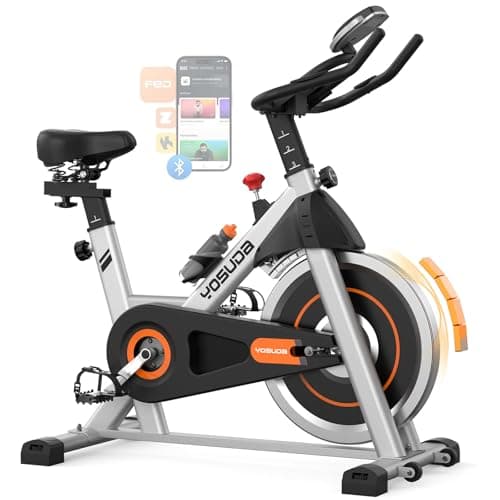
The YOSUDA 002C is our pick, because it gets the mechanism and the footprint right at once: magnetic resistance with no pad to wear out, a 25 lb flywheel, a published 300 lb capacity and 6.04 sq ft of floor — the second-smallest verified footprint here. If the ride matters more than the floor plan, the JOROTO X2PRO is the only bike on this page with a 40 lb flywheel and magnetic resistance, and the only one rated to 350 lb. The MERACH MR-S38 is the smallest verified floor area at 5.71 sq ft and the cheapest bike here, with a friction pad as the trade. The Sunny Nova publishes an inseam range so you can check fit before delivery, and the Sunny Fitness Pro II buys you 40 lb of flywheel feel for 99.4 lb of machine and the largest footprint on the page.
A spin bike is the one piece of cardio equipment that gets bought on feel and regretted on dimensions. It is compact in the way a filing cabinet is compact — a small rectangle that never moves. Not one of the five bikes here folds. Three of them publish transport wheels, which means you can tip and roll the bike to a different part of the same room, and that is the entire extent of the putting-away. If you need the machine to leave the floor between sessions, you are on the wrong page: our folding exercise bike roundup ranks the uprights and X-frames that collapse, and under-desk cardio machines covers the pedal units that have no frame at all.
The spec that decides this category: magnetic or friction
Every bike on this page spins a weighted flywheel. The difference between them is how that flywheel is slowed down, and it is the most consequential spec in the class — more consequential than flywheel weight, app support or price.
A frictionbike presses a felt pad onto the rim of the spinning flywheel. It is simple, it is cheap, and it feels wonderful: resistance arrives as a smooth, gritty drag that is the closest thing in a bedroom to grinding up a hill. The pad is also a consumable. It wears, it glazes, it picks up a squeak as it ages, and the squeak is the part your neighbor hears. Two of the five bikes here are friction bikes, and both say so in their own titles once you know what to look for: MERACH writes "Friction Stationary Bike" and Sunny writes "Dual Felt Resistance."
A magnetic bike moves magnets near the flywheel without ever touching it. Nothing contacts, so nothing wears and nothing squeaks in year three. The feel is cleaner and slightly less textured than a felt pad at the same load, and the resistance tends to change in smooth steps rather than by millimeters of knob. Three of the five bikes here are magnetic, and on a site about training in a building full of other people, that is the mechanism we rank above the other.
The trap in this category is the listing, not the bike.YOSUDA sells the friction version and the magnetic version of the same bike as variants of a single Amazon listing at two prices — and the title of the magnetic variant still carries the words "Brake Pad" from the friction one. The feature bullets on the magnetic variant name a color the variant selector does not sell. If you are buying any bike in this class, read the variant you are adding to the cart rather than the title at the top of the page, because the title may be describing its sibling.
What we ranked on
- Resistance mechanism, named first. Magnetic over friction, because the pad is the only consumable on an otherwise maintenance-free machine and because a worn pad is an audible problem in a shared building. The
Resistance row on every card below states MAGNETIC or FRICTION before it says anything else. - Published floor area, calculated from published dimensions.The spread here is 5.71 to 6.88 sq ft, and because nothing folds, that is the number you live with every day. Width matters more than you would guess: a 19.3 in bike and a 22.4 in bike fit differently beside a doorway even though both are "about two feet."
- Flywheel weight — where it is published at all. Heavier wheels hold momentum through the dead spot at the top of the stroke, which is what makes a bike feel like a bike rather than like a stepper. The published spread is 18 lb to 40 lb, and one bike publishes nothing.
- Published maximum user weight. Three bikes publish one (275, 300 and 350 lb) and one publishes nothing at all. On a machine you stand up on and rock side to side, a missing capacity rating is a real mark against the listing, not a neutral blank. Home gym equipment for heavier users collects every published capacity on the site in one place.
- Published rider fit. Four of the five publish a height range; exactly one publishes an inseam range, which is the measurement that actually decides whether your leg straightens at the bottom of the stroke.
How the five compare
| Bike | Resistance | Flywheel | Floor area | Weight | Max user |
|---|
| YOSUDA 002C | Magnetic | 25 lb | 6.04 sq ft | 59.5 lb | 300 lb |
| JOROTO X2PRO | Magnetic | 40 lb | Not usable (see card) | 80.4 lb | 350 lb |
| MERACH MR-S38 | Friction | Not published | 5.71 sq ft | 59.5 lb | 300 lb |
| Sunny Nova SF-B124066 | Magnetic | 18 lb | 6.61 sq ft | 60.4 lb | Not published |
| Sunny Pro II SF-B1995 | Friction (dual felt) | 40 lb | 6.88 sq ft | 99.4 lb | 275 lb |
Floor area is length multiplied by width from each listing's own published dimensions. The JOROTO row is blank on purpose: the only dimensions on that listing are 31.5 x 17.72 in, which is narrower than any assembled spin bike stance here and reads as a carton or a partial figure rather than a footprint. We would rather print that than quietly use a number we do not believe — plan the JOROTO into roughly the space the Sunny bikes need.
Measuring for a bike that never leaves
The published footprint is not the space you need. Add a clear lane on at least one side so you can mount and dismount without climbing over the handlebars, and leave clearance behind the saddle for the moment you step off backwards. For the bikes on this page that works out to roughly 43 x 32 in of usable space for the MERACH at the small end, and 50 x 32 in for the Sunny Pro II at the large end.
The one thing you do not need to plan for is an outlet. Not one bike on this page requires power: the monitors run on batteries and the resistance is mechanical, so where the bike goes is decided by floor and ceiling, not by sockets. That is a genuine advantage over a treadmill — see how much space does a treadmill need for the comparison — and it is the main reason a bike can live in the corner a desk cannot.
Height is the spec nobody checks and everybody regrets. These bikes stand 46 to 49 in tall before you add a rider, which means a bike under a window blocks the lower third of it, and a bike on a riser or a thick mat gets taller. Our ceiling height guide covers the standing-and-sprinting case, which is the only time a bike interacts with your ceiling at all.
Flywheel weight, honestly
Flywheel weight is the most-marketed number in this class and the least standardized. A 40 lb wheel carries momentum through the top of the pedal stroke, so the ride feels continuous at low cadence; an 18 lb wheel needs you to keep pushing, so low-cadence work feels choppier. Sunny is unusually straight about this — it calls the Nova's 18 lb wheel "entry-level" in its own bullet rather than dressing it up.
What flywheel weight does not tell you is how much resistance is available. That is the pad or the magnets, and only JOROTO puts any scale on it at all (0-20% for warm-up through 100% at maximum, which is a percentage of an unstated total). Nobody on this page publishes resistance in pounds or watts. If you have seen a spec sheet claiming a specific wattage for a bike in this price band, it was not on these listings.
Mass is the other half of ride feel. The 99.4 lb Sunny Pro II is the most planted bike here when you stand up and rock the bars; the 59.5 lb bikes move a little. Mass and portability are directly opposed, and in a small room, 99 lb is a machine you will not reposition to vacuum.
Noise: what is actually true
Three of these listings publish a decibel claim — 20 dB (YOSUDA), under 20 dB (JOROTO) and under 25 dB (MERACH). All three are makers' marketing figures with no third-party measurement behind them, and we do not repeat them as fact. 20 dB is quieter than a whisper in a sound-treated room, which is not a thing that happens in an apartment with a person breathing hard on a bike.
What is mechanically true is more useful: a magnetic bike has no contact point, so the only noise sources are the belt, the bearings and you. A friction bike adds a pad touching a spinning wheel, which is the sound that changes as the pad ages. Neither kind produces impact, which is the thing that travels through a floor to the apartment below — that is a treadmill problem, and we work through it in will a treadmill bother downstairs neighbors. For the ranked version of the quiet question across every machine class, quietest cardio machines for apartments is the page.
Do you need a mat?
For noise, no — there is no impact to absorb. For two other reasons, yes. A 60 to 99 lb machine on four small feet will print into a soft or finished floor over months, and a bike under a hard out-of-the-saddle effort can creep across a smooth surface. A mat solves both. Best home gym mats covers the options, and home gym on carpet is the version of the question where carpet pile is doing the damage instead.
Spin bike or another format?
A spin bike is the right answer when you want to train hard in a seated position and you can give up the floor permanently. If any part of that is not true, one of these pages is a better fit:
Brands in this category
Four of the five bikes here come from the Amazon-native fitness brands that dominate this price band — YOSUDA, JOROTO, MERACH and Sunny Health & Fitness — and their listings differ more in what they publish than in what they build. Sunny names its own flywheel entry-level; YOSUDA cannot keep two variants of one listing straight; JOROTO publishes a footprint that cannot be right. We sort that out brand by brand, with the receipts, in home gym equipment brands: who publishes real specs.