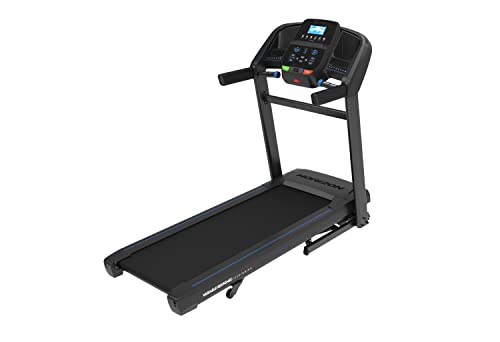
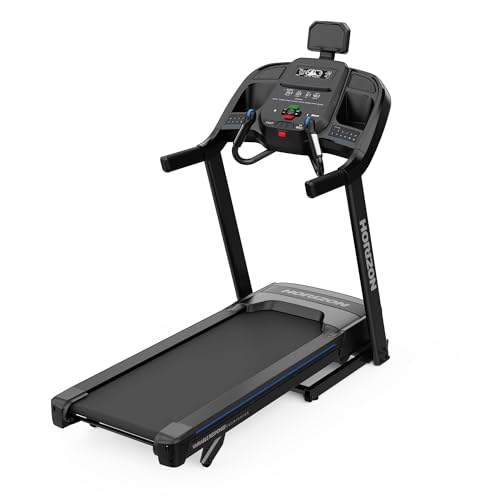
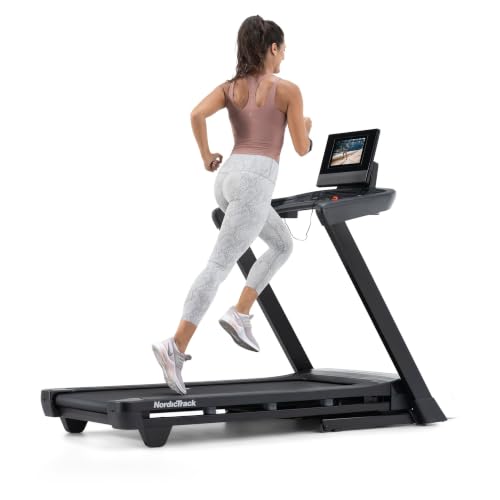
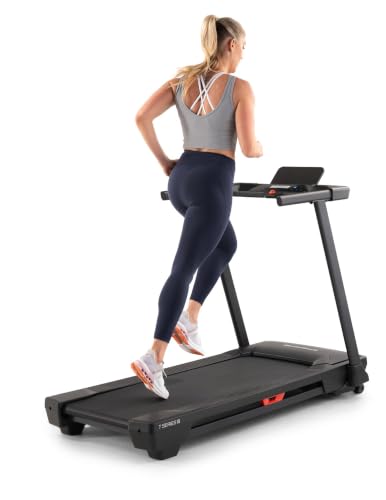
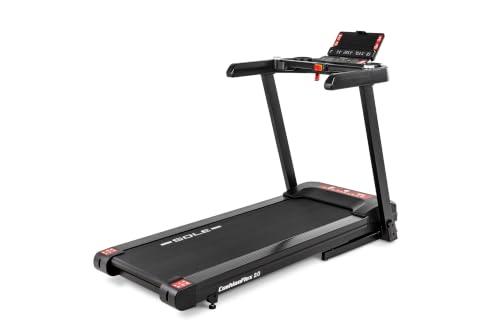
The SOLE F63 is our pick, because it is the only treadmill here that publishes all four numbers that decide a treadmill: a 20 x 60 in deck on 18 mm of cushioning, 12 mph, 15 incline levels and a 325 lb user capacity. The Horizon T202 is the value pick and matches that 325 lb figure for meaningfully less. The Horizon 7.0AT is the one to buy if you already pay for Peloton, Zwift or Strava, because it names them. The NordicTrack T Series 10 is the only touchscreen, with the caveat that its best features sit behind a $39/mo membership. The NordicTrack T Series 5 is the budget rung and the only machine here that two people can carry upstairs.
First, the honest warning: this is not the apartment page. Every machine ranked here occupies between 14.5 and 18.5 square feet of floor, stands 48 to 66 in tall, weighs 130 to 257 lb and arrives on a freight truck. If you live above someone, or your gym is a corner of a bedroom or a living room, the right answer is a walking pad that slides under the couch or a folding treadmill that stands against a wall, and this site has four pages about exactly that trade. This page is for the reader with a garage bay, a basement or a spare room that can give the machine up permanently — the buyer who searched for a treadmill and meant a treadmill.
The four numbers, and who actually publishes them
A full-size treadmill is decided by four published figures: the running surface, the speed range, the incline range and the maximum user weight. Across five machines from three of the biggest names in home fitness, exactly two publish all four. That is the single most useful finding on this page, so here it is as a table before anything else.
| Treadmill | Running surface | Speed | Incline | User capacity | Footprint |
|---|
| SOLE F63 | 20" x 60", 18 mm cushion | Up to 12 mph | 15 levels | 325 lb | 17.7 sq ft |
| Horizon T202 | 60" x 20" | Up to 12 mph | Up to 12% | 325 lb | 17.9 sq ft |
| Horizon 7.0AT | 20" x 60", 3-zone cushion | 0.5-12 mph | Not published | Not published | 18.5 sq ft |
| NordicTrack T Series 10 | Not published | 0-12 mph | 0-12% | Not published | 17.9 sq ft |
| NordicTrack T Series 5 | Not published | 0-10 mph | 0-10% | Not published | 14.5 sq ft |
Footprint is the assembled length multiplied by the assembled width from each listing's own published dimensions, divided by 144. It is the floor the machine stands on and nothing else — no run-off space behind it, no room to get on and off at the sides. Add both and the real number is closer to 25 to 30 sq ft, which is the arithmetic how much space does a treadmill need runs properly.
Horsepower is missing from that table on purpose.Only one treadmill in this whole group publishes a motor rating anywhere: the Sole F65, a step up from our top pick, at 3.25 HP. The F63 says "high-efficiency brushless", Horizon says "Rapid Sync motor", and both NordicTrack listings say nothing at all. Continuous duty horsepower is the figure every treadmill review quotes; it is also the figure these makers have quietly stopped printing on Amazon. We would rather leave the row blank than copy a number from somewhere it cannot be checked.
What we ranked on
- The running surface, first and hardest. A 20 x 60 in belt is the standard for running; shorter decks are walking and jogging machines whatever their top speed says. Three machines here publish that dimension and two do not, and a deck you cannot measure before it arrives is a real risk if you are tall. Published deck size beat every soft feature in our ranking.
- Published user capacity. Two machines publish 325 lb and three publish nothing. On a class of product where a heavier runner is precisely the person who needs to know the rating, that silence is a mark against the listing, and we scored it that way. The same reasoning runs through home gym equipment for heavier users.
- Whether the console works without a subscription.Two of these five machines are sold as hardware; two are sold as a doorway to a membership — the NordicTrack listings attach "iFIT membership required" to the auto-adjusting incline, the heart-rate control and the guided workouts, and price the Pro tier at $39 a month. Neither model is worse for it, but a $39/mo add-on changes the five-year cost of a treadmill more than the sticker price does.
- Assembled footprint against deck size.The useful ratio is how much of the machine's floor area is belt you can run on. The T Series 5 is the smallest machine here at 14.5 sq ft, and it is also the one that will not tell you how much of that is deck.
- Whether it folds, and whether the listing says so. Three of five publish a folding frame with assisted lowering. The Horizon 7.0AT and the NordicTrack T Series 5 publish no folding claim at all, which means you plan for the whole footprint, every day.
- Delivery reality. Sole states on its own listing that the machine ships freight with curbside service only and that assembly services are not affiliated with Sole. That is the most honest sentence in the group and it applies to most of these machines whether or not they print it.
Where each machine wins
The SOLE F63 wins on published information, which on a $1,000-plus purchase you cannot try before buying is the thing worth paying for. A 20 x 60 in deck on 18 mm of cushioning, 15 powered incline levels, 12 mph and 325 lb — plus a hydraulic kick-release fold and transport wheels, so the machine can be moved by one person rather than hired help. Its gaps are motor horsepower and its own unit weight, neither of which it publishes.
The Horizon T202 wins on money. It publishes the same 325 lb capacity, the same 12 mph ceiling and a 60 x 20 in deck for less than the F63, and it does it with no subscription anywhere in the listing. Horizon even prints its assembled dimensions inside the bullet text — 76 x 34 x 57 in — and states what the T202 adds over the cheaper T101: a longer deck, more incline, more speed. Its ceiling is a 12% incline, the lowest published figure here.
The Horizon 7.0AT wins on apps you already own. It is the only listing in the group that names third-party platforms — Peloton, Strava and Zwift — alongside Apple Watch and iPhone syncing, rather than routing you into a proprietary subscription. It pairs that with the same 20 x 60 in deck and three-zone cushioning. The cost is information: no published incline percentage, no published capacity, no folding claim, and 257 lb of frame to position once and leave.
The NordicTrack T Series 10 wins on the screen.A 10 in tilting touchscreen and adjustable SelectFlex cushioning are genuinely unusual at this price, and the listing is upfront that the machine "works great out of the box". But the features it leads with — auto-adjusting speed and incline, heart-rate control, streaming — are all marked as requiring the $39/mo iFIT Pro membership, and it publishes neither a deck size nor a capacity.
The NordicTrack T Series 5 wins on getting started. It is the cheapest real 0-10% powered incline with a 10 mph belt, in the smallest footprint here, at 130 lb — 73 lb lighter than anything else on the page, which is the difference between a two-person carry and a moving crew. It publishes the least of any machine here, and its listing never says it folds.
What this class costs you that a walking pad does not
Three costs, none of which show up on a product page.
The floor, permanently. Even the machines that fold reclaim height rather than length — a 75 in frame hinged upward still has a 75 in base. Plan for the assembled footprint plus about three feet of run-off behind the belt and a foot to each side. On a rented floor, put something under it: a mat does three jobs at once, and best home gym mats ranks them.
The noise, which is impact and not motor hum. A runner at 8 mph is a repeated 150 to 250 lb strike through a steel frame into a floor. No amount of deck cushioning removes that from the structure; cushioning protects your joints, not your neighbors. If there is a room below you, read will a treadmill bother downstairs neighbors before anything on this page, and the wider ranking is in quietest cardio machines for apartments.
Getting it into the room. These ship freight, curbside. Measure the doorway, the stair turn and the basement hatch before you buy, not after the pallet is on your drive. A 231 lb machine that does not fit the turn at the bottom of your stairs is a very expensive garage ornament — and the garage version of the plan is in garage corner home gym, the basement version in home gym in a basement.
Considered and not ranked
- SOLE F65. The only treadmill we found in this group that publishes a motor rating — 3.25 HP — alongside a 20 x 60 in deck, 0.5-12 mph and a 0-15% powered incline. It is a better machine than our top pick and it costs more; if the budget stretches and you want the published horsepower, buy it instead of the F63. Left off because the F63 covers the same ground at a lower price and because one maker should not hold two slots on a five-machine page.
- SOLE F50. Verified live and genuinely compact for this class at 70 x 34 in with a published 180 lb unit weight and a 300 lb capacity. Its deck is 20 x 55 in rather than 20 x 60 in, and 55 in of belt is where a tall runner starts clipping the motor cover. A good machine for a walker or jogger who wants a Sole frame in less floor.
- NordicTrack T Series 6.5 S. Sits between our budget pick and the T202, publishes a folding frame with assisted lowering and 203 lb of unit weight — but the same 0-10 mph and 0-10% ceilings as the much cheaper T Series 5. The T202 publishes more machine for similar money.
- NordicTrack Commercial 1750 and 2450. Both verified live and in stock, and both are a different budget and a different buyer. If you are shopping at that level the deck and motor stop being the question and the subscription becomes it.
- Horizon T101 Connect.The cheaper sibling of the T202, and Horizon's own T202 bullet is the clearest statement of what you give up. Its listing did not report a stock status when we checked, which fails our availability rule, so we did not rank it.
- Every walking pad and budget folding treadmill. Deliberately excluded. They are a different machine for a different room and they have their own pages: best walking pads, best folding treadmills and best folding treadmills under $300.
Everything above was verified live on 2026-11-12 and every ranked machine showed in stock. Prices on the cards come from the live price layer, never from this text — as a bracket, this whole page sits between the mid-hundreds and a little over a thousand dollars, which is three to ten times what the under-$300 page covers, and the gap buys you deck, incline and a published capacity.
Before you buy: five measurements and one phone call
1. Measure the floor, then add the run-off
Start with the assembled footprint from the table above — 14.5 to 18.5 sq ft — then add about 3 ft behind the belt for a bail-out and 1 ft either side to get on and off. That is the real claim on your room, and it is why this class belongs in a garage, a basement or a spare room rather than beside a sofa.
2. Measure the ceiling, and then measure yourself
A treadmill raises you 5 to 8 in off the floor, and an incline raises the front of the deck further. In a basement with 7 ft joists, a 6 ft 2 in runner on a 10% grade is closer to the ceiling than is comfortable. The general version of this arithmetic is in ceiling height for a home gym.
3. Measure the route in, not just the room
Doorway width, stair width, the turn at the landing, and the clear height of a basement hatch. These machines arrive on a pallet at the curb, in a box wider than the assembled frame. Two people and a hand truck is the minimum, and the carrier will not carry it in.
4. Decide whether you are buying a subscription
Price the machine over five years, not at checkout. A $39/mo membership is more than $2,300 across that period — more than the most expensive treadmill on this page. That is not an argument against it if you will use the classes; it is an argument for knowing which of these consoles needs it. Horizon's two listings name no proprietary membership; both NordicTrack listings attach iFIT to their headline features.
5. Call the floor below you, if there is one
Running is impact, and impact travels down through structure. If you share a building, this class is the single loudest thing on this website, and the honest answer is usually a walking pad instead. If you own the whole house, put the machine on a mat on a slab and stop worrying — apartment home gym flooring and home gym on carpet cover the surfaces.
Full-size treadmill versus the alternatives
| Option | Floor when idle | Can you run? | Main noise | Best at |
|---|
| Full-size treadmill (this page) | 14.5-18.5 sq ft, permanent | Yes — 20 x 60 in decks, up to 12 mph | Your footfall through the frame | Real running in a room you control |
| Folding treadmill | Stands on end against a wall | Yes, on a narrower deck | Footfall, plus frame flex | Running in a room with another job |
| Walking pad | Slides under a couch or bed | No — walking, sometimes a jog | Motor hum and footfall | Movement during the workday |
| Smart bike trainer | Folds; the bike lives where it already lives | Not running, but hard intervals | Drivetrain, no impact at all | Zero-impact cardio above a neighbor |
That last row is the one most treadmill shoppers in a shared building should read twice. If the reason you want a treadmill is cardio rather than running specifically, a smart bike trainer delivers controlled, app-driven intervals with no impact going into the floor, in a fraction of the footprint. The honest comparison of machine types is in treadmill vs exercise bike for small spaces.
What a treadmill does not replace
One machine is not a gym. A treadmill trains one thing extremely well and nothing else at all, and a home gym built entirely around cardio leaves every pressing and pulling pattern untouched. The cheapest honest fix is a doorway bar and a way to add load to your own bodyweight — our ranking of the belts that do that is best dip belts, and the order we would spend in is laid out in what to buy first for a home gym. The budget version of the whole room is best home gym under $1,000.