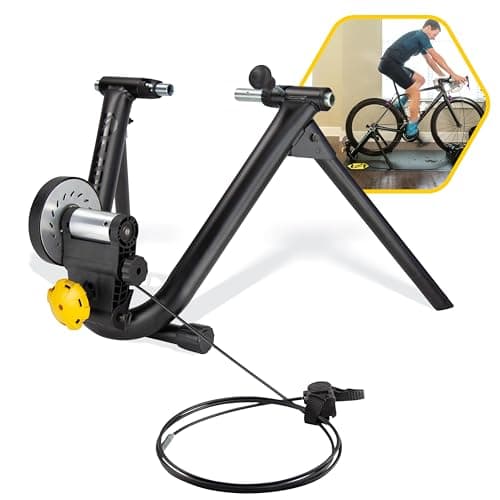
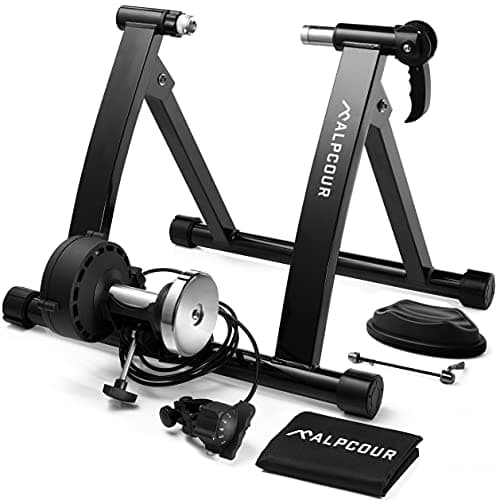
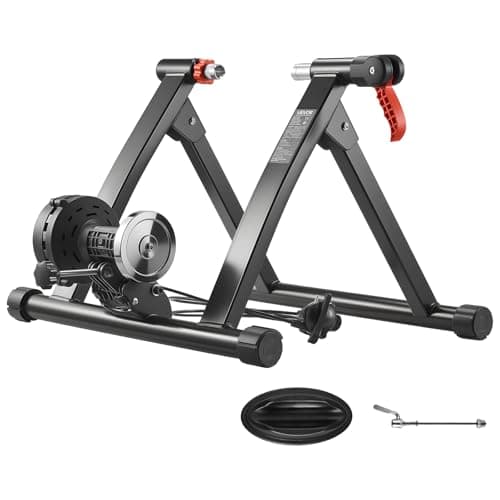
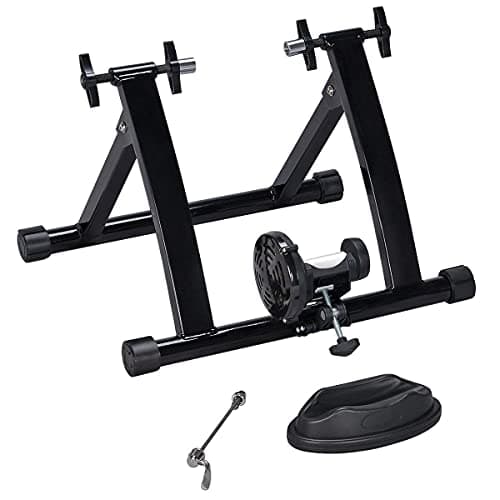
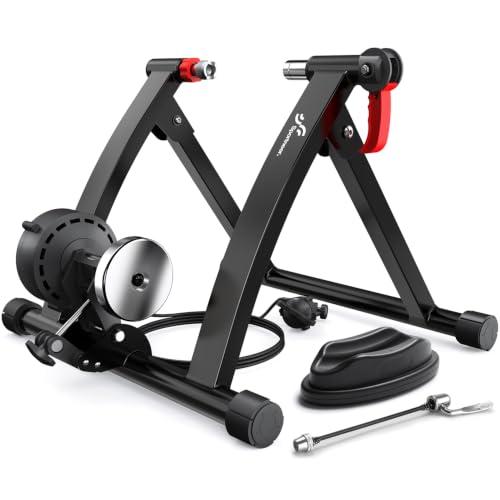
The Sportneer TY-JS007-C is our pick, for an unglamorous reason: it is the only trainer here that publishes the rear-axle window — 4.92 to 6.57 in — which is the number that decides whether your bike mounts at all. If you want a measured noise figure instead of an adjective, the Saris Magnetic Plus publishes 69 dB at 20 mph and is the only listing in the class that publishes anything. The Alpcour folds into a supplied bag, which is the difference between folded and genuinely gone. The VEVOR is the cheapest with a published 330 lb rating and the only one that fits 29 in wheels. The Yaheetech YT-165 has the smallest published stance on the page at 2.19 sq ft and the most honest sentence in the category.
A wheel-on trainer clamps your rear axle, lifts the tire onto a steel roller and makes the roller hard to turn. That is the entire machine. It is the only cardio option on this site that costs less than a pair of adjustable dumbbells, needs no outlet, folds flat, and delivers a session identical in kind to a spin bike costing four times as much — provided you already own a bicycle. If you do not own one, stop here: a trainer plus a bike is more money and far more floor than a folding exercise bike, and best folding exercise bikes is the page you want.
The footprint arithmetic nobody publishes
Every listing in this class advertises a compact stand, and the published stances really are small: 2.19 to 3.53 sq ft across the five trainers here. That number is also close to meaningless on its own, because the trainer is not what occupies your room.
- The bike is the footprint. A road bike is roughly 68 in long and about 24 in across the handlebars, and with the front wheel up on the riser block it sits in a rectangle of about 11 sq ft. That is more than a spin bike and less than a fan bike, and unlike either of those, it is the floor you were already giving up to store the bike.
- Nothing about the stance is permanent. Four of the five trainers here publish a folding frame, one comes with a bag, and the heaviest weighs 20.6 lb. The whole setup — trainer, riser block, bike — can be out of the room in two minutes. No other cardio machine on this site can say that.
- Height is a non-issue. The tallest trainer here is 16.5 in. After the ceiling arithmetic that vertical climbers and power towers force, this class is a relief: your head ends up exactly where it does when you ride outdoors.
The noise is your tire, and one listing admits it
Four of these five listings describe themselves with some version of "quiet," "silent" or "noise reduction," and not one of those four publishes a measurement. The Yaheetech listing is the exception on honesty: it states that "the noise/friction sound comes from the friction between the wheels and the trainer" and that its trainer "doesn't contain any noise-causing parts." That is correct, and it is the most useful sentence in the class.
The Saris listing is the exception on numbers: 69 dB at 20 mph. That is the only measured figure any trainer on this page gives, and it is loud — comparable to a hairdryer in the same room. Two practical consequences, both of which follow from the mechanism rather than from marketing:
- Knobby tires roar; slick tires hum. Three listings here recommend fitting a slick or road tire, and that is the single biggest noise change available to you. It costs less than any trainer on this page.
- It is airborne noise, not impact. Nothing strikes the floor, so a downstairs neighbor hears far less than you would expect — the problem is the person in the room and the shared wall. The same distinction decides the air bike question, and the whole ranking is in quietest cardio machines for apartments.
What we ranked on
- Published compatibility, axle first. Every trainer here is a quick-release design. If your bike has thru axles — most mountain bikes and many road bikes sold since about 2018 — you need an adapter, and on the Sportneer you need a different version of the product entirely. Exactly one listing publishes the axle window in inches. That is the spec that decides a return, so it decides our ranking.
- Published stance, before the bike. 2.19 to 3.53 sq ft. Width matters more than length here, because the trainer sits across a doorway or a hallway while you ride.
- Whether it stores, and in what. Folding is table stakes; a bag is not. One trainer here ships with one.
- What the listing publishes at all. Decibels, capacity, resistance level count, warranty term, axle window: five specs, and no trainer here publishes more than two of them. The ones that publish more rank higher, because a number you can check beats an adjective you cannot.
- Feet and leveling. A trainer lifts a bike you then rock side to side. Five adjustable feet beats four fixed caps, and both beat a flat frame on an uneven floor.
How the five compare
| Trainer | Stance | Wheel fit | Levels | Weight | Published noise |
|---|
| Sportneer TY-JS007-C | 3.36 sq ft | 26-28 in, 700C | 6 | 19.3 lb | Not published |
| Saris Magnetic Plus | Not published | Road and MTB frames | Shifter, count not published | Not usable (see card) | 69 dB at 20 mph |
| Alpcour APC-BTSMBK | 2.84 sq ft | 26-28 in, 700C | 6 | 20.6 lb | Not published |
| VEVOR HS-QX-009AK | 3.53 sq ft | 26-29 in, 700C | 6 | 17.31 lb | Not published |
| Yaheetech YT-165 | 2.19 sq ft | 26-28 in, 700C | Not published | 13.8 lb | Not published |
Stance is length multiplied by width from each listing's own published dimensions, divided by 144, and it excludes the bike. The Saris row is blank in two columns because Amazon's published dimensions for it (20.5 x 7 x 20 in, 7.3 lb) describe a folded or packaged object rather than a deployed trainer — we would rather print nothing than print a number we do not believe.
What a wheel-on trainer costs you that a bike does not
Three real costs, none of which appear on any listing:
Your rear tire. The roller wears a flat band into the center of the tread. Riders who use a trainer regularly keep a second rear wheel with a cheap slick on it, or accept that the tire on the trainer is now a trainer tire. Budget for one tire a season if you ride indoors often.
Drivetrain wear in one gear. Indoors you tend to sit in one or two gears for a long time, which concentrates chain and cassette wear where outdoor riding spreads it. Not a reason to avoid the class — a reason to shift occasionally.
Sweat, which outdoors the wind removes. It drips onto your stem, headset and top tube, and salt is unkind to all three. A towel over the bars and a wipe-down after each session is the whole fix. A mat under the whole setup catches the rest and protects the floor — best home gym mats ranks them, and apartment home gym flooring covers the rented-floor version of the question.
Considered and not ranked
- Saris Magnetic (SAR1020T). The sibling of our second pick at the same price, publishing five resistance levels and the dropout spacings it fits (120, 130 and 135 mm) — genuinely useful specs. Left off because it is the same maker and nearly the same product as the Magnetic Plus, which additionally publishes the decibel figure that makes this category legible. If you want the cheaper Saris, this is it.
- FDW magnetic trainer.Verified live but showing "Only 1 left in stock", which fails our availability rule.
- A $359 generic magnetic trainer stand.In stock, 6 levels, foldable — and sold under the brand name "Generic" with no published dimensions, no model lineage and a price four times the Yaheetech. There is nothing to verify and no reason to pay more.
- Direct-drive and smart trainers. The class above this one: you remove the rear wheel and bolt the bike to a cassette on the trainer, which kills tire wear and adds controllable resistance. They are better machines and a different budget, and they are not what the small-space, already-own-a-bike reader on this site is shopping for. We may rank them separately; we will not pretend a $99 wheel-on trainer competes with one.
Everything above was verified live on 2026-11-05 and every ranked trainer showed In Stock. Prices on the cards come from the live price layer, never from this text — this whole class sits in the under-$200 bracket, which is why it is the cheapest honest cardio on the site.
Before you buy: four checks on your own bike
1. Look at your rear axle
This is the one that gets people. A quick-release wheel has a thin skewer with a lever you flip to remove the wheel; every trainer on this page is designed for it and ships a skewer to replace yours. A thru axle is a thick rod that threads through the frame, and it needs an adapter — sometimes an accessory, sometimes a different version of the trainer. Check before you order, not after.
2. Measure the wheel, and read the range as a hard limit
Published ranges here are 26-28 in and 700C, with one trainer reaching 29 in. A 29er mountain bike on a 28 in trainer sits with the roller in the wrong place, and no amount of adjustment fixes it. The number is on your tire sidewall.
3. Decide where the bike lives between sessions
The trainer folds. The bike does not. If your bicycle already lives in the hallway, this class costs you nothing in floor and is the best value on the whole site. If it lives in a shed or a basement bike room, you are now carrying a bike up and down stairs to do cardio, and you will stop within a month — buy a machine instead. The storage-first version of this thinking is in foldable home gym equipment.
4. Fit a slick tire and put something under it
A slick or road tire is the biggest noise reduction available in this class, and three of these five listings recommend it themselves. Under the whole setup, a mat does three jobs: catches sweat, protects the floor finish, and takes the small amount of frame buzz out of the structure. On a rented floor that is not optional — best home gym mats.
How this class compares with buying a machine
| Option | Floor when idle | Main noise | Needs an outlet? | Best at |
|---|
| Wheel-on trainer + your bike | Folds; the bike stays wherever it already lives | Tire on roller | No | Cheapest real cardio, if you own a bike |
| Spin bike | 5.71-6.88 sq ft, permanent | Almost none | No | Seated endurance with no bike to own |
| Folding exercise bike | Folds to a narrow upright | Almost none | No | Storability above all |
| Air bike | 6.55-9.71 sq ft, permanent | The fan, loudly | No | Short, brutal intervals |
Read the first row as the conditional it is. Own a bike and the trainer is the best value in home cardio by a wide margin. Do not own one and it is the worst, because you are buying two things to replace one. Our honest sequence for a small room is still one conditioning option plus one loadable thing — what to buy first for a home gym and best home gym under $100 both put the money in that order.