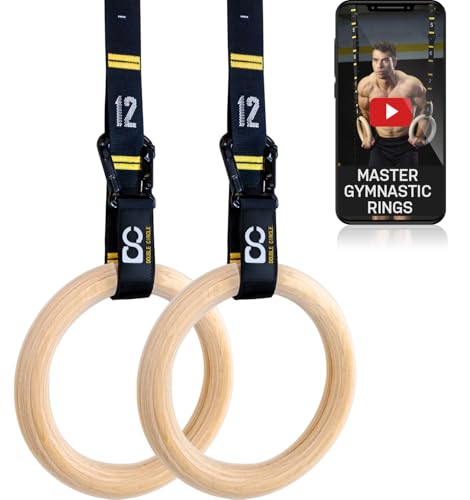
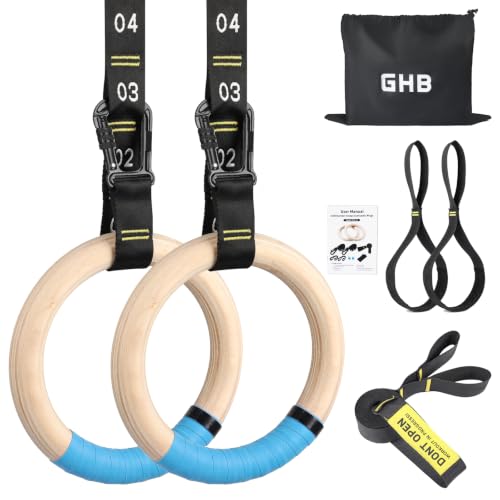
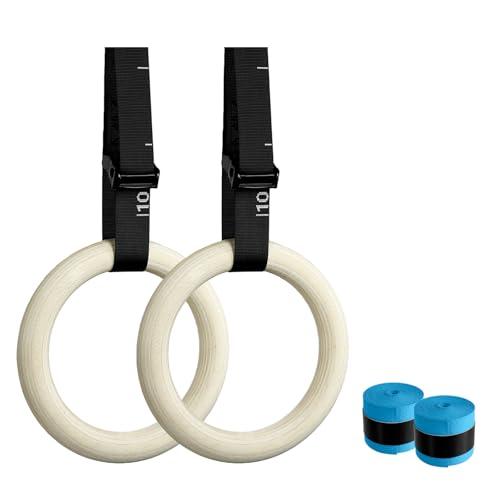
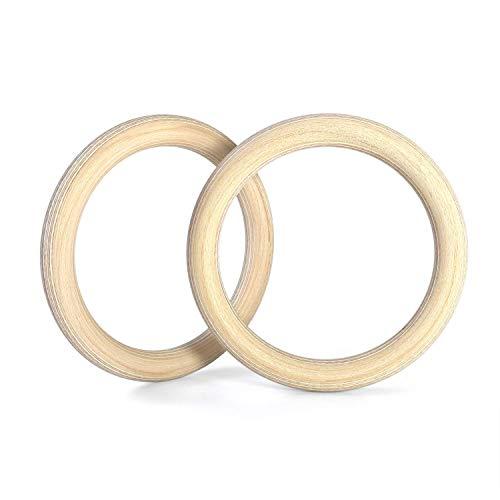
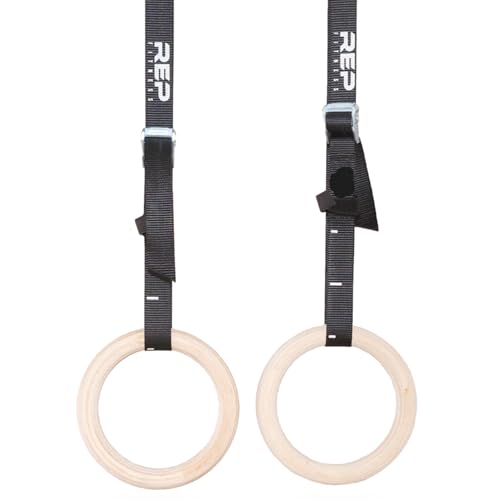
The REP Fitness rings are our pick for one reason that matters more than anything else in this category: REP publishes a number. A stated 600 lb tested rating, on Baltic birch, in your choice of 1.11 in or 1.25 in ring diameter. The Double Circle set wins on day-to-day usability — numbered hooks that index in 4 in steps get both rings level in seconds, backed by a published 3-year warranty. The GHB TLP-15 is the renter's answer, because it ships a door anchor and does not need a pull-up bar at all. The Cesilili set is the budget pick and carries 5.1 m straps — roughly double everyone else's reach. The Double Circle rings-only pair is here for the narrow case of upgrading webbing you already own.
Gymnastic rings are the most on-brief product on this entire website and we have never ranked them, which is an oversight worth correcting plainly. Everything else we recommend trades floor area for capability. Rings do not trade anything: the complete set is two wooden rings, two straps and four carabiners, it weighs about three pounds, it costs less than one adjustable dumbbell, it stores in a kitchen drawer, and it trains pulls, rows, dips, pushes, core and — eventually — things most people cannot do at all. The catch is not the rings. The catch is what you hang them from, and that is where this page spends most of its words.
The honest problem with this category: one maker publishes a number
We rank gear on published specifications. Across five ring sets from five makers, here is what is actually published about strength:
- REP Fitness states 600 lb, described as a tested rating. That is the only numeric strength figure anywhere in this group.
- GHB describes "ultra-high load-bearing performance" and "exceptional load-bearing capacity" — adjectives, with no figure attached.
- Double Circle, Cesilili and the rings-only listing publish nothing about load at all, on products whose entire job is to hold a human body in the air.
We are not going to pretend that is a comparison. So the ranking runs on what is checkable: strap length against what you can anchor to, ring diameter against your hand and your goals, the buckle and carabiner arrangement against how fast you can get both rings level, whether an anchor is included, and the published warranty. Where strength is a bare marketing claim we say so on the card rather than scoring it.
One piece of reassurance, honestly framed: the webbing used in this class is 1.5 in nylon or polyester of the same family used for cargo straps, and the realistic failure point in a home setup is never the strap. It is the thing above the strap. Which brings us to the real subject.
What you hang them from is the actual purchase
This is the section no Amazon listing writes, and it is the reason most ring sets end up in a cupboard. Rings need an anchor overhead that is rated to hold your bodyweight plus the dynamic load of you swinging on it — and in a small home, your options are specific and finite:
- A pull-up bar you already own. The cleanest answer. Loop the straps over the bar, and with a wall-mounted bar or a power tower you have a published capacity to check against. On a doorway bar, check that capacity carefully — rings put you further from the frame, and the load is no longer straight down.
- A squat rack's top crossmember. If you own a compact power rack, you own the best ring anchor in this building. Straps over the top bar, done.
- An exposed joist or garage beam. The strongest anchor most homes have, and the one that needs the long straps. A 10 ft garage ceiling with the rings at chest height is 5 to 6 ft of webbing per side before you have adjusted anything, which is why strap length is ranked as hard as it is on this page.
- A ceiling or joist mount you install. The permanent answer, and it needs a lag bolt into structural timber, not a drywall anchor. If you rent, this is not your option — read renter-friendly home gym ideas first.
- A door. The GHB set includes a door anchor that hooks over the top of a solid door, which is the only no-bar, no-drill answer in this group. It is genuinely useful and it comes with an honest caveat covered below.
- A tree branch or playground frame. Free, outdoors, and the reason the 16.7 ft Cesilili straps exist.
If none of those exist in your home and you cannot drill, rings may not be your product yet. A door-anchored suspension trainer is designed from the ground up for that constraint, with a wider anchor kit and a lower skill floor — we rank those separately and we are not going to re-argue the comparison here.
What we ranked on
- Strap length, published. The spec buyers overlook and then regret. The range here is enormous: 7.5 ft on the REP variant we ranked, 8.2 ft on the GHB, 9.2 ft on the Double Circle set and 16.7 ft on the Cesilili. Short straps are tidier over a doorway bar; long straps are the only ones that reach a garage beam.
- Ring diameter. 1.11 in (28 mm) is Olympic competition spec and the right choice if you want a true gymnastics grip or you have smaller hands. 1.25 in (32 mm) is the cross-training standard — easier on the forearms for high-volume rows and dips, and what most people prefer. REP is the only maker here that sells both.
- How fast both rings get level. Numbered webbing is table stakes; indexed numbered hooks that step in fixed 4 in increments are better, because symmetry is the difference between a clean dip and a tweaked shoulder. Double Circle publishes that mechanism, and it is why a set with no load rating still ranks second.
- The buckle and the hardware. Four carabiners let you clip the strap back on itself instead of threading it; a swivel carabiner is easier to adjust mid-session than a screw-set design. GHB publishes the most hardware here; REP publishes the least and relies on a cam buckle.
- Whether an anchor is included. One set in five ships something you can hang from. In a rented one-bedroom with no bar, that single item outranks every other spec on this page.
- Wood over plastic, always. Every set here is wood, and that is deliberate — we did not rank plastic or composite rings. Wood holds chalk, absorbs sweat and stays grippy as a session goes on. Plastic gets slick exactly when you are tired, which is the worst possible moment on a ring dip.
- Published warranty. Two sets publish three and two years; one claims a lifetime term with no document behind it; one publishes nothing.
The one measurement to take before you buy: ceiling drop
Rings are the only product on this site where your ceiling height sets your training ceiling too, and the arithmetic takes two minutes:
- Measure from your anchor to the floor. A doorway bar is typically 6.5 to 7 ft; a garage joist might be 9 to 10 ft.
- Subtract 7 to 8 in for ring height. That is where your hands end up when the straps are fully shortened.
- Compare that against your standing reach. If the rings sit below your shoulders at full shortening, you cannot hang — you can still row, push and do support holds, but dips and pull-ups are out.
- For dips and pull-ups, you want the rings above your head with your feet clear of the floor when you hang. On a 7 ft anchor, most adults are tucking their knees. It works; it is just worth knowing before the box arrives.
Two consequences. First, a low anchor is not a dealbreaker — rows, push-ups, support holds, L-sits and the entire beginner progression happen with the rings at hip to chest height, and that is 80% of the first year. Second, a 7 ft doorway bar means you need almost no strap, which is why we did not penalize the 7.5 ft REP variant for apartment readers. If your ceiling is the constraint on your whole gym, our page on ceiling height for a home gym covers the rest of the equipment list.
What rings replace, and what they do not
Rings are the cheapest route to a genuine upper-body gym, and they are not a complete gym. Honest accounting:
- They replace a cable machine for pulling, at a fraction of the cost and with no footprint. Ring rows scale from near-vertical to near-horizontal just by walking your feet forward, which is a smoother load curve than any compact cable machine gives you.
- They replace a dip station and most of a push-up bar set, while adding instability that recruits more of the shoulder. Our push-up bars and parallettes page is the stable, floor-level alternative for anyone who wants the same movements without the wobble.
- They do nothing for legs. Ring work is upper body and core. Pair them with adjustable dumbbells or a squat rack, or accept that you are building half a gym.
- They are harder than they look.A ring dip is meaningfully harder than a bar dip; a ring push-up is harder than a floor push-up. That is the point — the progression is free and nearly endless — but it means the first month is humbling, and nobody's listing says so.
- They are the quietest strength equipment there is. Nothing is dropped, nothing strikes the floor, nothing rattles. For anyone who has read our page on lifting in an apartment, that is not a small thing.
1.11 in or 1.25 in? A real fork
Ring diameter is the one spec on this page that changes how the product feels in your hands, and most buyers never notice the choice exists.
1.11 in (28 mm) is Olympic competition spec. It is what gymnasts use, it suits smaller hands, and it demands more grip strength — which is either the training effect you want or the thing that ends your set early. Choose it if you have small hands, if you want to train toward actual gymnastics skills, or if grip is a weakness you want to attack. Our grip strength equipment page covers the rest of that lane.
1.25 in (32 mm) is the cross-training standard. The thicker grip spreads load across more of the palm, which is kinder on the forearms during high-volume rows and dips and more comfortable for larger hands. Four of our five picks are 1.25 in, and for most readers of this site it is the right default.
REP Fitness is the only maker here that publishes both diameters, and Double Circle sells a 1.1 in rings-only pair alongside the 1.25 in version — so if you buy wrong, the rings alone are a cheap correction.
The door anchor, honestly
The GHB set includes a door attachment, and it is the only product in this group that works in a home with no bar, no rack and no permission to drill. That is a genuinely important feature and it deserves a genuinely honest caveat: a door anchor is only as strong as the door, the hinges and the frame, and none of those three things comes with a published rating. A solid-core door in a sound frame is a reasonable anchor for rows, push-ups and support holds. A hollow-core interior door is not an anchor for anything you hang your full bodyweight from.
The practical rules: anchor on the side the door closes toward so your pull pushes it shut, lock or wedge the door, keep the strap over the top of the door rather than the edge, and keep your feet on the floor. If you want to hang — dips, pull-ups, anything with your feet off the ground — put the rings on a rated bar, a rack or a joist instead. The same logic applies to the whole door-anchored category, which is why we cover it on best suspension trainers for small spaces as well.
How much strap do you actually need?
| Anchor | Typical height | Strap you want (per side) | Sets here that fit |
|---|
| Doorway pull-up bar | 6.5-7 ft | Under 5 ft — short is tidier | All five |
| Wall-mounted bar or power tower | 7-8 ft | 5-6 ft | All five |
| Squat rack crossmember | 6-7.5 ft | Under 5 ft | All five |
| Garage joist or beam | 9-10 ft | 6-8 ft | Double Circle 9.2 ft, Cesilili 16.7 ft |
| Tree branch, outdoor frame | 10-14 ft | 8 ft or more | Cesilili 16.7 ft |
Note what this table says about price. The cheapest set on the page is the only one that reaches the highest anchors, and the most expensive is mid-length. Strap length is not a quality signal in this category — it is a format choice, and the makers do not charge for it. Buy the length your room needs.
Where rings sit in a small-space gym
| Purchase | Floor it takes | What it trains | Needs an anchor? |
|---|
| Gymnastic rings | Zero stored; the air under your anchor in use | Pull, row, dip, push, core | Yes — bar, rack, joist or door |
| Doorway pull-up bar | Zero floor; one doorway | Pull-ups, hangs, and the anchor for rings | A door frame |
| Suspension trainer | Zero stored | Row, press, lunge, core | Yes — ships its own anchor kit |
| Push-up bars / parallettes | About 2 sq ft, stored flat | Push, dip, L-sit, handstand work | No |
| Adjustable dumbbells | 2-3 sq ft permanently | Everything, including legs | No |
Read down the first column and the argument for this page makes itself: rings are the highest capability-per-square-foot purchase in a small home gym, provided you already own an anchor. If you do, they belong in the first fifty dollars you spend, and they sit naturally alongside the kit on best bodyweight home gym equipment and the complete cheap setup we cost out on best home gym under $100. If you do not own an anchor, buy the bar first — the order we would spend in is laid out on what to buy first for a home gym.
Considered and not ranked
Three listings were checked and left off. The PACEARTH rings publish a 1500/1000 lb strap claim and a 14.76 ft strap, which would have been competitive, but the listing reported only three units left in stock on 2026-11-19 and we do not rank a product that may be gone before you read this. The REP 14 ft strap variant is the better buy for a garage reader than the 7.5 ft version we ranked, but it was also showing scarce stock, so the main listing carries the pick and this note carries the upgrade. The Double Circle 1.1 in rings-only pair is the Olympic-diameter twin of our fifth pick and is a fine purchase — we ranked the 1.25 in version because it suits more readers of this site.